In my previous blog about Garhwal, I had
discussed about destinations accessible from Haridwar side.In this video I have tried to cover
destinations that are easily accessible from Kotdwar and Dehradun side and provided links
that give detailed description of the destinations through my blogs –
Kotdwar –
As the name suggests, it is the entry
point to the other side to Garhwal region and is a small township situated on
banks of River Khoh.The railway station
was established by the Britishers way back in 1890 and the first passenger
train arrived here in 1901.
Lansdowne –
Perched at an altitude of 1706 meters
above mean sea level, this small hill station is home to the famed Garhwal
Rifles regiment that migrated from Almora in 1887.It is a small nondescript little destination
for idling out for a few days and is situated about 45 Kms. from Kotdwar.
Khirsu is a small village perched about
an altitude of 1700 meters and is nestled amongst the Oaks & Rhodendrons
that offers a 300 Km. view of the Himalayan ranges on a clear day.It is about 11 Kms. from Pauri via Bua Khal
and about 119 Kms. from Kotdwar and one can visit the famed Jwalpa Devi temple
enroute from Kotdwar.
Although this destination is not easily
accessible via Kotdwar and there are other better ways of reaching Mussourie.I am putting up the details of this
destination in this blog, as it is one of the most renowned tourist
destinations of Garhwal and amongst one of the best hill stations of India and
best accessible from Dehradun.
Like Mussourie, this destination is not
easily accessible through Kotdwar, but for the same reason, I am putting in the
details of this destination, as it is a place of solitude and to be one with
nature.Definitely a nature lovers delight
and best accessible from Dehradun side.
Syalsaur – the non-existent village (A photo blog)
As the morning sun lights up the Kedarnath peaks - view from Syalsaur
After spending some quality time
at Devprayag we headed toward the final destination of the day i.e.
Syalsaur.From Devprayag, the road runs along the right bank of the river Alaknanda for
a distance of 29 km up to a small township Kirtinagar, which was founded by one
of the former Maharajas of Tehri Garhwal named Kirti Shah. Here Alaknanda is
crossed over on a bridge to its left bank and then after traversing a further
distance of 6 km comes the town of Srinagar. The road from Devprayag to
Srinagar is all level driving without much of climbs or downhill runs.
The road traverses through some small villages namely Bagwan, Maletha and Kirti
Nagar.After crossing Srinagar, which is
also a significant and historically important seat of modern learning,
associated with the Garhwal University established here by the British in late
1920’s, is still known to be a seat of learning, where NIIT and other modern
teaching establishments flourish.The
township of Srinagar is also known for the holy temple dedicated to Goddess
Dhari Devi.The statue inside the temple
is said to change its colour in the reflection during various phases of the
day.Despite protest by locals for not
disturbing the temple, which was to be relocated from original position due to
construction of dam downstream, the relocation was undertaken on 10th
June, 2013 and within three days the devastation in form of unprecedented
floods shook the entire region on 13th June, 2013 wherein thousands
of human lives and livestock perished and caused irreparable loss to
property.The devastation that took
place is still attributed by the local people to the wrath of Goddess Dhari
Devi.
As River Alaknanda meanders beyond Devprayag
Green terraced fields on the road side
Approaching Srinagar town
The River Alaknanda widens as we near Srinagar town
Traversing a further distance of
33 Kms. alongside the Alaknanda River, we reached Rudra prayag, which is another
confluence on the holy Ganga River.This
confluence is that of Alaknanda River with Mandakini River flowing in from
Kedarnath. I will provide you all with a
brief detail about this destination in one of my ensuing blogs, as due to
paucity of time, we did not have a stop over here during our journey, so as to
reach Syalsaur in time i.e. before the evening set in.From Rudraprayag, the road again bifurcates,
the road that runs along Alaknanda River heads towards Badrinath and the other
one that crosses the Alaknanda River heads towards Kedarnath and this road runs
along the mesmerizing Mandakini River. Having gone past small, but well known townships of Tilwara and Agast Muni and after having traversed a distance of 28 Kms. from Rudraprayag we finally reached Syalsaur, which is actually a non-existent
village, with only wilderness and a single
house and a silk breeding center, parked in between the villages of Chandrapuri
and Banswara of Rudraprayag district
of the Uttarakhand State.Having
covered a distance of 165 odd kilometres during the entire day, that included a
small stop over after Dev Prayag in a small home run café of sorts, where we
had some really nice noodles & Coffee, we reached Syalsaur late in the
afternoon and as the lunch hour was over, we ordered some pakodas etc. being
famished and tired.Being the only
occupants of the TRH, the entire staff was ready to receive and provide for us
and we enjoyed our grand stay.
The gate leading upto Dhari Devi temple near Srinagar
Distant view of Dhari Devi temple
Headed towards Rudraprayag
Going past Tilwara
Going past Agast Muni
Reached Syalsaur finally
This nondescript little destination i.e. Syalsaur, which
houses the Tourist Rest House run by the Garhwal Mandal Vikas Nigam Ltd. (GMVN)
is perched at an altitude of about 870 meters above mean sea lever (MSL) and provides
for accommodation in bamboo cottages that are speckled alongside the pristine
Mandakini River, with its turquoise water spluttering on the rocks and the
distant Kedarnath peaks looming over the valley.It is a very beautiful location, calmness and
serenity personified and for the tormented souls, to spend a few days in bliss,
away from the hustle and bustle of city life. Pilgrims to Kedarnath can stay
here, the
holy place is about 55 km from Syalsaur.Being a virgin destination, Syalsaur itself was home to about thirteen
odd hotels, constructed in a row facing the serene Mandakini River.All of them, including the GMVN run one,
were destroyed during the ravaging floods of 2013 and I have garnered some
photographs from the internet showing the location of the GMVN run TRH then and
you can compare the same with my present video.The only hotel that withstood the ravage and remained standing was built
away from the river.
The Kedarnath peaks - early morning view from Syalsaur
Photo sourced from internet to show the pre-2013 position of TRH at Syalsaur
Photo (2) sourced from internet to show the pre-2013 position of TRH at Syalsaur
Dev prayag - close up of Alaknanda & Bhagirati confluence - where from holy River Ganga flows
Having enjoyed the serene Ganga aarti on the banks of the
holy River in Rishikesh the night before, we were all geared up for our day’s
journey heading for our next destination i.e. Syalsaur, which was to remain our
base camp of sort for exploring some destinations nearby.
Beyond Rishikesh - view of Ganga River valley - shot in 2001 (using Yaschica FX2000 SLR)
Beyond Rishikesh - view of Ganga River valley - shot in 2018 (using Nikon D5300 DSLR)
We commenced with our journey at around 8.00 A.M in the
morning after partaking our Breakfast.The weather was clear and the winter sun was bright, its warmth was
cushioning in the cold morning air.The
journey towards the destination runs along the holy River Ganga and its scenic
beauty can mesmerize and rejuvenate any tormented soul.Although the road requires some repairs, but
apparently the tree cutting spree all along the road i.e. National Highway 58
indicates that it will be done alongwith the proposed widening, for
construction of all-weather road in the region, for connecting the Chardham
destinations.I was traversing this road
almost after ten long years and there has been a tremendous increase in building
activity all along the road, but it still retains it old charm of being a
picturesque valley.
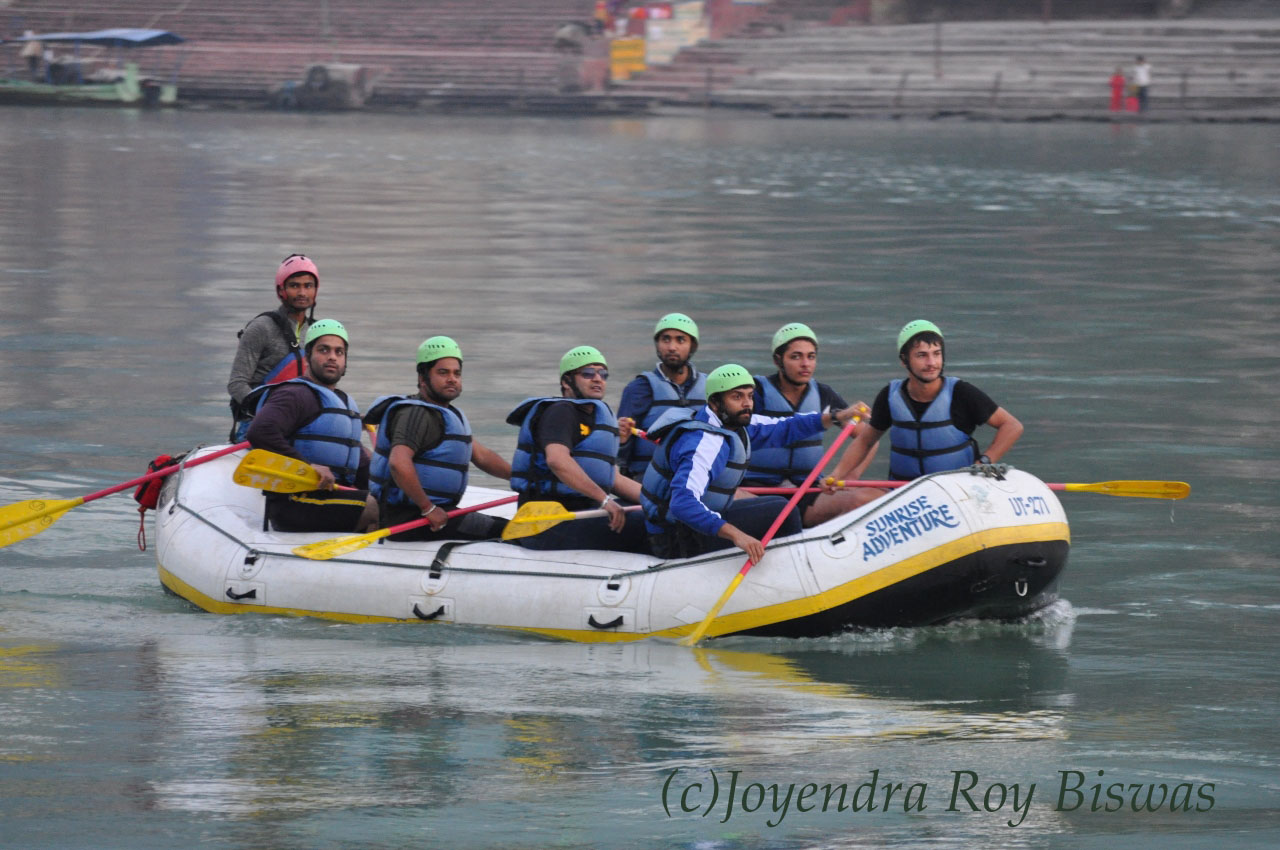
Rafting in Ganga River
Close up of Ganga River
Devprayag
is situated at a distance of 70 odd kilometres from Rishikesh and as I had
instructed the driver to keep a steady pace, so that we could imbue the scenic
fragrance of the hills, we expected to reach the destination in about two
hours’ time.Devprayag is a small town snuggled amidst three mountains, whose peaks
are considered sacred, named Giddhanchal
Parvat, Dashrathanchal Parvat, and Narsinghancal Parvat. Giddhanchal Parvat is
on top of Raghunnath Ji temple. Narsinghanchal Parvat is in front of
Giddhanchal Parvat and Dashrathanchal Parvat is on top right side of
"Sangam". Devprayag is one of the five prayags that dot
the holy River Ganga and the first one while headings from the plains towards
the mountains. Perched at an altitude of about 472 meters, Devprayag is
a small but religiously significant township in the Tehri District of
Uttarakhand. Devprayag, as the name suggests and literal translation would be
‘God’s confluence’, is the site of the confluence of the two rivers -
Bhagirathi and Alakananda and from thence it flows out of as the sacred river
Ganga. The
Alaknanda flows from the left, and is an eye-catching shade of light blue or a
powder blue from Badrinath side; whereas the Bhagirathi is of a light shade of
green that flows in from Gangotri. However, the colours change with the change of
weather and the colours seem to alternate.
Meandering in the upper reaches - Ganga River
Panoramic view of the Ganga River valley
Devprayag is also otherwise a
significant township, as all the pandas
of Sri Badrinath temple hail from this town. Most of the pandas are Bramhins
and are scholars in Vedic scriptures. Their knowledge of Sanskrit comes
as a family inheritance from times immemorial. A local pandit called Sri
Chakradhar Joshi had established an elaborate observatory known as Vidya
Mandir. This institute is considered to be the seat for astronomical and
astrological learning in this area. The observatory has a library with a
collection of large number of ancient texts and books and hand written
manuscripts dealing with subjects of ancient learnings. This
observatory is open to visitors during particular timings during the day, but
is at end of a steep climb upwards and hence not for the faint hearted souls.Devprayag
is 47 Kms from Pauri, 74 Kms from Rishikesh, 80 Kms from New Tehri, 93 Kms from
Haridwar, 112 Kms from Dehradun, 150 Kms from Kotdwara, 230 Kms from Ranikhet,
303 Kms from Nainital,322 Kms from Kathgodam
A village perched atop a hill side
Devprayag finds mention in mythological
texts also and according to the Ramayana, Lord Rama and King Dasharatha did
penance at Devpraryag, to relieve themselves of their sins of Brahmahatya. It
is also believed that the Pandavas also performed ablutions at Devprayag before
visiting Badrinath to attain salvation, during their journey towards heaver
through Swargarohini valley.The
religious significance of Devprayag is further enhanced, as according to the Vaishnavism,
Devprayag is one among the 108 Divya Desams or the sacred abodes of Lord
Vishnu. Devprayag holds the fifth place among the five sacred river confluences
or the Panch Prayag, the other four being Vishnu Prayag, Nand Prayag, Karn
Prayag and Rudra Prayag. The piousness of Devprayag is considered equivalent to
the Triveni Sangam located at Allahabad.
Panoramic view of Devprayag - shot in 2001 (using Yaschica FX2000 SLR)
Panoramic view of Devprayag - shot in 2018 (using Nikon D5300 DSLR)
Devprayag houses many temples
within its precincts and the temple of Raghunathji is dedicated to lord Rama.
The temple is claimed to be 10,000 years old. It is one of the oldest existing
temples of India. Raghunathji temple is built of huge stones, meticulously
placed one over the other, in a pyramid shape. The temple was destroyed during
an earthquake in 1803, and was later rebuilt by Daulat Rao Scindia. The temple
compound also hosts Annapurna Devi temple, Hanuman temple, Shankaracharya
temple and Garud temple.Another temple is
of Chandrabadani, which is dedicated to the Goddess of power. As per legends,
Sati, a consort of Shiva, who had committed suicide due to insults heaped on
Lord Shiva by her father and Lord Shiva had picked up her body and started the
tandava, the dance of destruction.Finding no other way to stop Lord Shiva, the Gods decided to decimate
the body of Sati into pieces, as the Gods cut off her body parts, her torso fell
at this place. Her weapons got scattered in the locality. There are some old
statues and lots of iron trishuls (tridents) outside the temple. A fine view of
the Sirkanda, Kedarnath and Badrinath peaks can be enjoyed from here.The other main temple is that of Dashrathshila,
which is supposed to be the place where Dashrath, father of lord Rama,
performed penance. A small water stream, Shanta, is named after the daughter of
Dashratha. The seat of Dashrath is one a small hillock called Dashrathachal
Peak.Besides these temples, there are
many other smaller temples, like the Baital Kund, Brahm Kund, Surya Kund,
Vashisth Kund, the Indradyumna Tirth, Pushyamal Tirth, Varah Tirth,
Pushpavatika, Baitalshila, Varahishila, the shrines of Bhairava, Bhushandi,
Durga and Vishveshvara, and a temple dedicated to Bharata. A bath at
Baithalshila is claimed to cure leprosy.
I had last visited the Garhwal region, especially the Chardham route way
back in 2007 and thereafter have been busy visiting other regions. I had briefly visited the Garhwal region
during my trip to Chakrata in January, 2011 and thereafter visited Lansdowne
and Khirsu in January, 2012. Whereas,
the first trip was from Dehradun side, the other one was through Kotdwar side
and only during the return trip from Khirsu, I traversed briefly through
Rishikesh while returning back to Delhi.
So in effect, it was a journey to this part almost after 10 long years,
especially after the tragedy that befell this region in the summers of
2013. During this trip, I found that the
region was much changed, as expected, but a journey to the hills of Uttarakhand
is always welcome, as it provides solace to the tormented souls. Thus, begins my first blog for the New Year,
with a visit to the Dev Bhoomi or Land of Gods. We started from Delhi on 30th
December, 2017 for the brief tour that included visit to Chopta and the first
halt was at Rishikesh, about 241 odd kilometers from Delhi. The journey, to begin with, was not without a
bit of drama, as near Meerut a Roadways bus overtaking our car from the left
hand side pushed it towards the main road and as is in vogue in the state of
Uttar Pradesh (I sometimes jovially refer to it as ‘ulta’ - meaning opposite in
English - Pradesh) wherein all kinds of vehicles ride on the National Highways,
a small truck like vehicle with heavy metal girders built around its front side
scrapped past the front mudguard of our car, thereby dislodging it in its
entirety. We had to spend more than an
hour to find a suitable mechanic to repair it.
Ganga aarti that was performed way back in 2008
Offering prayers after completion of Ganga aarti
Rishikeshis situated 27 Kms. upstream from
Haridwar on the foothills of Shivalik hills where the holy River Ganga makes
her first footfall, just before entering the great plains in India. Rishikesh township is also the entry point for
three districts of Uttarakhand State of India, namely Dehradun, Tehri Garhwal
and Pauri Garhwal. It is also the gateway to the famed Chardham Yatra The town
is located at an average elevation of 372 meters from sea level. Rishikesh and
the nearby town of Haridwar are well-connected through road and rail with many
North Indian cities including Delhi, Jaipur, Varanasi, Amritsar, etc. The
place is associated with lord Ram who is said to have done penance here on advice
of sage Vashistha before embarking on his mission to kill Ravana. There
are several other mythological beliefs associated with this ancient place, the
other one being that after long penance by sage Rabiya Rishi, god named
Hrishikesh (another incarnation of Lord Vishnu) appeared before him and the
place derives the name from and gradually it became Risikesh. Another
mythological event associated with this destination is that Bharat brother of
Lord Ram also performed penance and hence a temple dedicated to him stands in
this township. However, the visit by the
famed Adi Shankracharya during the 9th century AD gave fame and name
to destination as a spiritual doorway to the kingdom of the Gods and it is the
entry point for the famed Chardham Yatra that attracts lakhs of tourists from
all over India and the world.
Parmarth Niketan Ashram across the River Ganga that holds elaborate Ganga aarti
Ganga River upstream of Rishikesh
Panoramic view of Rishikesh
The other attractions of Rishikesh, apart from the mythological
importance are the existence of many temples, ashrams etc. in and around it and
to detail some –
Neelkanth Mahadev temple
Neelkanth Mahadev - is
32 Kms from Rishikesh and is connected by Taxis which run on shared basis as
well as can be hired individually. The place derives its name from the
mytholigical event of Samudra
Manthan wherein the venom/vish
generated during the manthan /
churningwas gulped down by Lord Shiva and held in his throat (Kanth in hindi) because
of which his body turned blue (Neel
in hindi) and hence the place is known as Neelkanth.
The temple situated here boasts of South India style architecture
and has a huge silver Shivling situated inside.
Laxman Jhula -There are many mythological tales associated with this
bridge. According to myths, the bridge got its name from Hindu Lord Rama’s
brother Laxman, who crossed the river Ganga at the same site with jute ropes. Situated about 4 Km from the main Rishikesh
town, Laxman Jhula, a 450 feet long hanging bridge across the river Ganga at a
height of 70 feet, is one of the most popular sightseeing destinations in
Uttarakhand.
Panoramic view of Ram Jhula
Ram Jhula - Yet another suspended
bridge in Rishikesh is the Ram Jhula. The bridge serves as the connection
between the Shivanand Ashram and Swarg Ashram. It is dedicated to Ram,
Lakshmana's elder brother.
Trimbakeshwar temple alongwith Laxman Jhula
Trimbakeshwar Temple - is among the spectacular temples situated
in Rishikesh. Also known Tera-Manzil temple, it has built up 13 stories and is
the largest temple of Rishikesh. Its ornate and symmetric architecture,
nearness to Lakshman Jhula, and panoramic view one gets from temple’s top, make
it extremely popular among tourists. Tera-Manzil is also famous amongst the
tourists for its beautifully crafted idols of various Hindu Gods and Goddesses,
coupled with its collection of various traditional artifacts. While
devotees are driven by their devotion enthusiastically climb up the 13 storey, whereas
the other not so religiously committed tourists take up the challenge, so as to
relish the scenic view of the town and the majestic Himalayas from the 13th
floor, especially at sunset.
During the recent years Yoga
has made a mark on the World map, but Rishikesh has been the Yoga capital
for many years now. The self-styled yoga
capital of the world surely lives up to its name. Unlike what many believe,
Rishikesh didn’t step up on the yoga pedestal when the Beatles arrived here. In
fact, Rishikesh, often referred to as the Gateway to Himalayas, has been the base
camp for ascetics and sages travelling to and from the Himalayas, after having
spent years learning yoga and meditation from their gurus in the white
wilderness. However, the coming of Beatles sure put Rishikesh on the
international map. Rishikesh is home to
- numerous ashrams that offer yoga classes and lodging at a nominal fee, yoga
teacher training retreats which are thronged by international yoga
practitioners who want to advance their practice and become certified teachers,
and luxury yoga and Ayurveda resorts that offer extended wellness holidays
interspersed with yoga , organic diets and high-end spa treatments. Almost all ashrams in and around Rishikesh
have been built by some religious guru or his foundation. Most ashrams offer
classes on classic yoga and meditation. They even offer lodging and satvic food
to travelers. Nestled away from the chaotic mundane life, premium yoga
resorts offer not just change of scenery but a luxurious wellness holiday -
where yoga meets 5 star ambience, Ayurvedic massages, and therapeutic and
beauty spas. Guests get an opportunity to unwind, detoxify and explore the
surroundings. These resorts are a perfect getaway for those looking for a
healthy and rejuvenating holiday; and for those wanting to experience yoga. The
town is peppered with a number of ashrams, world renowned centers for spiritual
studies and lessons on meditation. Some of the most popular and much visited
ashrams in Rishikesh include Paremarth Niketan, Sivanand Ashram, Yoga Niketan,
Omkaranand Ashram, Vanprastha Ashram, Shankaracharya Nagar Transcendental
Meditation Centre, Vithal Ashram and Yoga Study Centre.
Commencing with the rituals of Ganga aarti at Shatrughan ghat in Rishikesh
Ganga Aarti – Another
aspect that has now made an impact on Rishikesh is the performance of Ganga
aarti at various ghats & ashrams across the township situated along the
banks of holy River Ganga. Earthen and
dough lamps floating in small leaf boats on the river banks, coupled with the
chanting of sacred hymns reverberating in your ears and flickering flames emanating
from the hand held brass lamps inspire a feeling of awe and reverence stirring
ones’ heart & soul. With the mighty
Sun taking the final bow for the day, as it appears to dip into the holy Ganga River
– it is a site to behold, which is both invigorating as it is soothing.
Spiritually inclined or not, attending the Ganga aarti at Rishikesh is a memory
that is etched in the hearts of the onlookers for a lifetime. As the sun sets, priests start chanting sacred hymns while
rotating huge oil lamps burning bright with large flames. The devotees can be
seen putting earthen lamps wrapped in leaves in the holy river. Mirroring the
night sky littered with sparkling stars, the entire bank is lit up with earthen
lamps, where somewhere in the background music can be heard playing as the
priests and devotees sing Sanskrit hymns in praise of their dear Goddess, in a
mellifluous chorus. The Ganga aarti can
be witnessed at the Triveni Ghats and at Parmarth Niketan Ashram every day at
dusk. Everyone is welcome to attend the aarti. However, visitors are expected
to respect the sanctity of the ritual and the place. At the Triveni ghats,
local priests conduct the aarti. The aarti at Parmarth Niketan is slightly
different, as ashram residents, especially children who come there to learn the
vedas, conduct it. A havan and hymn singing precede the aarti. Visitors looking
to experience the aarti should arrive at the chosen venue an hour before dusk
to book a spot from where they can witness the spectacular ritual with
ease. A surreal experience, the Ganga aarti evokes different emotions in
different people. And irrespective of the visitors’ background and knowledge,
its power is universal.
One of the many adventure sports offered in & around Rishikesh - Rafting
Rafting – Taking advantage of its’
unique position, being situated at the foothills of the Himalayas, as the Ganges snakes down the Himalayas into the Indian
planes, it offers perfect white rapids for rafting. Flanked by snow and tree
covered mountains, the rapids are of varying intensity; perfect for novices as
well as rafting pros. Plunging from the Himalayan glaciers, the River Ganga
promises adrenalin-gushing adventure and complements it with a superb
view. River Rafting in Rishikesh is for everyone. From short
rafting tours to rafting journeys laced with activities like mountaineering,
rappelling, and camping, Rishikesh has something to offer to all adventure
seekers desire. Tourists looking for a thrill in their holiday can take a
half-day rafting tour at rapids of grade level I & II, while the pros can
spend an entire weekend camping and exploring each of the 16 rapids. Tour
operators offer all-inclusive packages for adventure seekers including rafting,
camping, mountaineering and more in a 3-night stretch. Most tour operators can
be found online and offer good deals. Rapid
is most tame at Brahmpuri that has Grade II rapids. The stretch between Kaudilya and Rishikesh at
about 36 kms is the longest stretch and is home to grade IV & V level
rapids, making it the most difficult stretch in the entire rafting route. Each rapid has a unique and interesting name.
There are the benign ones like Sweet Sixteen and Double Trouble, which can be
enjoyed by the entire family. Then there are the likes of adrenalin pumping
Golf Course, The Wall, and Roller Coaster, traversed by rafting junkies.
Amongst these, the Wall, which falls in the Kaudilya-Rishikesh stretch of the
rafting zone, is considered the most dangerous and challenging rapid.
Here is the link to the video of performance of Ganga Aarti in Rishikesh -