Ranikhet – during
monsoon in August, 2025 (A photo blog)
There
are a plethora of blogs on my link describing the various facets of the quaint
little hill station of Ranikhet, as I keep visiting the destination to oversee
the maintenance work related to my pad in a village called Timila that is
situated in Tarikhet Block of Ranikhet Tehsil.Therefore, I am not describing any details regarding the journey from
Delhi to Timila village, but briefly to state, we took the early morning
Shatabdi upto Kathgodam and after reaching their around Noon, we proceeded
further in hired Taxi.Being peak
monsoon season, we had a blast eating local fire grilled maize and I found to
my dismay that many of the sellers were pushing maize from plains as one from
the hills, the latter is costlier and have a distinct sweet & soft texture.
However, this time around, having
visited after quite a long time, I had not anticipated that the Kainchi Dham
would be packed, however the entire stretch was and as we were already late for
lunch, but we kept our tryst with the ‘Highway Inn’ run by KMVN at Khairna for
our lunch.
My
wife had not travelled to any of the hill stations during monsoon, so it was
first time for her and the scenic beauty of the hills totally mesmerized her
and describing it in words would be futile, so I chose to post a photo blog
this time around.Here goes the
photographs with brief descriptions –
Miaze being grilled on local wood
Wild Begonia flowers blooming around the hillside during monsoon
After days of dark cloud cover - the Himalayan ranges gave us a rare glimpse
Panoramic view of Baba Haira Khan temple in Chilyanaula, Ranikhet during monsoon season
Panoramic view of Ranikhet township during monsoon from road leading to Majhkhali
The cloud covered with a green top golf ground of Ranikhet
View of the valley below from Naini Village enroute of Majhkhali from Ranikhet
Umbrella Liverwort growing during monsoon season in Ranikhet region
Chetnuts growing on tree in Chaubatia Garden in Ranikhet
Panoramic view from Chaubatia Garden in Ranikhet
As the clouds envelope the Pine trees of forest in Ranikhet region
Panoramic view of Timila village in Ranikhet Tehsil
As the cloud cover moves in - view from Timila village during monsoon
As the tufts of clouds drift along the valley - view from Timila village in Ranikhet Tehsil
A wide angle view from my Timila village home in Ranikhet Tehsil during monsoons
Just after a bout of rains - view from village Timila in Ranikhet Tehsil of Uttarakhand
Just after brief bout of rain - rainwater on Colocasia (Arbi in Hindi) leaves - shot in Timila village in Ranikhet Tehsil of Uttarakhand
Rose of Sharon (locally called Kaner or Gular in Hindi) - after rains - shot in village Timila in Ranikhet Tehsil of Uttarakhand
The year 2024
is almost drawing to a close and we are in the last month of the year.But due to several issues, I could not
compose my blogs and decided that at least for the sake of records, I should
conclude the year with some of my blogs in respect of places visited during the
year.After visiting Puducherry for some
admission related work of my daughter, we decided for a short visit to Ranikhet
during July, 2024.
Panoramic view of Binsar Mahadev temple
A view of 'Dolia Pahadi' restuarant in Ranikhet
As my car was
due to complete its 15 years life time tenure in September, 2024 we decided to
make a last trip in my car to Ranikhet.Usually, I refrain from visiting the hills during the rainy season, but
this time around as the rains were scanty and there was no other time available
for the visit, we decided to take a chance.It was hot and humid as we proceeded for the journey from Delhi and
remained so till we reached the hills.We had two short breaks for B’fast, around Gajraula and for lunch at
Bhimtal (having driven via Haldwani) and on the way to Bhimtal, tried some fire
grilled Maize (Bhutta in Hindi), but due to lack of rains, the taste was not as
good as we were used to having during our past visits.Having started at 6.30 A.M sharp from Delhi,
we reached my pad in village Timila in Ranikhet Tehsil in the evening at around
4.00 P.M.
Hydrangea (Guldasta in Hindi) in bloom
We settled in
for a few days in the peace and tranquility of the hills, although it was not
very hot, but lack of rains had made an impact all around and the hills were
not as green as they are during monsoons in the hills.During this stay, we visited the famed
‘Binsar Mahadev Temple’ that is about 2.5 Kms. from my village home.We also visited Ranikhet main market also
during the said visit and headed for lunch in a restaurant that boasts about
its cuisine etc. named ‘Dolia Pahadi’.It had started drizzling by the time we could locate the restaurant
entrance, which is about 100 odd meters away from the road head and finding a
parking space is also a challenge.But
apart from the ambience, the food was not at all to our satisfaction,
especially the chapattis were smelling, as if made from stale atta (flour) and
despite asking them the replace, the second serving was also the same.So despite having high hopes of having a
sumptuous lunch, we had to retrace our steps back, simply dissatisfied with the
outing.The only silver lining was that
we could get half a plate of famed mutton chap from Prakash dhaba in Ranikhet
market for my daughter on our way back.As it had started raining, we simply retraced our way back to our pad in
the village.
A Khalij pheasant (male) in jungle adjoining my house in village Timila
After having
settled for a few days in our pad, simply enjoying the tranquil enviorn, we
started back for Delhi.However, this
time around we decided to travel from Ramnagar side, as it is shorter distance as
compared to coming back via Haldwani.But I rued my decision , as after crossing Kashipur the road heads
across a short bridge built over a small rivulet and therefrom the entire road
was splattered with huge potholes and a journey of about 40 odd kilometers took
3 hours to complete and the experience was atrocious.We reached Delhi late in the evening and
thus, completed my first visit to Ranikhet for the year.
Road along Shipra River - from Kainchi Dham towards Khairna
On the way towards 'Binsar Mahadev temple'
Himalayan ranges at sunset - as seen from my pad in village Timila
A panoramic view of the Himalayan ranges as seen from village Timila
The second
visit to my pad in village Timila in Ranikhet Tehsil was undertaken by me with
a family friend of mine in November, 2024.Since my vehicle had been scrapped on completion of the tenure, we had
no other option but to travel by train.We boarded the Kathgodam Shatabdi from New Delhi Railway station at 6.20
A.M in the morning, after having had an altercation with the Taxi Driver, who
dropped us on the road on Paharganj side, without completing the journey citing
jam and we had to trudge about 500 odd meters to reach the station.However, the train journey was smooth and we
got down at Kathgodam at around 12.00 Noon and therefrom commenced on our
journey towards Ranikhet via Jeolikote side by local Taxi driven by my long
standing trusted driver Mr.Amit (Monu being his nickname).On the way we had a sumptuous lunch of Mutton
and rice at a road side eatery (dhabha), but were struck in a mild jams
starting from entrance to Nainital till the time we crossed Kainchi dham.Although my friend was inclined to visit
Kainchi Dham, I insisted that he undertakes the visit during his return
journey, which was scheduled earlier than my departure.We reached my pad in village Timila in
Ranikhet Tehsil at around 3.45 P.M and it was quite cold in the evening, as the
winters had started setting in, I had asked my caretaker to prepare a fire wood
stove (Angithi in Hindi) to ward for the extreme dampness and cold faced during
first day due to the fact that the house remains closed for months
together.During my friend’s very short
visit, we went to Binsar Mahadev temple one day and rested for the remaining
days.I continued for some more time and
spent my time cooking and washing utensils etc. and enjoying the environs of
the village to soothe my strained nerves, away from the hustle and bustle of
the city life.I returned back following
the same route, but after collecting and purchasing some local vegetables, ginger
and kidney beans from village home.Thus,
ended my second visit to Ranikhet region for the year.
A representative image of adventure tourism (sourced from internet)
I
have posted a series of blogs regarding the destinations associated with
eco-tourism destinations in Ranikhet, in the first blog of the series I had
provided for links to my older blogs covering the major tourist destinations of
Ranikhet that had been visited by me in the past.Another aspect of mountain tourism that is
fast evolving and is becoming a favorite of the youngsters is termed as
‘Adventure tourism’ and incorporates activities such a hiking, trekking,
mountain biking, Zip line or Flying fox etc.Although extreme adventure tourism like trekking across high mountain
passes or visiting remote locations requires one to visit such locations that
are very far off from the modern amenities and is designed for fitness freaks
and extreme adventure lovers.However,
anyone, especially youngsters, visiting the hills now seek lighter adventure
tourism activities like Para-gliding and Zip lining etc.In this context, Ranikhet has also developed
some such adventure tourism destinations –
Adventure
Tourism
The hotel cum restaurant wherefrom the zip lining and cycle zip line can be enjoyed
A photo of enthusiast enjoying the zip line (sourced from internet)
The pamphlet of company offering activities (sourced from FB page of the company)
Do's and dont's etc. of pamphlet from FB
The most enjoyed mild adventure
tourism are Zip line or Flying Fox activity that can be enjoyed both by
children, youngsters and adults alike subject to their being physically
fit.There is an agency called ‘Mogli
Adventures’ that operates the Flying Fox or Zip lining from a hotel complex
called ‘Sahaj’ (whose link is given as follows - http://www.sahajhotel.com/), wherein one can dine as well as stay, so a day outing
with the adventure tourism activities of both Flying fox/Zip lining, which happens to be one of the longest in
India i.e. about One Km. or exactly 3116 (claimed to be as second longest in
India) is a must visit destination for adventure lovers.In addition to normal Zip line, the agency in
the aforesaid Hotel complex also runs a ‘Cycle
Zip Line’, wherein a person cycles on a Zip line to and fro suspended about
7 meters above the ground, although precautionary upper line with safety
harness attached, for a period of about 30 minutes.The activities cost about Rs.1300/- per
person for the Flying fox/Zip lining adventure that includes pick up from the
end point of the Zip line back to the Hotel and about Rs.800-1000/- for the
Cycle Zip Line for 30 minutes, depending upon the season.To check out the first-hand experience of the
Flying fox/Zip lining activity, may check out this You Tube link - https://youtu.be/MeFqCju6gAc).Here is a link to the Facebook link of the
agency i.e. Mowgli Adventures - https://www.facebook.com/Mowgli-adventure-101905267854049/.The Sahaj Hotel is situated on the road
leading to Majhkhali from Ranikhet and as on crosses the Kalika region and the
Golf ground, just before reaching Majhkhali, the hotel is situated in Naini
village at a distance of 9.2 Kms. from Ranikhet and Majhkhali lies further
ahead at a distance of 12 kms.
Here is a short representative video of the destination -
Bubudham
temple
Panoramic view of Bubu Dham temple
A close-up shot of the Bubu dham temple
As
one traverses across the road from Ranikhet towards Majkhali, the Siddheshwar Mahadev also known as the
Bubudham is situated on a curve known as Kaligad dath (‘dath’ means a curve on the road in Kumaoni language) in Village
Dadhgaliya.The place is situated about
7.5 kms. from Ranikhet township and is very easily accessible all-round the
year as many busses as well as shared taxis normally ply on this route and even
private taxis can be hired locally.The
temple has had a long past, as during the British era only the cantonment area
was developed with proper roads and villages around it were poorly
connected.The villagers from adjoining
areas used to trek for job related activities as well to purchase goods etc. to
Ranikhet and back.It is said that a
person travelling late in the night through the dense forest area, if in
difficulty, invariably used to get attended to or helped discreetly by an aged
person, who would thereafter disappear.As the fame of such a person spread, the local villagers started
lighting lamps etc. at the place where this elderly person usually appeared and
they referred to him as ‘Bubu’
(grandfather in Kumaoni language) and with passage of time this place came to
be known as the Bubudham.Now a days a big temple complex has been
built at the site, which is dedicated to Lord Shival and now known as
Siddheswar Mahadev and this temple complex is presently managed by one Mahant
Srhi Jairam Bharti ji.Since, this
quaint little temple is situated right on the highway, one can take some time
out of their schedule and visit this destination, as it is situated with a
magnificent background.
Here is the link to a short video of the destination -
Binsar
Mahadev temple
A panoramic view of Binsar Mahadev temple
It is located at a distance of 19 Kms. from from Ranikhet, on the way
to Ramnagar amidst dense Pine, Oak, Rhododendron and Deodar forests with a
rivulet flowing in front of it. Dedicated to Lord Shiva, the Binsar Mahadev is a
unique place for Yoga and spiritual meditation amidst the solitude. Located at
an altitude of about 2000 meters over mean sea level, Binsar Mahadev is an
important and most visited temple of the region. It is also important for its
architectural significance as well and mythological anecdote being that it was
constructed overnight by the Pandavas. Historically, the temple was built by
King Pithu in memory of his father Bindu is hence is also called Bindeshwar temple.
The temple comprises of idols of Ganesh, Har Gauri and Maheshmardini. The idol
of Maheshmardini is engraved with texts in 'Nagiri lipi' (an ancient form of
scripture), which indicates the link of temple back to ninth century. However,
the temple complex had fallen into disuse over the years and in the late 1950’s
the Panch dashananJuni akhada saint Mahant Mohangiri was pivotal
in its reconstruction and giving it the modern day look.An important fair is held here every year on
the occasion of Baikunth chaturdashi in the month of June.
Here is a link to a
short video of the destination -
I
have posted two blogs as part of the series in respect of the initiatives
undertaken by the Forest Department, Research Wing of Uttarakhand highlighting
the concept and ecological importance of the destinations.The last in this series is the ‘Open Air
Fernery’ that was inaugurated on the 12th of September, 2022 by
renowned expert of ferns Nilambar Kunetha, who has also guided in curating the
project.The fernery has the largest collection of fern species, second
to only Jawaharlal Nehru Tropical Botanical Garden and Research
Institute (TBGRI), Thiruvananthapuram. However, it is the country’s
first open-air fernery in natural surroundings, which is not under any
poly-house/ shade house, but in open air conditions.The Ranikhet fernery, situated in the Kalika
range region, has around 120 different types of fern, spreads over four acres
of land at an altitude of 1,800 meters.The facility has been developed under Central Government’s ‘Compensatory
Afforestation Management Funds Management and Planning Authority’
(CAMPA) scheme, by the Research Wing of Uttarakhand Forest Department
over a period of three years.The
fernery is home to fern species that are both endemic to the state as well as
those that are from other States, especially the Western Ghat region. Some of
these ferns have medicinal value, while some are threatened species that
require care and protection.Therefore,
this project has been conceived with the dual objectives of ‘Conservation of the ferns’ as well as
to ‘create awareness about the
ecological and day to day role these ferns play’ in our lives.
Various types of fern species identified and named
Another fern species identified and indented
Some more ferns
Many of my
readers, may by now be intrigued to know, as to what are Ferns exactly are.Ferns are the oldest form of plants, which had evolved from the
multicellular Bryophytes into plants
that had proper vascular system with tree trunk like structures.The earliest forms of plants were single cell
organisms that multiplied through fission i.e. breaking into two cells. They
were followed by Bryophytes that were
multi celled, but these too propagated through fission.The Ferns were more like present day plants
with a proper vascular system i.e. root, stem & leaves/false leaves that
had specific internal channels like Xylem & Phloem to transmit water &
food throughout the plant and classified as Pteridophytes
(more recently the taxonomical classification has been changed as Pteridophyte Phylogeny Group) .The Ferns pre-date the present day flowering
plants that are classified as Angiosperms
and existed in abundance even during the pre-historic periods, during the times
when the Dinosaurs roamed the Earth.The
basic difference between the Angiosperms
and Pteridophytes is that while the
former uses flowers & seeds as means of reproduction for
dispersal/propagation, the later uses spores for reproduction and
propagation.I am putting in a few
diagrams to make the concept of life cycle and reproduction of Ferns (as
sourced from the internet), for explaining it in a pictorial manner -
Parts of a fern (Sourced from the internet)
Life cycle of a fern (Sourced from the internet)
Ferns first appear in the fossil record about 360
million years ago in the late Devonian, but many of the current families and
species did not appear until roughly 145 million years ago in the early
Cretaceous, after flowering plants came to dominate many environments. The fern
Osmunda claytoniana is a
paramount example of the evolutionary trends and the paleontological evidence shows
that it has remained unchanged, even at the level of fossilized nuclei and
chromosomes, for at least 180 million years.
Ferns and fern are the
second largest group of allied plants in the Indian flora. It consists of 1,267
species and 130 genera represented by a total of 33 families, of which about 70
species are endemic to India. In
addition, ferns are indicators of moisture and clean the ecosystem akin to Lichens.
These are good nitrogen-fixing agents like the widely used Leguminosae (Pea/various daals) in crop
rotation. They are also used to filter heavy metals from polluted water and are
a bio-indicator for the health of an ecosystem.
The Ferns therefore have a wide range of benefits for humans and the
ecosystem. Some of them possess
medicinal properties, whereas other are edible and still others have other
uses. One of them is the Lycopodiosida
or commonly called the Club ferns and their spores are used to produce
‘Lycopodium powder’ and those playing Carrom Board would be well aware of its
use during the game i.e. for smooth flow of the Striker & Coins, now a days
instead of the Lycopodium powder, Boric powder is used, as the former is quite
costly.
More named variety of ferns at the fernery
Another named variety of a fern in the Fernery
More fern in the Fernery
The spores of a fern plant on the hind side of the leaf at the Fernery
The
fernery in Ranikhet has round 30 species which have large medicinal
significance. The species embrace Hansraj (Adiantum
venustum) which has been given significance in Ayurveda in addition to
within the Tibetan system of drugs as a treatment for a lot of illnesses.The fernery additionally shows some distinguished
edible species of fern like Lingura
(Diplazium esculentum), a preferred
meals merchandise within the hills of Uttarakhand as well as North East India, which
is extremely nutritious and collected in wild during the monsoon season.It has a mixture of species from the western
and Himalayan areas in addition to from Western Ghats. It homes many uncommon
species, distinguished amongst that are Tree Fern (Cyathea spinulosa) which has been declared as “threatened” by the
State Biodiversity Board of Uttarakhand.Only some crops of this species are left within the wild and is taken
into account one of the crucial historic species of fern. It’s stated that herbivore dinosaur used to
feed on its trunk which is wealthy in starch.Moreover, the fernery additionally shows many epiphyte, aquatic ferns
and fashionable and attention-grabbing ferns like Vishkanya, Mayurshikha,
Boston Fern, Woman Fern, Rock Fern, Basket Fern, Ladder Fern, Golden Fern and
Horsetail Fern. Further boasting of
varied fern species, it additionally shows attention-grabbing info about ferns
like reference of invisible seeds of ferns in Shakesphere’s play Henry IV and
the craze of ferns generally known as ‘Pteredomania’ during the Victorian
period.
A panoramic view of the Ranikhet Fernery
Some ferns that grow on tree trunks
Another variety of fern that grows on decaying tree trunks
Lingura (Diplazium esculentum) a local delicacy and edible fern
It is also a must visit destination for nature lovers and
for me it was a great journey as it rekindled memories of my student days, as I
have a Honors Degree in Botany and having studied the Ferns as one of subjects,
I was teleported to a bygone era.I have
therefore crafted this blog in a detailed manner to convey the importance of
Ferns even in today’s world.
Here is a link to a short video of the destination -
The view of the entry gate to the Nature awareness center & camping site
A counter set up at the entry gate - colorfully decorated with animated figures
Panoramic view of the camping site in the center
I
have posted several blogs in the past about the various tourist destinations in
Ranikhet, although they too did not contain details of all the
destinations.However, of late Ranikhet
is being developed as an eco-tourism destination and in this series the second
such center to be developed by the Almora Forest Division is the ‘Ranikhet Nature Awareness Center & Camping
site’.This center has been
developed near the famed temple of Binsar Mahadev and this region is a notified
forest area, with a British era ‘forest rest house’ situated in the vicinity
and me alongwith some of my office friends had stayed there way back in
December, 2013 (am sharing a few of those photos to give a visual feel of the
area about ten years back).This center as
has been set up now, was inaugurated by the local MLA Shri Karan Mahra on 12th
August, 2021.
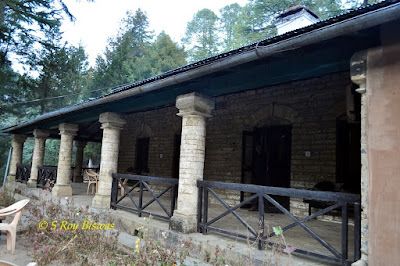
The British era forest guest house in the vicinity of the Nature awareness camp
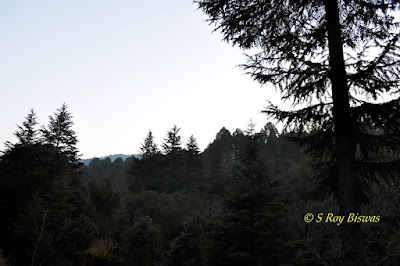
A silhouette of the Binsar forest in early morning
A Verditer flycatcher in the Binsar forest
This
center is situated near village Sauni, which is about 12 Kms. away from
Ranikhet on the Ranikhet-Ramnagar State Highway. On this Highway itself, as one traverses
towards Bhatraujkhan, the road bifurcates from a point called Soni daat (about
1 Kms. from Sauni village) leading towards the famed Binsar Mahadev temple and
other villages beyond like Devlikhet, Chamarkhan etc. and after traversing a
distance of about 600 odd meters, one comes upon the entry gate of the said ‘Ranikhet Nature Awareness Center & Camping
site’. The site has been developed
along a small rivulet flowing through the forest and there are about 09 (Nine)
riverside camps that have been set up with several common toilets placed
alongside for facilitating the visitors during their stay. In order to provide proper security, within
the environs of the forest, this area is properly fenced all around, to protect
it from encroachment by the wild animals.
The place has a big dining space cum restaurant, where the resident
visitors as well as the other daytime visitors can order some food and
drinks. The cost of stay per tent for
two persons is Rs.1500/- per night. The
region boasts of a plethora of birds and for adventure tourism lovers there is
mountain bike trail with cycles being provided (at a nominal cost) to the
visitors alongwith treks within the forest also being organized through trained
guides. A 3D small movie theater with a
seating capacity of about 15 (Fifteen) persons is also operational for the
visitors at a nominal fee. The entire
complex has been tastefully decorated with paintings of birds and animals
painted on the buildings within the complex.
It is a must visit destination for nature lovers (I have placed a copy
of the pamphlet of the complex for contact purpose.) and here is a link to the
inaugural function of the camp - https://ne-np.facebook.com/theproductionpronews/videos/199782995512894/
Nature awareness
center and camping site, Soni village,Ranikhet is on Facebook also (may check out the photos) - https://www.facebook.com/sonitourism/


.jpg)