After the brief stopover at Rudraprayag on our way back
from Syalsaur, we imbued the glimpse of the River Ganges and the mesmerizing
valleys cocooning it, one last time, before returning back to the nature
ravaged city life.We stopped at the
same small eatery, this time also before reaching Devprayag and had some snacks
etc. and a nice hot cup of Coffee.Thereafter, we boarded our Car and began the last leg of our journey,
which was uneventful till we actually reached Haridwar.In Haridwar, in order to locate headed for the
Hotel where in had made the booking.As
the town of Haridwar had grown immensely over the years and we could not trace
out the once familiar land marks, we used the Google map, which confounded us
further through its messages and finally after resorting back to the old, tried
and tested method of asking the local Rickshaw wallahs for directions, we
finally reached our destined Hotel in Haridwar at about 3.00 P.M.After checking in and thereafter partaking
some light snacks and coffee, we prepared for attending the evening Ganga aarti
that commences at 6.00 P.M.
As the River Ganga meanders towards the plains, so does the road running alongside
Haridwar, whose literal meaning would be ‘Gateway of
Gods’ is one of the oldest surviving human habitations on Earth.It has
been proved by archaeological findings that terracotta culture was existing in
this region of in & around Haridwar during 1700 B.C. and 1800 B.C. Historically,
this region was ruled by Maurya Empire from 322 BC to 185 BC and later it
came under the rule of Kushan Empire. The place also finds mention in the
treatise of ancient Chinese traveler Huen T’sang, who had visited India in 629
AD. At that time Haridwar was part of the kingdom of the King Harshvardhan (590
to 647). The city was also invaded by Timur Lang (1336–1405), a Turkish King on
January 13, 1399. First Sikh Guru, Guru Nanak (1469–1539) bathed at the famed
'Kushwan Ghat' on Baisakhi Day. Later in the 16th century Haridwar came under reign
of Mughals and emperors like Akbar and Jehangir stamped their domination here.
According to Ain-e-Akbari Mughal Emperor, Akbar drank water from the Ganges
River collected from Haridwar, which he called 'the water of immortality'.
The cold evening has set in and River Ganga flows by Haridwar
The congregation waits on banks of River Ganga for the Aarti to start in Haridwar
Mythologically also Haridwar finds mention in many of
the ancient Hindu scriptures, according to Kedarkhand of Skanda Purana, the ancient great
King named as Shwet did long penance on the bank of river Ganges at Haridwar.
The Brahma pleased with his devotion & blessed that the place will be
special place with blessing from all gods and bathing here will be very
fruitful to devotees. Raja Vikramaditya's brother Bhratuhari has also done
penance here. In his memory, King Vikramaditya built a “Paudi (pawadi)”/ step
way here, which later became famous as Har Ki Paudi or Har Ki Pauri. Apart from
this Guru Datatrey had also spent great amount of time here in meditation.
Haridwar is mentioned in various other ancient Indian scriptures of Purans,
Upanishads and Mahabharata, where it finds mention as a Mayapur, Kapilsthan,
Mokshdwar or Gangadwar. In Mahabharata great sage Dhaumya had also mentioned
Haridwar (Gangadwar) as a major pilgrimage town to Yudhisthira. Sage Kapila also lived here in an ashram, so
this place was also known as Kapilsthan. The tradition which was established by
King Bhagirath is now followed by thousands of Hindu devotees, who bring the
ashes of their departed family members, in hope of their salvation by the water
of river Ganges.
The preparations for the evening Ganga Aarti have begun on ghats of Hridwar
The Ganga Aarti begins on ghats of Haridwar
An interesting aspect of the Pandits (Priests) of the
Haridwar is that they have kept the genealogy records of most of the Hindu
population, which is maintained in hand written vahis (hand crafted note books).
These records are updated on each visit to the city by the families and are a
repository of vast family trees of family in entire India. Further, it is
believed that the nectar (Amrit), which was one of the fourteen valuable condiments
that came out during the churning of the Sea by both the Devas & Ashuras
i.e. Samundra Manthan, this nectar was sprinkled at 12 places in the entire
universe. Out of that 12 places 08 places are in heaven and only 04 places on
earth. Har-Ki-Pauri
in Haridwar was one of the four places where Amrit was
sprinkled on mother earth. As a result, every 12 years Khumbh Mela comes to
Haridwar by turn as it is also held at other three places of Ujjain, Allahabad
(Sangam) and Nashik and draws immense crowds. The Ardha Kumbha Mela comes
once in every six years.
The pandits offering sacred lamp for seeking blessings after Ganga aarti in Haridwar
Accordingly, the Ganga aarti held at Har ki pauri has
both historical and mythological importance as explained hereinabove.However, the Pandas have now made it into a
money spinning exercise, as they try to extort money from pilgrims on premise
of keeping the banks/ghats of Ganga River clean, stating that the local
municipality does not contribute to its up-keep.We dodged past these vermin’s and proceeded
to watch the Ganga Aarti, where I found the priests being loud and uncivilized
while interacting with both foreigners and Indian devotees.However, I took cover under a stair case and
filmed the proceedings, which it appears is losing its sheen, as it is
performed in same manner as it was performed 10 years ago or even twenty years
ago, juxtaposed to the innovation that is taking place in Rishikesh, akin to
Varanasi aarti.After enjoying the Ganga
Aarti at Haridwar and having had some delectable sweetmeats on the way back to
Hotel, we wrapped up our winter vacations for the year.
Evening aarti taking place in adjoining temples on Ganga banks of Haridwar
I had last visited the Garhwal region, especially the Chardham route way
back in 2007 and thereafter have been busy visiting other regions. I had briefly visited the Garhwal region
during my trip to Chakrata in January, 2011 and thereafter visited Lansdowne
and Khirsu in January, 2012. Whereas,
the first trip was from Dehradun side, the other one was through Kotdwar side
and only during the return trip from Khirsu, I traversed briefly through
Rishikesh while returning back to Delhi.
So in effect, it was a journey to this part almost after 10 long years,
especially after the tragedy that befell this region in the summers of
2013. During this trip, I found that the
region was much changed, as expected, but a journey to the hills of Uttarakhand
is always welcome, as it provides solace to the tormented souls. Thus, begins my first blog for the New Year,
with a visit to the Dev Bhoomi or Land of Gods. We started from Delhi on 30th
December, 2017 for the brief tour that included visit to Chopta and the first
halt was at Rishikesh, about 241 odd kilometers from Delhi. The journey, to begin with, was not without a
bit of drama, as near Meerut a Roadways bus overtaking our car from the left
hand side pushed it towards the main road and as is in vogue in the state of
Uttar Pradesh (I sometimes jovially refer to it as ‘ulta’ - meaning opposite in
English - Pradesh) wherein all kinds of vehicles ride on the National Highways,
a small truck like vehicle with heavy metal girders built around its front side
scrapped past the front mudguard of our car, thereby dislodging it in its
entirety. We had to spend more than an
hour to find a suitable mechanic to repair it.
Ganga aarti that was performed way back in 2008
Offering prayers after completion of Ganga aarti
Rishikeshis situated 27 Kms. upstream from
Haridwar on the foothills of Shivalik hills where the holy River Ganga makes
her first footfall, just before entering the great plains in India. Rishikesh township is also the entry point for
three districts of Uttarakhand State of India, namely Dehradun, Tehri Garhwal
and Pauri Garhwal. It is also the gateway to the famed Chardham Yatra The town
is located at an average elevation of 372 meters from sea level. Rishikesh and
the nearby town of Haridwar are well-connected through road and rail with many
North Indian cities including Delhi, Jaipur, Varanasi, Amritsar, etc. The
place is associated with lord Ram who is said to have done penance here on advice
of sage Vashistha before embarking on his mission to kill Ravana. There
are several other mythological beliefs associated with this ancient place, the
other one being that after long penance by sage Rabiya Rishi, god named
Hrishikesh (another incarnation of Lord Vishnu) appeared before him and the
place derives the name from and gradually it became Risikesh. Another
mythological event associated with this destination is that Bharat brother of
Lord Ram also performed penance and hence a temple dedicated to him stands in
this township. However, the visit by the
famed Adi Shankracharya during the 9th century AD gave fame and name
to destination as a spiritual doorway to the kingdom of the Gods and it is the
entry point for the famed Chardham Yatra that attracts lakhs of tourists from
all over India and the world.
Parmarth Niketan Ashram across the River Ganga that holds elaborate Ganga aarti
Ganga River upstream of Rishikesh
Panoramic view of Rishikesh
The other attractions of Rishikesh, apart from the mythological
importance are the existence of many temples, ashrams etc. in and around it and
to detail some –
Neelkanth Mahadev temple
Neelkanth Mahadev - is
32 Kms from Rishikesh and is connected by Taxis which run on shared basis as
well as can be hired individually. The place derives its name from the
mytholigical event of Samudra
Manthan wherein the venom/vish
generated during the manthan /
churningwas gulped down by Lord Shiva and held in his throat (Kanth in hindi) because
of which his body turned blue (Neel
in hindi) and hence the place is known as Neelkanth.
The temple situated here boasts of South India style architecture
and has a huge silver Shivling situated inside.
Laxman Jhula -There are many mythological tales associated with this
bridge. According to myths, the bridge got its name from Hindu Lord Rama’s
brother Laxman, who crossed the river Ganga at the same site with jute ropes. Situated about 4 Km from the main Rishikesh
town, Laxman Jhula, a 450 feet long hanging bridge across the river Ganga at a
height of 70 feet, is one of the most popular sightseeing destinations in
Uttarakhand.
Panoramic view of Ram Jhula
Ram Jhula - Yet another suspended
bridge in Rishikesh is the Ram Jhula. The bridge serves as the connection
between the Shivanand Ashram and Swarg Ashram. It is dedicated to Ram,
Lakshmana's elder brother.
Trimbakeshwar temple alongwith Laxman Jhula
Trimbakeshwar Temple - is among the spectacular temples situated
in Rishikesh. Also known Tera-Manzil temple, it has built up 13 stories and is
the largest temple of Rishikesh. Its ornate and symmetric architecture,
nearness to Lakshman Jhula, and panoramic view one gets from temple’s top, make
it extremely popular among tourists. Tera-Manzil is also famous amongst the
tourists for its beautifully crafted idols of various Hindu Gods and Goddesses,
coupled with its collection of various traditional artifacts. While
devotees are driven by their devotion enthusiastically climb up the 13 storey, whereas
the other not so religiously committed tourists take up the challenge, so as to
relish the scenic view of the town and the majestic Himalayas from the 13th
floor, especially at sunset.
During the recent years Yoga
has made a mark on the World map, but Rishikesh has been the Yoga capital
for many years now. The self-styled yoga
capital of the world surely lives up to its name. Unlike what many believe,
Rishikesh didn’t step up on the yoga pedestal when the Beatles arrived here. In
fact, Rishikesh, often referred to as the Gateway to Himalayas, has been the base
camp for ascetics and sages travelling to and from the Himalayas, after having
spent years learning yoga and meditation from their gurus in the white
wilderness. However, the coming of Beatles sure put Rishikesh on the
international map. Rishikesh is home to
- numerous ashrams that offer yoga classes and lodging at a nominal fee, yoga
teacher training retreats which are thronged by international yoga
practitioners who want to advance their practice and become certified teachers,
and luxury yoga and Ayurveda resorts that offer extended wellness holidays
interspersed with yoga , organic diets and high-end spa treatments. Almost all ashrams in and around Rishikesh
have been built by some religious guru or his foundation. Most ashrams offer
classes on classic yoga and meditation. They even offer lodging and satvic food
to travelers. Nestled away from the chaotic mundane life, premium yoga
resorts offer not just change of scenery but a luxurious wellness holiday -
where yoga meets 5 star ambience, Ayurvedic massages, and therapeutic and
beauty spas. Guests get an opportunity to unwind, detoxify and explore the
surroundings. These resorts are a perfect getaway for those looking for a
healthy and rejuvenating holiday; and for those wanting to experience yoga. The
town is peppered with a number of ashrams, world renowned centers for spiritual
studies and lessons on meditation. Some of the most popular and much visited
ashrams in Rishikesh include Paremarth Niketan, Sivanand Ashram, Yoga Niketan,
Omkaranand Ashram, Vanprastha Ashram, Shankaracharya Nagar Transcendental
Meditation Centre, Vithal Ashram and Yoga Study Centre.
Commencing with the rituals of Ganga aarti at Shatrughan ghat in Rishikesh
Ganga Aarti – Another
aspect that has now made an impact on Rishikesh is the performance of Ganga
aarti at various ghats & ashrams across the township situated along the
banks of holy River Ganga. Earthen and
dough lamps floating in small leaf boats on the river banks, coupled with the
chanting of sacred hymns reverberating in your ears and flickering flames emanating
from the hand held brass lamps inspire a feeling of awe and reverence stirring
ones’ heart & soul. With the mighty
Sun taking the final bow for the day, as it appears to dip into the holy Ganga River
– it is a site to behold, which is both invigorating as it is soothing.
Spiritually inclined or not, attending the Ganga aarti at Rishikesh is a memory
that is etched in the hearts of the onlookers for a lifetime. As the sun sets, priests start chanting sacred hymns while
rotating huge oil lamps burning bright with large flames. The devotees can be
seen putting earthen lamps wrapped in leaves in the holy river. Mirroring the
night sky littered with sparkling stars, the entire bank is lit up with earthen
lamps, where somewhere in the background music can be heard playing as the
priests and devotees sing Sanskrit hymns in praise of their dear Goddess, in a
mellifluous chorus. The Ganga aarti can
be witnessed at the Triveni Ghats and at Parmarth Niketan Ashram every day at
dusk. Everyone is welcome to attend the aarti. However, visitors are expected
to respect the sanctity of the ritual and the place. At the Triveni ghats,
local priests conduct the aarti. The aarti at Parmarth Niketan is slightly
different, as ashram residents, especially children who come there to learn the
vedas, conduct it. A havan and hymn singing precede the aarti. Visitors looking
to experience the aarti should arrive at the chosen venue an hour before dusk
to book a spot from where they can witness the spectacular ritual with
ease. A surreal experience, the Ganga aarti evokes different emotions in
different people. And irrespective of the visitors’ background and knowledge,
its power is universal.
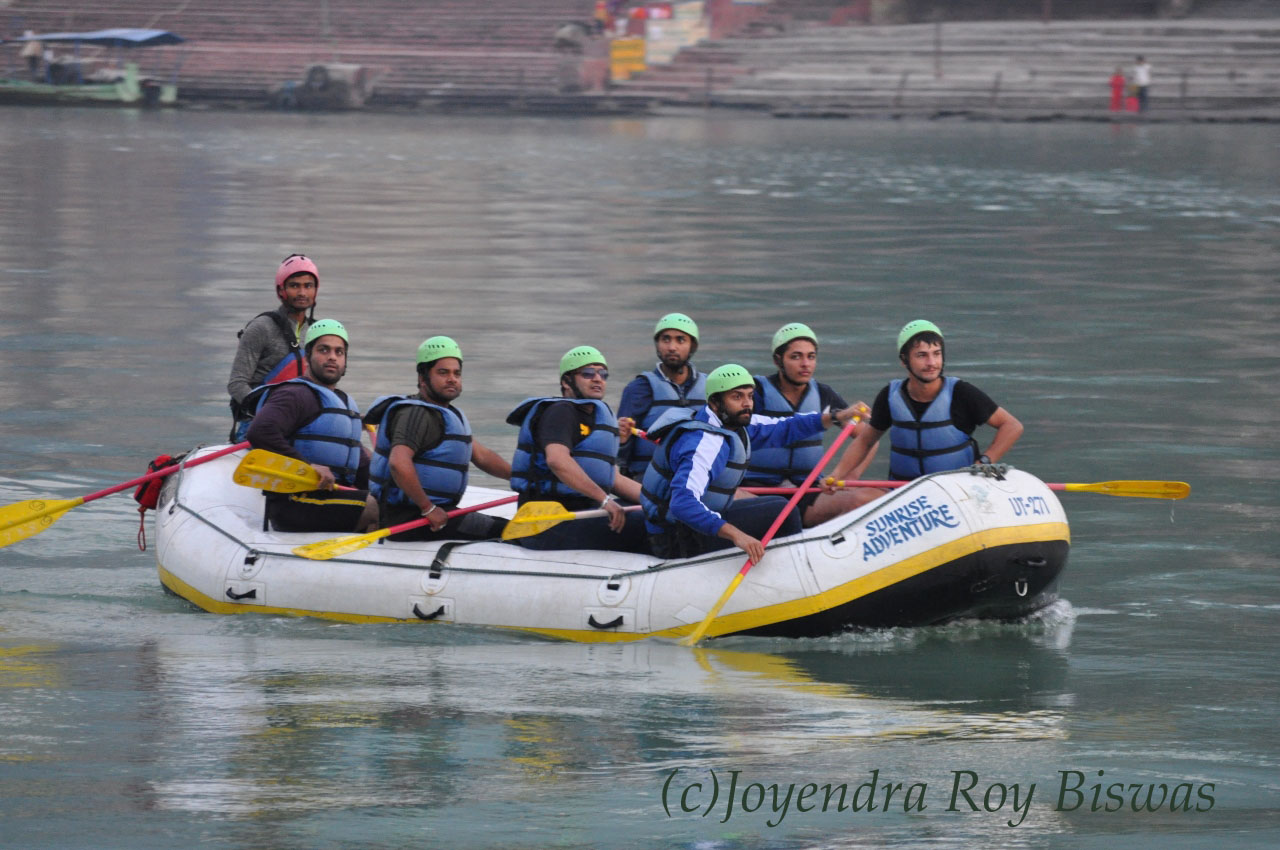
One of the many adventure sports offered in & around Rishikesh - Rafting
Rafting – Taking advantage of its’
unique position, being situated at the foothills of the Himalayas, as the Ganges snakes down the Himalayas into the Indian
planes, it offers perfect white rapids for rafting. Flanked by snow and tree
covered mountains, the rapids are of varying intensity; perfect for novices as
well as rafting pros. Plunging from the Himalayan glaciers, the River Ganga
promises adrenalin-gushing adventure and complements it with a superb
view. River Rafting in Rishikesh is for everyone. From short
rafting tours to rafting journeys laced with activities like mountaineering,
rappelling, and camping, Rishikesh has something to offer to all adventure
seekers desire. Tourists looking for a thrill in their holiday can take a
half-day rafting tour at rapids of grade level I & II, while the pros can
spend an entire weekend camping and exploring each of the 16 rapids. Tour
operators offer all-inclusive packages for adventure seekers including rafting,
camping, mountaineering and more in a 3-night stretch. Most tour operators can
be found online and offer good deals. Rapid
is most tame at Brahmpuri that has Grade II rapids. The stretch between Kaudilya and Rishikesh at
about 36 kms is the longest stretch and is home to grade IV & V level
rapids, making it the most difficult stretch in the entire rafting route. Each rapid has a unique and interesting name.
There are the benign ones like Sweet Sixteen and Double Trouble, which can be
enjoyed by the entire family. Then there are the likes of adrenalin pumping
Golf Course, The Wall, and Roller Coaster, traversed by rafting junkies.
Amongst these, the Wall, which falls in the Kaudilya-Rishikesh stretch of the
rafting zone, is considered the most dangerous and challenging rapid.
Here is the link to the video of performance of Ganga Aarti in Rishikesh -