A short visit
to Rajaji National Park – Chilla range
A Golden backed woodpecker inside the TRH Chilla
We were struck up and could not
undertake any short trips due to certain difficulties in my home front. However, we got a short window of about a few
days and I had to plan for a destination that could be reached overnight or
across a day and after visiting the destination for a day, return back the next
day. After much research, I zeroed in on
Chilla range of Rajaji National Park. It
is situated in Haridwar District of Uttarakhand and is about 220 odd kilometres from Delhi and
further lies about 8 Kms. from the Hardwar Railway Station. The distance was doable within about five
hours and in case of any exigency I could rush back at home quickly. Being a reserve forest, it was an ideal
location for us, to be away from the hustle and bustle of city life for some
time. For the trip to fructify, the
foremost requirement was to identify a suitable place to stay at the location
and also to find out if any accommodation was still available. There are only two good boarding &
lodging arrangement within the precincts as well as periphery of the Park
vicinity i.e. the Forest Rest House and the other one is the Tourist Rest House
run by Garhwal Mandal Vikas Nigam Ltd. (GMVN for short). By luck I could source a family room in the
GMVN run facility, as the Forest Rest house was fully booked.
A map showing location of Rajaji National Park, Chilla (sourced from net)
The outer gate of TRH, Chilla
Inside wide-angle view of TRH, Chilla
View of water canal formed by the barrage behind TRH, Chilla
A Cormorant looking for fish in the canal behind TRH, Chilla
We
started in the morning at around 7.30 A.M, which was quite late by our
standards, considering the fact that whenever I visit my summer pad in
Ranikhet, we usually start at around 6.00 A.M sharp.But as the distance was about more than a 100
Kms. less and coupled with the fact that the present drive did not require any
hill driving, we were quite comfortably placed.The road from Delhi to Meerut was excellent, being newly constructed, by
using the bye-pass we were able to make quick progress upto Meerut.Thereafter, the road was again congested and
the journey, time consuming.Around
10.00 A.M we reached Muzzafar Nagar and had our first break for B’fast at
Bikanerwala, which is very conveniently placed, right on the highway, with
ample parking space.The restaurant
offers great food and there is a wide variety to choose from and the public
utilities are well maintained and is a most suitable spot to drop in for a
short break.Having, had our fill we
proceeded further and reached Haridwar after negotiating another bottleneck at
Roorkee.Having reached Haridwar, we
overshot the cut which led to the destination and instead manoeuvred our car
towards the barrage entry and were rightly guided back to take the cut from
road that leads towards Chandi Devi temple and we finally reached Chilla at
around 3.00 P.M.Thereafter, having made
ourselves comfortable in our rooms, we ordered some snacks and really enjoyed
them, the food per se was quite delicious in the GMVN run Tourist Rest
House.Having had our tea and snacks, it
was time to call up Viru Negi to check out about the next day’s safari booking
for visiting Rajaji National Park.Late
in the evening he turned up in his Jeep and after dropping his guests for the
day, we had tete a’ tete and I sought the afternoon safari for the next
day.During the period that I waited for
Viru Negi ji to make an appearance, I strolled along the canal formed due to
barrage across the Ganga River and could spot quite a few birds around the TRH
complex itself and shot photographs using my camera and am sharing with you all
in my blog.
A Buzzard flying by at the birding spot near Chilla
Some Cormorants flying across in the sky avboe
Bahminy Shelduck in Ganga in the birding spot near Chilla
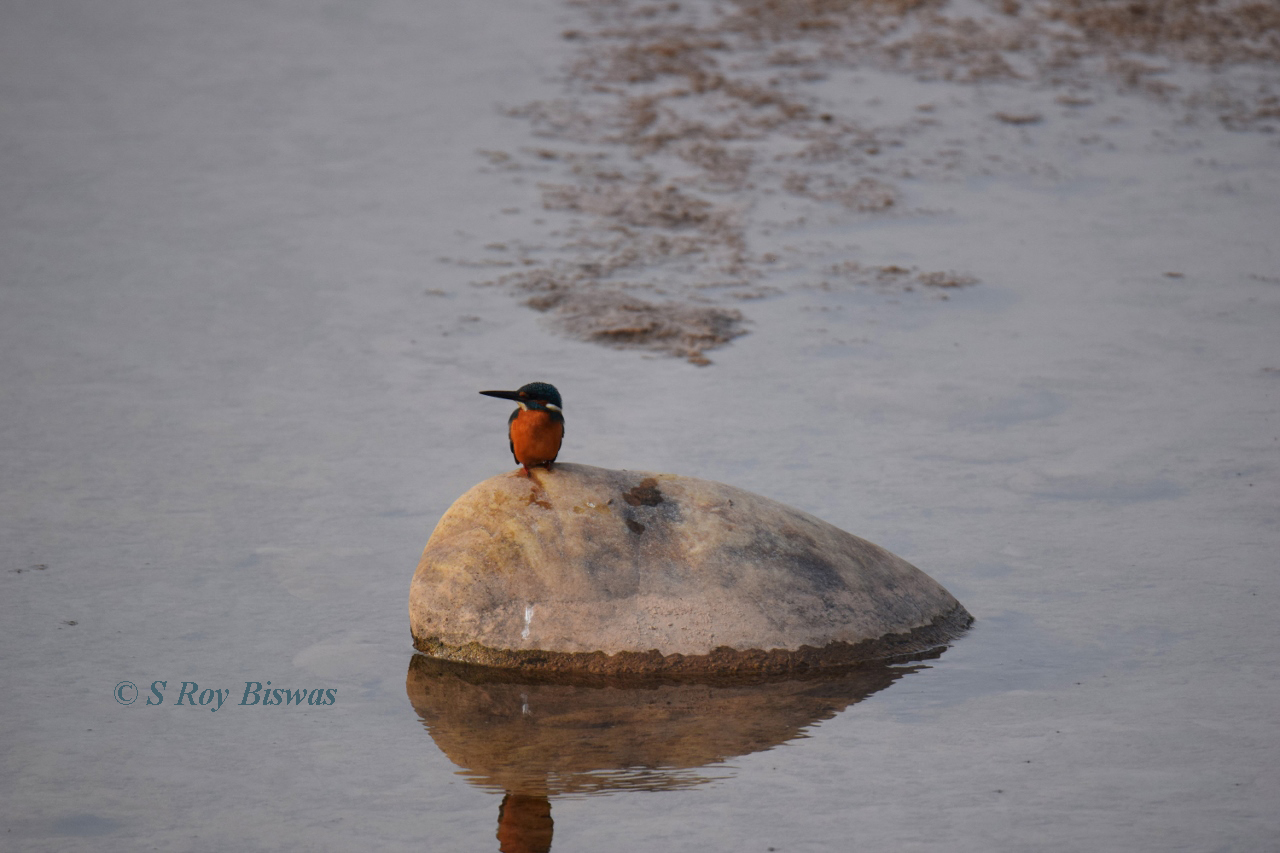
A Common Kingfisher in the birding spot near Chilla
New day morning
while I was strolling with my camera along the side of TRH, another local bird
enthusiast approached me and gave me some information about another birding
spot in the locality and we drove up to the destination and shot a few birds
with my camera, accompanied by my Son and daughter. Thereafter, we returned back to have lunch
around 1.30 P.M and were thereafter, picked up by Viru Negi ji for our
afternoon safari at around 2.30 P.M, since the safari began at 3.00 P.M. The Rajaji National Park is situated along the hills
and foothills of Shiwalik ranges in the Himalayan foothills within the Shivalik
biosphere. Historically speaking, there used to be
three separate wildlife sanctuaries namely – Rajaji Wildlife Sanctuary
established in 1948; Moticur Wildlife Sanctuary established in 1964; and Chilla
Wildlife Sanctuary established in 1977.
In the year 1983 all these three reserves were all combined to create
one body named as the Rajaji National Park and in the year 2015 it received the
status of a Tiger Reserve. It is named
after Sri C Rajagopalachari – the first Governor General of free India. Spread across more than 800 Sq. Km., with
altitude spanning from 330 to 1350 meters, it is a fairly large park that is
adjacent to the holy cities of Hardwar, Rishikesh and Dehradun in Uttarakhand. Chilla Reserve is situated next to the
hydropower plant. So one can see a
branch of Ganga flowing here, with many seasonal rivers merging into it. In fact, the GMVN guest house is located on a
narrow strip of land where one such seasonal stream meets the Ganga.
A Golden backed woodpecker inside Chilla range
Terai like grasslands inside the Chilla range
Huge Sal trees and other trees inside the forest in Chilla range
A Back shouldered Kite inside the Chilla range
A Siberian stonechat inside Chilla range
A male Chital or Spotted deer inside Chilla range
A small portion of the holy River Ganga flows for about 24 km
within the park precincts. Other small seasonal rivers or rivulets join it at
various places within the reserve forest. However, we could only see some dry River beds
across the reserve, through which our jeeps drove through during the
safari. The
area is covered with diverse forest types ranging from semi-evergreen to
deciduous and from mixed broad-leaved to terai like grassland and has been
classified as Indus-Ganges Monsoon Forest type. Lofty strands of Sal dominate
in many parts of this forest range giving it a surreal feeling, as the evenings
set in.
Pug mark of both Elephant and a leopard inside Chilla range
A watch tower inside the Chilla range
A Mountain Hawk Eagle inside the Chilla range
A juvenile Sambar male inside the Chilla range
A Sambar female inside Chilla range
Rajaji
is home to a plethora of avian species, which are found in forested foothills
and in open grassland. The location of
this reserve forest being in a transition zone between temperate western
Himalaya and central Himalaya enhances the species diversity and consequently
the viewing prospects of a large number of birds that inhabit this broad
spectrum. As per the official website, the Rajaji's checklist has about 400
bird species and includes good birds like Greater Scaup, White-naped
Woodpecker, Great Hornbill, Black-bellied Tern, Pallas's Fish Eagle, Northern
Goshawk, Black-necked Stork, Yellow-billed Blue Magpie, Scaly Thrush,
Snowy-browed Flycatcher, Rusty-flanked Tree-creepers, Pale-footed Bush Warbler,
Tytler's Leaf Warbler, Green Avadavat and Reed Bunting. Apart from this, the National park is
best known for is its elephants. I had always heard about herds of elephants
roaming freely in the region that one can come across while driving through the
forest, but it was not to be in our case. In fact, this is the identified North
Western end of Elephant corridor in India. If you travel further North or West
from here, you would not find any wild elephants.
A male Peacock inside Chilla range
A female Red Jungle fowl inside Chilla range
A White breasted Kingfisher inside Chilla range
A Woolly necked Stork inside Chilla range
Sambhar deer - both male & female inside Chilla range
The safari charges are quite
reasonable with a Jeep Safari of two and half hours duration costing around
Rs.3,500/- with guide, but may vary from season to season.As the winters had yet to pass and the
weather was not very clear and being quite cold early in the morning, I
preferred an afternoon safari.The
afternoon safari starts at about 3.00 P.M and ends at about 5.30 P.M and one
can book it in advance or get one at the entry gate itself, if the rush is
less.I, on the other hand, was able to
establish contact with one of the well-known guides operating in the Rajaji
National Park and is quite well acquainted with all the portions of the
park.I had contacted him over phone and
he was courteous enough to arrange for the entire safari for us and his name is
Viru Negi (Mobile No.+91-9917606031).He is a very nice person and anyone interested can contact him directly
on this mobile.The safari itself is
better than that of Corbett in respect of time and distance covered, albeit
there are fewer Tiger sightings in the region.We got to see a lots of deer, birds including Jungle fowls and by the
time as the evening set in, we could hear alarm calls of Langurs and Sambars,
but could not sight any Tiger nor any Elephants to speak of.By the time we were returning back, it had
become literally cold and we were also famished, as the Park authorities do not
allow any packed food items inside the park and rightly so.The photographs shall speak for themselves
about the trip and a short video of the safari inside the park for my viewers –
After the brief stopover at Rudraprayag on our way back
from Syalsaur, we imbued the glimpse of the River Ganges and the mesmerizing
valleys cocooning it, one last time, before returning back to the nature
ravaged city life.We stopped at the
same small eatery, this time also before reaching Devprayag and had some snacks
etc. and a nice hot cup of Coffee.Thereafter, we boarded our Car and began the last leg of our journey,
which was uneventful till we actually reached Haridwar.In Haridwar, in order to locate headed for the
Hotel where in had made the booking.As
the town of Haridwar had grown immensely over the years and we could not trace
out the once familiar land marks, we used the Google map, which confounded us
further through its messages and finally after resorting back to the old, tried
and tested method of asking the local Rickshaw wallahs for directions, we
finally reached our destined Hotel in Haridwar at about 3.00 P.M.After checking in and thereafter partaking
some light snacks and coffee, we prepared for attending the evening Ganga aarti
that commences at 6.00 P.M.
As the River Ganga meanders towards the plains, so does the road running alongside
Haridwar, whose literal meaning would be ‘Gateway of
Gods’ is one of the oldest surviving human habitations on Earth.It has
been proved by archaeological findings that terracotta culture was existing in
this region of in & around Haridwar during 1700 B.C. and 1800 B.C. Historically,
this region was ruled by Maurya Empire from 322 BC to 185 BC and later it
came under the rule of Kushan Empire. The place also finds mention in the
treatise of ancient Chinese traveler Huen T’sang, who had visited India in 629
AD. At that time Haridwar was part of the kingdom of the King Harshvardhan (590
to 647). The city was also invaded by Timur Lang (1336–1405), a Turkish King on
January 13, 1399. First Sikh Guru, Guru Nanak (1469–1539) bathed at the famed
'Kushwan Ghat' on Baisakhi Day. Later in the 16th century Haridwar came under reign
of Mughals and emperors like Akbar and Jehangir stamped their domination here.
According to Ain-e-Akbari Mughal Emperor, Akbar drank water from the Ganges
River collected from Haridwar, which he called 'the water of immortality'.
The cold evening has set in and River Ganga flows by Haridwar
The congregation waits on banks of River Ganga for the Aarti to start in Haridwar
Mythologically also Haridwar finds mention in many of
the ancient Hindu scriptures, according to Kedarkhand of Skanda Purana, the ancient great
King named as Shwet did long penance on the bank of river Ganges at Haridwar.
The Brahma pleased with his devotion & blessed that the place will be
special place with blessing from all gods and bathing here will be very
fruitful to devotees. Raja Vikramaditya's brother Bhratuhari has also done
penance here. In his memory, King Vikramaditya built a “Paudi (pawadi)”/ step
way here, which later became famous as Har Ki Paudi or Har Ki Pauri. Apart from
this Guru Datatrey had also spent great amount of time here in meditation.
Haridwar is mentioned in various other ancient Indian scriptures of Purans,
Upanishads and Mahabharata, where it finds mention as a Mayapur, Kapilsthan,
Mokshdwar or Gangadwar. In Mahabharata great sage Dhaumya had also mentioned
Haridwar (Gangadwar) as a major pilgrimage town to Yudhisthira. Sage Kapila also lived here in an ashram, so
this place was also known as Kapilsthan. The tradition which was established by
King Bhagirath is now followed by thousands of Hindu devotees, who bring the
ashes of their departed family members, in hope of their salvation by the water
of river Ganges.
The preparations for the evening Ganga Aarti have begun on ghats of Hridwar
The Ganga Aarti begins on ghats of Haridwar
An interesting aspect of the Pandits (Priests) of the
Haridwar is that they have kept the genealogy records of most of the Hindu
population, which is maintained in hand written vahis (hand crafted note books).
These records are updated on each visit to the city by the families and are a
repository of vast family trees of family in entire India. Further, it is
believed that the nectar (Amrit), which was one of the fourteen valuable condiments
that came out during the churning of the Sea by both the Devas & Ashuras
i.e. Samundra Manthan, this nectar was sprinkled at 12 places in the entire
universe. Out of that 12 places 08 places are in heaven and only 04 places on
earth. Har-Ki-Pauri
in Haridwar was one of the four places where Amrit was
sprinkled on mother earth. As a result, every 12 years Khumbh Mela comes to
Haridwar by turn as it is also held at other three places of Ujjain, Allahabad
(Sangam) and Nashik and draws immense crowds. The Ardha Kumbha Mela comes
once in every six years.
The pandits offering sacred lamp for seeking blessings after Ganga aarti in Haridwar
Accordingly, the Ganga aarti held at Har ki pauri has
both historical and mythological importance as explained hereinabove.However, the Pandas have now made it into a
money spinning exercise, as they try to extort money from pilgrims on premise
of keeping the banks/ghats of Ganga River clean, stating that the local
municipality does not contribute to its up-keep.We dodged past these vermin’s and proceeded
to watch the Ganga Aarti, where I found the priests being loud and uncivilized
while interacting with both foreigners and Indian devotees.However, I took cover under a stair case and
filmed the proceedings, which it appears is losing its sheen, as it is
performed in same manner as it was performed 10 years ago or even twenty years
ago, juxtaposed to the innovation that is taking place in Rishikesh, akin to
Varanasi aarti.After enjoying the Ganga
Aarti at Haridwar and having had some delectable sweetmeats on the way back to
Hotel, we wrapped up our winter vacations for the year.
Evening aarti taking place in adjoining temples on Ganga banks of Haridwar
Haridwar, Rishikesh & Neelkanth - a short excusion
The famed clock tower in Haridwar
Haridwar - Haridwar is approximately 210 Kms. from Delhi and around 5 hours drive from Delhi. Ithas been ahot bed of Hinduism over the eons and even it's name elicits strong response from its followers, whereas Shivaites (Har)prefer to call it Hardwar, followers of lordVishnu (Hari) prefer to call it as Haridwar. At Haridwar you can watch the confluence of Hindus coming from all over the country belonging to every strata of Society. Mythologically also it finds mention in the Skand puran and has been referred to as Mayapuri, Kapila and Gangdwar(being the first Cirty to emerge on banks of Ganga when it emerges from the mountains - Himalayas). Terracotta findings in the place establish its existence between the 12th to 17th Century B.C. It is beleived that one drop of Amrit (Elixir of life) spilled over from the Kumbh and fell at Bramhkund in Har ki pairi (footsteps of Lard Vishnu are said to be imprinted here and Ganga touches the feet here) and devouts believe that a holy dip in the river here leads to eternal bliss/heaven and washing away of all their sins. The city is also known for its Mahakumbh which takes place every 12 years, last one being heldin 1998. The evening Aarti of Ganga is a treat to watch and is held during the evening every day.
Evening Ganga aarti in Haridwar
Around Haridwar - Around Hardwar there is the Chandi DeviTemple situated at a hill top opposite Har ki pairi called the Neel Parvat. According to the legend the Commander of the Army of demons called Chanda-Munda was defeated in a battle by godess Chandi and hence the name. Just behind the Har ki pauri on top the hill known as Bilwa Parvat is situated the famous Mansa Devi temple. She is the benefector godess / Adhisthatri of Haridwar and it is said that it is one of the sidh peeth where the heart & navel of Sati fell. The other note worthy visiting sites are Daksh Mahaadev Temple & Sati Kund situated in Kankhal which is 4 Kms. away from Haridwar. Bhim goda tank - 1 Kms. from Har ki pairi. Sapt Rishi Ashram which is around 5 Kms. away from Haridwar on Rishikesh Road where Ganga is said to have split into seven distributaries so as not to disturb the seven Rishis meditating there.
Panoramic view of Mansa Devi temple
Rishikesh - is situated 30 Kms. upstream from Haridwar. The place is associated with lord Ram who is said to have done penance here on advise of sage Vashistha before embarking on his mission to kill Ravana. Mythologically it is beleived that after long penance by sage Rabiya Rishi, god named Hrishikesh appeared before him and the place derives the name from this. It is the starting point for the Char dham yatra in Uttranchal. There are many ashrams in the vicinity of this quaint township.
View of River Ganga in Rishikesh
Neelkanth Mahadev - is 32 Kms from Rishikesh and is connected by Taxis which run on shared basis as well as can be hired individually. The place derives its name from the mytholigical event of Samudra Manthan wherein the venom/vish generated during the manthan /churningwas gulped down by Lord Shiva and held in his throat (Kanth in hindi)because of which his body turned blue (Neel in hindi) and hence the place is known as Neelkanth. The temple situated here boasts of South India style architecture and has a huge silver Shivling situated inside.
With the arrival of the auspicious day of Akshya Trithiya the doors to the famous temples of Yamuntori, Gangotri and Kedarnath open every year and the doors to Badrinath opens only thereafter. With the opening of the three temple gates on a single day, an occassion which has come after many years, the doors to the Himalayan kingdom of Uttaranchal is now open to the pilgrims for ablution of their sins and penance for getting rid of the karma cycle. The journey commences with arrival of the pilgrims to the holy city of Haridwar. The literal meaning of the word 'Haridwar' is 'Hari ka dwar' or 'gateway to abode of Gods'. Haridwar is the first corridor where the holy river Ganges emerges in to the plains from its mountainous abode. Every evening Aarti or invocation of the river Goddess is performed with aplomb at 'Har ki pairi' which literally means 'Feet of the lord'. Haridwar is well connected by rail network as well as by road and is about 230 Kms. from Delhi via Meerut, Khatauli, Roorkee etc. There are many small dharmashalas and hotels available at Haridwar which suit all kinds of budgets.
Panoramic view of Rishikesh - Gita Bhawan across Ganga
The next stoppage after Haridwar is Rishikesh which is another 27 Kms. from Haridwar and is the actual launching pad for onward journey to the Gharwal Himalayas. The Gharwal Nigam Vikas Mandal, GMVN for short has a tourist office here and during the yatra period advance bookings as well as spot bookings are undertaken by them for packages to any one, two, three or all four destinations that are covered under the Chardham yatra pilgrimage. Busses, shared taxis/jeeps etc. are also available for hire for the Chardham Yatri from this place. Rishikesh is home to many famous temples as well as shops selling curios.
Ananda Resort at Kanatal
Chardham Yatra is usually performed starting from the westernmost Yatra and then proceeding on to the Easternmost destination. Accordingly, the first Yatra destination is the Yamunotri. It is considered sacred to Hindus as it is considered to the source of mighty river Yamuna, named after daughter of Yam or God of death. From Rishikesh the journey commences and passes through Narendra Nagar (at a distance of 16 Kms. from Rishikesh), Chamba (62 Kms.), Dharasu mor/bend (120 Kms.), Bramhakhal, Barkot (175 Kms.), Syanachatti (204 Kms.) and Hanumanchatti (209 Kms.) - which is the final motorable road head on this circuit. Since the roads are not very good, it is advisable to restrict ones journey to within 150 Kms. per day to avoid over exhaustion. The GMVN has many small rest houses/hotels enroute for overnight stay which may be booked in advance. After reaching Hanuman Chatti one can hire the local jeeps which can travel another distance of 12 Kms. upto Janiki Bai Chatti (2576 meters) via Phool Chatti and this torturous journey will take upto 1 hour 15 minutes depending upon road conditions, like overnight rains etc. From here one can either trek for the remaining 7 Kms. upto Yamunotri (3323 meters) or else hire ponies, dandies or palkis and rates are displayed on the board but usually higher rates are quoted and one has to do a bit of haggling and bargaining to get the right price.
Bridge across Yamuna - just after crossing Barkot
Yamuna at Syana Chatti
River Yamuna at Hanuman Chatti
As the journey begins at Janki Chatti
The road to Yamunotri - narrow and clinging to the mountain side
The Bandarpoonch range seen from Yamunotri
The famed Yamunotri temple
Prasad of rice & potatoes being boiled in hot springs in the temple complex
Panoramic view of the famed temple & Bandarpoonch range in background