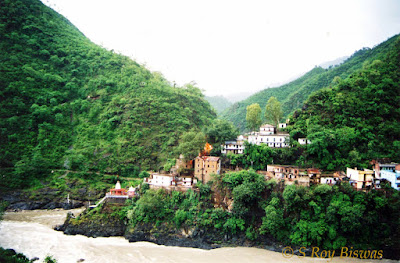
After the brief stopover at Rudraprayag on our way back
from Syalsaur, we imbued the glimpse of the River Ganges and the mesmerizing
valleys cocooning it, one last time, before returning back to the nature
ravaged city life.We stopped at the
same small eatery, this time also before reaching Devprayag and had some snacks
etc. and a nice hot cup of Coffee.Thereafter, we boarded our Car and began the last leg of our journey,
which was uneventful till we actually reached Haridwar.In Haridwar, in order to locate headed for the
Hotel where in had made the booking.As
the town of Haridwar had grown immensely over the years and we could not trace
out the once familiar land marks, we used the Google map, which confounded us
further through its messages and finally after resorting back to the old, tried
and tested method of asking the local Rickshaw wallahs for directions, we
finally reached our destined Hotel in Haridwar at about 3.00 P.M.After checking in and thereafter partaking
some light snacks and coffee, we prepared for attending the evening Ganga aarti
that commences at 6.00 P.M.
As the River Ganga meanders towards the plains, so does the road running alongside
Haridwar, whose literal meaning would be ‘Gateway of
Gods’ is one of the oldest surviving human habitations on Earth.It has
been proved by archaeological findings that terracotta culture was existing in
this region of in & around Haridwar during 1700 B.C. and 1800 B.C. Historically,
this region was ruled by Maurya Empire from 322 BC to 185 BC and later it
came under the rule of Kushan Empire. The place also finds mention in the
treatise of ancient Chinese traveler Huen T’sang, who had visited India in 629
AD. At that time Haridwar was part of the kingdom of the King Harshvardhan (590
to 647). The city was also invaded by Timur Lang (1336–1405), a Turkish King on
January 13, 1399. First Sikh Guru, Guru Nanak (1469–1539) bathed at the famed
'Kushwan Ghat' on Baisakhi Day. Later in the 16th century Haridwar came under reign
of Mughals and emperors like Akbar and Jehangir stamped their domination here.
According to Ain-e-Akbari Mughal Emperor, Akbar drank water from the Ganges
River collected from Haridwar, which he called 'the water of immortality'.
The cold evening has set in and River Ganga flows by Haridwar
The congregation waits on banks of River Ganga for the Aarti to start in Haridwar
Mythologically also Haridwar finds mention in many of
the ancient Hindu scriptures, according to Kedarkhand of Skanda Purana, the ancient great
King named as Shwet did long penance on the bank of river Ganges at Haridwar.
The Brahma pleased with his devotion & blessed that the place will be
special place with blessing from all gods and bathing here will be very
fruitful to devotees. Raja Vikramaditya's brother Bhratuhari has also done
penance here. In his memory, King Vikramaditya built a “Paudi (pawadi)”/ step
way here, which later became famous as Har Ki Paudi or Har Ki Pauri. Apart from
this Guru Datatrey had also spent great amount of time here in meditation.
Haridwar is mentioned in various other ancient Indian scriptures of Purans,
Upanishads and Mahabharata, where it finds mention as a Mayapur, Kapilsthan,
Mokshdwar or Gangadwar. In Mahabharata great sage Dhaumya had also mentioned
Haridwar (Gangadwar) as a major pilgrimage town to Yudhisthira. Sage Kapila also lived here in an ashram, so
this place was also known as Kapilsthan. The tradition which was established by
King Bhagirath is now followed by thousands of Hindu devotees, who bring the
ashes of their departed family members, in hope of their salvation by the water
of river Ganges.
The preparations for the evening Ganga Aarti have begun on ghats of Hridwar
The Ganga Aarti begins on ghats of Haridwar
An interesting aspect of the Pandits (Priests) of the
Haridwar is that they have kept the genealogy records of most of the Hindu
population, which is maintained in hand written vahis (hand crafted note books).
These records are updated on each visit to the city by the families and are a
repository of vast family trees of family in entire India. Further, it is
believed that the nectar (Amrit), which was one of the fourteen valuable condiments
that came out during the churning of the Sea by both the Devas & Ashuras
i.e. Samundra Manthan, this nectar was sprinkled at 12 places in the entire
universe. Out of that 12 places 08 places are in heaven and only 04 places on
earth. Har-Ki-Pauri
in Haridwar was one of the four places where Amrit was
sprinkled on mother earth. As a result, every 12 years Khumbh Mela comes to
Haridwar by turn as it is also held at other three places of Ujjain, Allahabad
(Sangam) and Nashik and draws immense crowds. The Ardha Kumbha Mela comes
once in every six years.
The pandits offering sacred lamp for seeking blessings after Ganga aarti in Haridwar
Accordingly, the Ganga aarti held at Har ki pauri has
both historical and mythological importance as explained hereinabove.However, the Pandas have now made it into a
money spinning exercise, as they try to extort money from pilgrims on premise
of keeping the banks/ghats of Ganga River clean, stating that the local
municipality does not contribute to its up-keep.We dodged past these vermin’s and proceeded
to watch the Ganga Aarti, where I found the priests being loud and uncivilized
while interacting with both foreigners and Indian devotees.However, I took cover under a stair case and
filmed the proceedings, which it appears is losing its sheen, as it is
performed in same manner as it was performed 10 years ago or even twenty years
ago, juxtaposed to the innovation that is taking place in Rishikesh, akin to
Varanasi aarti.After enjoying the Ganga
Aarti at Haridwar and having had some delectable sweetmeats on the way back to
Hotel, we wrapped up our winter vacations for the year.
Evening aarti taking place in adjoining temples on Ganga banks of Haridwar
As we started
our return journey back from Syalsaur, I had made it a point to revisit
Rudraprayag (having visiting the famed destination way back in June, 2001 –
here is the link to my previous blog - https://ghummakar-biswas.blogspot.com/2011/12/towards-badrinath.html).Having traversed a few kilometres we had
reached Agastmuni, although very few travellers stop by this holy township that
is named after the Sage who goes by the same name and there is a temple
dedicated to him in this township.However, we too did not stop here as we had to reach Haridwar before
commencement of the evening Ganga Aarti there.
Going past Agasthmuni
Rudrapryag from other side - shot during my visit in 2001
Close up of Rudraprayag from the town side - shot during my visit in 2001
Rudraprayag from the opposite side of the town - shot in 2018
Rudrapryag is at a distance of about
19 Kms. from Agastmuni township and the road runs along the tranquil Mandakini
River that emanates from the Kedarnath region.
Rudra Prayag is a small township that is located in the state of
Uttarakhand and in the district that goes by the same name. The town is
situated at the confluence of the River Alaknanda and River Mandakini, perched
at an altitude of 610 meters. Some locals describe the place, as where the two
rivers resembling like two sisters embrace each other and there is a quaint mystery
about the place. The entire district is
steeped in immense natural beauty and one can visit many a famed holy
destinations other that trekking destinations encompassing lakes, glaciers,
rivers and streams here. There are a few temples that are located in the town
as well and these are a must visit while travelling to Rudra Prayag. The main temple that sits at the confluence
is known as Rudranath temple that is dedicated to Lord Shiva and the town also
gets its name from the same. The
township is all the more important for the Chardham Yatra as it is the
destination wherefrom the road splits towards Kedarnath, after crossing the
bridge across Alaknanda River and the other road, after crossing the township,
heads straight towards Badrinath along the Alaknanda River.
As the Mandakini flows in from Kedarnath side at Rudraprayag
Rudraprayag the confluence of Mandakini & Alaknanada Rivers
The close-up shot of Rudraprayag confluence - Alaknanda & Mandakini meeting
A panoramic view of Rudraprayag
As the River Ganga meanders amongst the hills
We gradually head back towards the plains of Haridwar
Mythology
of the region states that the Narad Muni (a holy
sage) has meditated and prayed for years together to please Lord Shiva so as to
gain expertise in music. Through his
dedicated worship, Lord Shiva was pleased to bless him and appeared before
Narad Muni in his ‘Rudra Avtaram’ (a fierce form of Lord Shiva) at this
confluence and the temple was built and dedicated to Lord Shiva since. The confluence of Alaknanda with Mandakini is
one of the holiest of confluences amongst the ‘Panch Prayag’ (Holy confluences
of holy River Ganga) and the others being Dev Prayag (wherefrom Ganga River
emerges as one and is considered as the holiest) followed by Nandprayag
(confluence on Alaknanda and Nandakini Rivers the latter emanating from the
Nanda Devi glacier), Karanprayag (this
confluence is of Alaknanda and Pidar Ganga Rivers and the latter emanating from
Pindari glacier) and Vishnuprayag (the confluence of Alaknanda with Dhauli
Ganga River and the latter emanates from the Niti pass region). Having spent some time trying to get some
shots of the confluence albeit across the light, we headed back towards the
plains for our next halt for the night i.e. Haridwar.
Kartik Swami temple – a platform for viewing
Himalayan vistas
The majestic view of the Himalayan ranges as seen from Kartik Swami temple
I had read about this destination with awe and had seen
the photographs of the spectacular vistas of Himalayan ranges on the
internet.Accordingly, visiting Kartik
Swami temple was the last, but not the least in order of priorities for
me.I had kept this trek for the last
leg, so that even if we got tired, it would be the last trek of the trip.Having visited Deoriatal the previous day and
that being a tiresome journey, sans any food etc. we all got up late in the
morning, including the driver.The
ladies of the group i.e. my wife and daughter had started mumbling and
grumbling about the trek to Kartik Swami temple, when they heard that it was a
3 km. trek one way.Therefore, I had no
other option than to drop them at Syalsaur and my Son also volunteered to stay
back with them.Thus, I visited the
famed Kartik Swami temple on my own.
View of Kedarnath peaks from Syalsaur as we start for Kartik Swami temple
As the road construction activity is underway the vehicles stop on either side
Going past Mohan Khal en-route Kartik Swami temple road
Katik Swami temple is a small temple dedicated to Lord
Kartik, son of Lord Shiva & Parvati, placed on a ledge that offers 270º
view of the Himalayan ranges.It can be
reached by trekking for 3 Kms. from a nondescript little village called
Kanakchauri.This village can be
accessed both from Rudraprayag as well as a small village called Banswara on
Kedarnath Highway, about a kilometer from Syalsaur.Kanakchauri village is about 40 kms from
Rudraprayag on the Rudraprayag - Pokhari route, whereas from the road at
Banswara, it is about 37.9 Kms. from Syalsaur.This road is a narrow and due to ongoing road construction work for
another road, connecting some of the villages in the hills, which was taking
place, due to displacement of rocks in the process, we had to wait mid-way for
about 45 minutes or so.But this road
being used mainly by the local villagers falling in this route, namely – Gair,
Kanyas, Akauri etc., till one reaches Mohankhal, which is the nodal point wherefrom
the road from Pokhri meets, it is a smooth ride with very few vehicles
traversing along this road patch.Kanachauri
village can also be approached from Karanprayag, which is about 40 Kms. from
Pokhri and it is another 15 Kms. from Pokhri to Kanakchauri.
Terraced fields and small villages perched on mountainsides en-route Kartik Swami temple
First view of the Kanakchauri village and ridge astride which is the famed Kartik Swami temple
The first view of Chaukhamba massif on trek route to Kartik Swami temple
Kanakchauri village is a very small village and total
length would not exceed 150-200 meters along the main road, wherein numerous
shops catering to local requirements as well as eateries dedicated to tourists
run shop. In case of heavy rush of
tourists, there is not ample space available and the road, being quite narrow,
parking is definitely a problem here.
The Mayadeep group has a reasonable rest
house constructed mainly with bamboo here and they quote a price of Rs.2000/-
per night for each such bamboo hut.
However, I have come across blogs wherein it has been claimed that
bargaining can give you a good deal of around Rs.800/- per room per night also
during lean seasons. The trek route for
the famed Kartik Swami temple is easily identifiable by a gate constructed on
the road side leading towards the trek route.
Although, there are no sight to any Himalayan peaks visible from the
village road itself, but a few hundred meters upward trek would make them
visible. The trek route is about 3 Kms.
and takes about two hours’ time at a medium pace and the trek runs through a
pleasant and virgin Oak and Rhododendron forest and the stillness is broken
only with a twig or two breaking under your shoe or that of a bird chirping
somewhere in the canopy and the gradient is moderate.
A Nuthatch bird on trek route to Kartik Swami temple
The description hoarding on trek route to Kartik Swami temple
The hut of the temple priest of Kartik Swami temple
A display poster erected by Uttarakhand Tourism near Kartik Swami temple
Nestled in
the Garhwal Himalayas at an altitude of 3048 meters (about 10,000 ft) in the Rudraprayag
district of the State of Uttarakhand is the temple of Kartik Swami. Kartik
Swami temple is perched on a spur of a ledge, in a serene and beautiful
location, that provides a spectacular panoramic view of some of the highest
mountains peaks of the Himalayan ranges in India. The snow laden peaks of Bandar punch are
visible to the west. In addition, the peaks of Kedar Dome, Meru,
Kedarnath, Neelkanth, Trishul, Nanda Ghunti and Nanda Devi group of peaks are
also visible from Kartik Swami. The main attraction of Kartik Swami is the
mighty Chaukhamba peak which appears, as if as, it is framed as the temple’s
background. En-route, just before you
take onto the huge stone steps for the final assault on the ridge to reach the
temple top, is the home of the priest of the temple, who stays in a basic
concrete house (an ashram), which is less than 1 km before the temple and he will
accompany travelers/devotees to the temple, if required. There is something mystical about Kartik
Swami temple trek, as on the way you find broken bangles and vermillion
(sindoor) all along the path made as offerings, while the temple complex has a
lot of bells hanging around it. The ever
interrogative mind of mine was getting vexed to know about the mythology of the
place and hence I made some research on the internet, searching for answers to
my query.
The pen nib like peak_Janhukoot peak as seen from Kartik Swami temple
Panoramic view of the famed Kartik Swami temple
The main temple doorway of Kartik Swami temple
The idol of Lord Kartikey in Kartik Swami temple
The mighty Chaukhambha peak as seen from Kartik Swami temple
Mythological anecdotes relate this place to Lord Kartik
Swami, who is the elder brother of Lord Ganesha and according to Hindu
mythology, he is considered as “God for War and Victory.” He is also known as Murugan Swami in Tamil
Nadu, Subramanya in Andhra Pradesh and Karnataka and Kartikeya in Bengal. The
temple encompasses an idol of Lord Kartik Swami carved on a marble rock.According to Hindu mythology, Lord Shiva (the
destroyer) told his sons Ganesha and Kartikeya that one of them, who will be
the first to take seven rounds of the universe will have the privilege of being
worshiped first.Ganesha took seven
rounds around Shiva and Parvati, stating that he saw the Universe in them, while
Kartikeya faithfully circled the universe. Impressed by Ganesha, Lord Shiva
gave him the honor of being worshipped before anyone else. While Lord Kartikeya
was taking his final round, he encountered Narada Muni (albeit intentionally),
who informed him that he had been made to look like a fool by circling the
Universe and that Lord Ganesh had already been granted the boon. Angered by this kind treachery, Kartikeya
sacrificed his body and gave his flesh back to his mother Parvati and his bones
to Lord Shiva as an ultimate sacrifice.
As the evening sets in we head back to Syalsaur from Kartik Swami temple
Having visited the temple and spent some quality time
there, we traversed back through the serene trek through the Oak and
Rhododendron tree forest and reached back Kanakchauri in about an hour’s
time.As we were totally famished by
this time, myself and my driver, who had accompanied me to the temple top, ate
some noodles with eggs and tea, which was so sweetened that I could only have
one gulp, before discarding it.Thereafter, as we were about to make our way back, a forest worker
requested for ride upto Mohankhal as he had missed the last bus.We dropped him at his desired destination and
made our way back to Syalsaur and thus, ended my winter sojourn for the year, albeit
visiting a few more destinations on our way back.