A panoramic view of main road & market of Tarikhet
Tarikhet is a big
hamlet, which is the Block headquarters that goes by the same name and
comprises of 134 village Panchayats. The STD code of the destination is –
05966 and PIN code is – 263663.It is at
a lower elevation of about 1500 odd meters above mean sea level and apart from
the Block Development Office, it houses banks, ATMs, a Primary Health
Centre, Govt. Inter College et al. With Indian
independence struggle movement in its credit, Tarikhet is a charming, verdant
and beautiful cute village nearby Ranikhet on the way to I have been away from
writing blogs for a long time and as I am struck down because of the pandemic,
while searching for smaller destinations in the region of the internet, I could
find only some scanty and scattered information.Accordingly, I decided to gather information
and put them on the internet in form of blogs for the readers and hence
starting this series as ‘Nondescript destinations of Kumaon’.In this series, I am starting with Tarikhet
being the nearest township from my village.
A panoramic view of Tarikhet from Gandhi Kutir
Tarikhet is a
charming, verdant and beautiful cute hamlet nearby Ranikhet on the way to
Ramnagar. It is a rather big hamlet, which is the Block headquarters that goes
by the same name and comprises of 134 village Panchayats. It is perched at a lower elevation of about
1500 odd meters above mean sea level, but has salubrious climate the year
round.Being the block headquarters, apart
from housing the Block Development Office, it also has two banks and their
ATMs, a Primary Health Centre, many private run as well as Government run
schools, Govt. Inter College et al. The STD code of the
destination is – 05966 and PIN code is – 263663.
Outside view of the Gandhi Kutir
Close up of the pillar commemorating visit by Gandhi ji
A plaque indicating the Gandhi kutir
Tarikhet is well
known for its association with the Indian independence struggle movement in its
credit.The recognition of Tarikhet and
its association with freedom struggle is attributable to the famous ‘Gandhi Kutiya', a small hut where Mahatma
Gandhi stayed for three days in June, 1929. Tarikhet was the nerve
center for all the activities related to the freedom struggle. This is a must
place to be visited to get the feeling of the history of India and
its independence. This prime attraction is now in a rather neglected
state here, which is the small hut known as Gandhi Kuti, where Mahatma Gandhi,
the great symbol of peace and tranquility and Father of our Nation, stayed once
during the freedom movement. This place is thus,
a symbol of India’s freedom struggle against the British Raj.
However, as you approach this venerated place, the government apathy is palpable
& noticeable straight away. The condition of the approach road is
atrocious, with no maintenance whatsoever. Even more so is the actual
Kutir, which is ceremonially spruced and decked up during the Gandhi Jayanti
etc., as informed by the local residents, or else in case when some local
leaders troop in and make tall claims, only to disappear later. The
staircase is in bad shape, the place where Gandhiji stayed was converted into a
school but the same is now in a state of total disrepair and the locals have
even removed the doors & windows from the building, that sans any kind of
security or periphery wall whatsoever. The statute of Ghandhiji that was
placed inside the Kutir and was on verge of being vandalized, has been kept in
safe custody by the Principal of the local school of Prem Vidyalaya,
Tarikhet.
The statue of Gandhi ji kept in Prem Vidyalaya in Tarkhet
The
place bristles with activities all round the year, with people moving to and
fro in the market or visiting Government offices for their works.The market is spread across both sides of the
State Highway that connects Ranikhet with Ramnagar and is the main market for
local villagers for sourcing their requirements, be it clothes or other day to
day sundry requirements.It houses some
quaint little sweetmeat shops and a few restaurants that cater mainly to local
cuisine.There is a small hotel or
rather a home stay that goes by the name of ‘Pine grove Hotel’ and is situated
in the outer vicinity of the township.The
place also offers an opportunity to visit a temple housing the famed Golu Devta,
the reverend deity of the region and also is home to a small temple dedicated
to Lord Hanuman inside the temple complex.
Thus, this destination
known as Tarikhet, although may not be a destination of great tourist
attraction, but is definitely a quaint and tranquil little destination, where
the nature lover traveler can spend a few days in solitude.
Here is a link to a short video of the destination
Monsoons in
Kumaon – a pictorial display of the mood
As the monsoon clouds drift across the valleys and the mountains
I have had the privilege of growing up in the
hills, having been born and brought up there and also having had my education
up to the middle level, in one of the pristine hill stations of Himachal Pradesh.The hills are a place where one can
experience all the four full seasons, along with the two transitional seasons
of Spring & Autumn, of the natural cycle of seasons.Having now spent a better half of my life in
the plains of Delhi, I can clearly distinguish the difference between the
nature’s glories that spreads its splendour in the hills, as compared to some
drab seasons of Delhi.In the hills, one
can distinguish the seasons distinctly.Starting with Spring, which heralds in after the harsh winters, there is
a nip in the air, but also a distinct feel good factor, as the day temperatures
get steady and pleasant, accompanied by the same, with most of the stone fruit
bearing trees being in full bloom, with flowers of different shades and hues covering
the entire trees and creating an aura of pleasure and happiness all
around.After the gaiety Spring, comes
in the summers that ushers in a feeling of gay abandon.Gone are the heavy woollen clothing and as the
days gete hotter and longer, but bearable and nights are short and sweet. After summers move in the monsoon season or
the rainy season and as the clouds move in, one can experience the intensity of
the rains, which is such that torrents flow through the roads, as if some
seasonal rivulet has sprung forth. This
abundance of water paints forth all the hills in all green and it is one of the
spectacular visual experiences that one can have amongst the four seasons, other
than the winters that is also truly spectacular. Although not a favourite season for the
tourists and thus, only those who stay in the hills enjoy its beauty.The present narration is a pictorial
depiction of the spectacular scenery that unfolds in the hills during monsoons
–
As the rain clouds loom over Ranikhet
The clouds stretch from the plains to the hills - view of Kosi River along Corbett
Tufts of clouds lay scattered across the Ranikhet valley
Clouds drifting in the Nainital valley
Cloud cover all across - view from Bhatrochkhan
A panoramic view of the cloud filled valleys on Naintial
View of the river valley near Garampani in Naintial district
Cloud cover has just lifted - Nainital hills from Bhimtal road
A tuft of cloud suspended mid air - Nainital hills from Bhimtal road
Just after a fresh bout of rain, as the clouds part - view of Ranikhet hills from Timila village
As the clouds envelope - view of Nainital hills from road to Khairna
As the veil of clouds part, some village homes become visible again - shot from Timila village
After fresh shower of rain everything around is dripping with pure water
After a fresh bout of rains, even the grass collect some water
As the monsoon clouds loom large - shot on way to Almora
Just after a bout of rain, the cloud cover clears over Almora
How green is my valley - monsoon green - view from Bhowali village
As the rain clouds drift in - view from Timila village of Teh.Ranikhet
Panoramic view of the rain clouds drifting - view from Timila village of Teh.Ranikhet
As the rain clouds envelopes the valleys - view from Timila village of Teh.Ranikhet
As the clouds hug the hill sides - - view from Timila village of Teh.Ranikhet
Rain clouds nestled in the hills & valleys - - view from Timila village of Teh.Ranikhet
Another view of the rain clouds enveloping the valleys - - view from Timila village of Teh.Ranikhet
Rain drops like diamonds scattered on leaves after rain
As the clouds descend upon the Bhimtal lake
I will follow up this blog with similar
pictorial depictions of the other seasons in the hills, in my ensuing blogs, to
bring out the distinctiveness of the six seasons that one experiences in the
hills.
Himalayan ranges from Badan Khet of Timila
village
(A photo blog)
Sunrise as viewed from Badan Khet, Village Timila
After having visited my
pad in the month of January, when I had visited Padampuri & Sitlakhet also
and as narrated in my earlier blogs, I had some work and had to visit my pad in
Bdan Khet of Timila Village in March, 2017.
The day we reached the place, I found that it was all cloudy and covered
with no view of the Himalayas. But I
also did not get time to explore much as I was busy with other chores. However, during the ensuing days, I not only
got some good views, but was able to stitch a panorama of the Himalayan ranges
visible from the village.
I have described the geographical location of this little village in my earlier blogs in detail, but for the benefit of the new viewers I am describing it again. It is situated on a ridge on the State highway running from Ramnagar (Corbett National Park) to Ranikhet and in between Bhatrauch Khan and Tarikhet, just about 3 Kms. before reaching Tarikhet, while coming from Ramnagar side and is about 14 Kms. from Ranikhet Market. Placed on a spur of a mountain ridge, the entire valley is open as far as eyes can see and was once the fruit basket of the region, with Apples growing in the region. But with the climate turning warmer and migration of the people from villages, now hardly any apples grow here, but it is resplendent with Plums, Apricots etc. during the fruiting season. The scenic beauty of the destination is sublime and as I was unable to find much data about the pictographic description of the peaks that are visible from here, I did some research and am presenting my take on the mountain peaks in the photographs that I am posting in this blog –
The Chaukhamba peaks panorama
The Gangotri peaks panorama
The Hathi & Ghoda peaks panorama
Some unidentified peaks panorama
The Kedar peaks panorama
The Trishul & Nanda Devi peaks
In case any of my readers/viewers have a
different opinion about the peaks they are free to post in the comments to
correct me.
Sunrise over the Himalayan ranges - view from Ranikhet
My blog about
Almora is already available and the link is as follows - http://ghummakar-biswas.blogspot.in/2011/12/almora-visiting-jageshwar-katarmal.html
but as happens, you cannot visit every small temple or tourist spot at one
go. Therefore, as we were traversing
back from Jalna, we found out that in order to reach Ranikhet, we had to return
back to Almora and thereafter head towards Ranikhet. We proceeded towards Saharphatak, this road
further leads to Lohaghat from Jalna, till we came across another small village
about 4-5 Kms. from Jalna called Lamgara.
Here from a small road bifurcates through some small villages and
connect with the Almora-Pithoragarh road.
Instead of back tracking through the same route that we had used while
travelling from Almora for Jalna, we chose this route instead to avoid
monotony.
Huge cobwebs - absorbing the moisture from the clouds/fog enveloping the valley
Impatiens spp. - Balsam flowers
Terraced fields - on way from Jalna to Almora
Lamgara is also
perched at an altitude which is almost similar to Jalna and also offers some
good panoramic view of the Himalayan ranges & the vales below. The road that runs towards Almora from here
can be best described as a little better than a dirt track, but it runs through
some pristine forest area and regions untouched by the modern world
gizmos. The life these village still
trudges at a slow speed that can be kept pace with and the lack of hustle &
bustle leads to a sense of serenity in these region. There were a lot of birds to see and
photographer, but our friend’s father, who is almost an octogenarian, was
getting impatient due to constant halts and hence we had to rush through. He was more intent to reach Jageshwar temple
complex, as it was the auspicious Hindu month of ‘Sawan’ and performing puja (performing Hindu rituals) at the
various ‘Shivlingas’ (Shiva’s phalanx
is worshipped in Hindu temples) is considered very auspicious by Hindus. Most
Hindus believe that Jageshwar is the place ofNagesh,
8th among theDwadasa
Jyotirlingas i.e. Ten plus two Jyotirlings(the twelve resplendent Lingas ofLord Shiva established by Lord
Vishnu), which is stated to exist in
the forest ofDaruka/Deodar (Cedrus deodara) ordarukavan/forest. Jageshwar holds a special position as being
the first in the list of such Jyotirlingas
Brown fronted woodpecker
Asian Koel
Yellow breasted Greenfinch or Himalayan Greenfinch
We reached Jageshwar temple complex at
around 11.00 A.M and found that the complex was almost empty. While purchasing the ritualistic articles
required for performance of the puja inside the temple complex, I struck up a
conversation with the shopkeeper and he informed that during this year, because
of the calamity that had struck Kedarnath region, the tourist influx had been
badly affected in entire of Uttarakhand and the business was very poor, almost
a slump of 80% from normal. We too could
sense this, as despite being a very auspicious month for performing Puja, the
crowd of Hindu devotes were quite conspicuous by their absence. But this offered us a window of opportunity
and we could perform the Puja in an elaborate manner inside the temple complex,
which otherwise would have been a luxury in case of heavy rush of
pilgrims. There is no definite dating of the construction of Jageshwar group of
temples but according to the Archaeological Survey of India (ASI), they belong
to the post-Gupta and pre-medieval eras and are estimated to be about 450 yrs
old. These temples range in the period from the 8th century (early Katyuri Dynasty) to the 18th century
(Chand Dynasty). The temples were renovated during the reign of Katyuri King
Shalivahandev. There is an inscription of Malla Kings on the main temple
premises indicating their devotion to Jageshwar. The Katyuri Kings also donated
villages to the temple priests for its maintenance. The Chand Kings of Kumaon were also
patrons of the Jageshwar temple. Numerous
Jageshwar temples were constructed or restored during the Gurjara Pratihara
era.It is believed that while
establishing the various maaths in Uttarakhand,
like the Kedarnath and Badrinath dhams, Adi Shankaracharya too had visited
Jageshwar and renovated and re-established many temples before leaving for
Kedarnath. The Samsan ghat of Jageshwar is also the cremation ground of the
erstwhile Chand Kings. The temples
architecture belongs to the Nagarastyle,
characterized by a tall curved spire surmounted by an amalaka (capstone) and a
kalasha crown. Most of the temples enshrine a stone Lingam, surrounded by stone
sculptures of various deities. The pilgrimage to Jageshwar is considered as
sacred as the famous Chardham yatra.
Temple spire of Jageshwar temple - near Almora
Panoramic view of Jageshwar temple - near Almora
Inside the Jageshwar temple precincts
Idol of Kal Bhairav in Jageshwar temple complex
The ceremonial fire or 'Yagna kund' in Jageshwar temple
The folklore in the regions around
Jageshwar tells us a gripping story about building the Main temple Near Kot
Linga Temple
Complex. Lord Shiva selected this place to be his abode. During the Tapasya by
Lord Shiva, demons obstructed his penance. Then God "Sam" came into
being as Trinetra (the third eye of Lord Shiva), who sent his ‘Ganas’/Demons to kill these demons. It
is believed that Lord Sam will come to Kot Linga temple premises to save
humanity and Jageshwar in Kalyuga. Adi Shankacharya tried to build the maim
temple at Kotlinga but to no avail as Lord Sam wanted Kotlinga to be specifically
reserved for the Meditation of his beloved Lord Shiva. Old Ruins of a temple
structure can be found near Kotlinga. Local People still believe that Lord Sam will
come and built the real Jageshwar temple near Kotlinga and thus, save the
mankind from adversities of Kalyuga. It
is also believed that anyone who prays here is saved from ‘akaal mrityu’/untimely or sudden violent death. The temple city comprises a cluster of 124
large and small stone temples, dating 9th to 13th century AD, with many
preserved by the (ASI), which
include Dandeshwar Temple, Chandi-ka-Temple, Jageshwar Temple, Kuber Temple,
Mritunjaya Temple, Nanda Devi or Nau Durga, Nava-grah temple, a Pyramidal
shrine, and Surya Temple. The most
famous of them is the Mahamrityunjay temple is the largest and oldest temple in
the Jageshwar temple complex. This temple
of Shiva is eastern
facing and the Linga is worshipped as the saviour from death. The unique linga
has an eye shaped opening. Pilgrims believe that reciting theMahamritunjaya Mantrais a fruitful, auspicious and powerful
method of self-realisation, removal of evil effects, and freedom from all kinds
of fears, illness and negativity. The Mahamritunjaya Mantra is attested in theSukla Yajurveda SamhitaIII/60. Thus, having performed the Puja at the main
temple, we proceeded further to visit another the famous temples that was
missed by me during my previous visit i.e. Golu Devta temple in Chitai, Almora.
Outside view of Golu Devta temple in Chitai, Almora
Temple gate of Golu Devta temple in Chitai, Almora
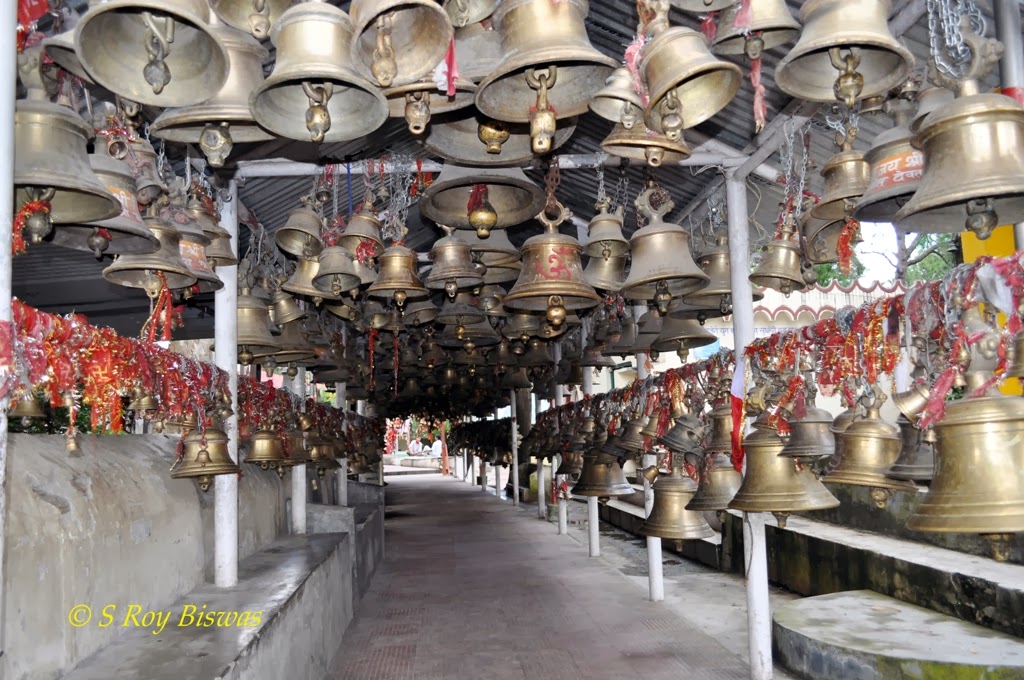
Bells placed by devotees inside Golu Devta temple in Chitai, Almora
Inside view of Golu Devta temple in Chitai, Almora
Golu Devata is thought to be as an incarnation ofGaur Bhairav(Lord Shiva), and is worshipped all
over the region and regarded as the dispenser of justice by the devotees with
extreme faith. Historically, he is
considered as the brave son and General of Katyuri King, Jhal Rai and his
mother was Kalindra, and his grandfather was Hal Rai and great-grandfather was
Hal Rai. Historically the origin of Golu Devata is accepted at Champawat in
Uttarakhand. His mother Kalindra is believed to be the sister of two other
local deities Harishchand Devjyun (the divine spirit of Raja Harish of the
Chands) and Sem Devjyun and both these deities are regarded by the locals as
uncles of Lord Golu. Another legend
suggests that he was a General in the army of the Chand King,Baz
Bahadur(1638–78), and died
displaying exemplary valour at war, the temple atChitaiwas erected in his honour, 8 km
from Almora city. On the other hand another
legend says that Golu Devta was killed by the king of Binsardue to some false doubt, and he
was beheaded by the king and his body fell at Gairad at Dana Golu and his head
fell at Kaparkhan, near modern day Binsar, a few km from Almora. At Dana Golu,
there is the original and most ancient temple of Golu Devta. The most popular story, however, about Gwalla
talks of a local king who, while hunting, sent his servants to look for water.
The servants disturbed a woman who was praying. The woman, in a fit of anger,
taunted the king that he could not separate two fighting bulls and proceeded to
do so herself. The king was very impressed by this deed and he married the
lady. When this queen got a son, the other queens, who were jealous of her,
placed a stone in its place and the child in a cage and put the cage into the
river. The child was brought up by a fisherman. When the boy grew up he took a
wooden horse to the river and on being questioned by the queens, he replied
that if women can give birth to stone, then wooden horses can drink water. When
the king heard about this, he punished the guilty queens and crowned the boy,
who went on to be known as Gwalla devata.
Golu Devta is seen in form of Lord Shiva, his brother Kalva Devta is in
form on Bhairava and Garh Devi is form of Shakti. Golu Devta is also prayed as
key deity (Ista/Kula Devta) in many
villages of Chamoli. Normally a three
days puja or a 9 days puja ritual is
performed to worship Lord Golu Devta also known as Goreel Devta in Chamoli
District. Golu Devta is offered Ghee, Milk,
Curd, Halwa, Poori, Pakauri (in order
– Clarified butter, sweetmeat made out of wheat coarse flour, fried bread made
out of bread flour, fried snacks made with chick pea flour batter &
vegetables) and head of the sacrificed goat. Usually, two male goats are sacrificed
(Bali
is performed), preferably of black colored ones. One is sacrificed inside the
temple complex of Golu devta and the other outside temple in a remote location.
The sacrificed goat is received as ‘prasada’
of Puja. Golu devta is known as God of justice and prayed with great pride and
enthusiasm. Golu Devta is offered with White Cloths, whitepagari and whiteshaal. Having visited the temple and performed the
Puja/ceremony, we were famished by then and immediately proceeded to have our
lunch at the nearby dhaba/local
eatery joint.
Monsoon magic - all green valleys
Panoramic view of Almora township - view from road to Ranikhet
Sunrise over the distant Himalayan ranges - view from Ranikhet
Sunrise view from Ranikhet
As the clouds gather in the valleys below - view from Ranikhet
Having have had our lunch, we immediately proceeded towards
Ranikhet as we wished to reach there at the earliest before nightfall. Although it was about 2-3 hours journey, but
because of bad road conditions at certain sections, we were delayed and the
intense fog & clouds added to our misery and it had already started raining
by the time we reached Ranikhet. As we
were quite tired, after partaking dinner early we retired early to bed. The next morning we got up to a bright new
day, the cloud cover had all but disappeared and a glorious view of the sunrise
over the Himalayan ranges enlivened our spirits. There was a nip in the air due to overnight
rains and we walked out to the adjacent market and had piping hot ginger tea
(local tea with pieces of ginger boiled with water). Since it was a pilgrimage tour, after having
bathed we all headed for Binsar Mahadev temple that is situated at a distance
of about 19 Kms. from Ranikhet. I am not
narrating the details of the place as I have already posted a detailed blog
about this place and whose link is as follows - http://ghummakar-biswas.blogspot.in/2013/03/ranikhet-meadow-of-queen-revisited.html.
Begonia bloom in Bhowali
Another variety of Begonia bloom in Bhowali
White Begonia bloom in Bhowali
Close-up of Begonia bloom in Bhowali
An ornamental plant after rains in Sattal
Morning glory
After
paying our obeisance at the famed Binsar Mahadev temple, we ambled back to
Saattal on my request, with the intent of photographing some birds in the
area. But as the luck would have it, as
soon as we reached Saatal around noon, the weather took a turn for the worse
and it started pouring cats & dogs literally. We could no do anything but to wait it out
and the weather remained down under the next day too and as I was using a prime
mirror lens with an minimum aperture of f/6.3, the low light conditions took
away any chances of my photographing any of the exotic birds, but I did try to
shoot some and the results are there to see, although not upto the mark. After this short but rejuvenating break, we
headed back to Delhi and the rains kept us company
all the way back upto Delhi.
Black Drongo on its perch - Sattal
Asian barred Owlet - Sattal
Orange Minivet - shot against the light - Sattal
Orange Minivet - on the canopy camouflaged - Sattal