Pages

Showing posts with label Himalayan ranges. Show all posts

Sunday, January 24, 2021

Beating the lockdown blues – a visit to my village Badankhet

Beating the lockdown blues – a visit to my village Badankhet

(A Photo blog)

Panoramic view of Himalayan ranges seen from village Badankhet

As my daughter is to appear in the Board examination this year, there were no big plans for the year 2020 as such, regarding our summer vacations or winter vacations.  But still everyone looks forward for a short trips, as a break from the mundane and in order to replenish our souls and body.  I had last visited my home in Badankhet in Ranikhet Tehsil in October, 2019 for undertaking cleaning and maintenance works.  Thereafter, although we had made a very brief winter trip, but had gone to our home only for a day in December, 2019.  In the year 2020 also, we had planned to take a few days break in summers of 2020 at our home in Badankhet village.  But the COVID-19 Pandemic that resulted in total lockdown in the country being imposed from 24th March, 2020 onwards, resulted in all the plans for the year going haywire.  Everyone was struck in their homes, with children having online classes and tuitions, ladies busy in collecting essentials through online portals and as the offices and businesses had started opening up gradually by June, but inter-state movement remained barred.


A male Khaleej pheasant in Badankhet village

A female Khaleej pheasant in Badankhet village

A close up of the Moon against an azure blue sky and pine tree top in foreground

Close-up of the perennial mountain spring in village Badankhet

In order to maintain my blog, I had stitched together a few blogs using my old journeys, albeit being presented in a different manner.  It was only in November, 2020 that we finally decided to take a break and head for our home in Badankhet village for a week.  Accordingly, after procuring the mandatory e-pass from the Uttarakhand Government portal, we commenced with our journey from Delhi in the first week of November, 2020.  The journey was a lot different this year, as it was sans any stoppage at any restaurant or eatery, which was one of the favorite parts of our usual journeys.  The road was almost free with very few vehicles, due to the lockdown and we went past the first bottle neck i.e. Gaziabad in a jiffy, as during this period of almost a year, a bye-pass over the entire crowded stretch had been constructed, which resulted in a smooth and hassle free ride.  Having covered a sizeable distance because of the good road conditions coupled with scant vehicles, after turning towards Moradabad for onwards journey to Ramnagar, we had our first stop at around 10.00 A.M for Breakfast.   Wife had prepared stuffed sandwiches and hot piping coffee in thermo-flasks, we had our belly full and thereafter we headed towards Ramnagar.  After having crossed Ramnagar, Corbett and Mohan region, we took a short break and as some stuffed parathas had been prepared for partaking in lunch and I had also purchased a Butane stove and cans for heating up the food, just before start of the journey, but everyone declined to skip lunch as we were still full.  We had some chips and biscuits only during this short stop over.  The journey upwards on towards the hills gradually begins after Mohan and finally the steep gradient begins from Kumheria onwards.  I and the driver took another break only for tea en-route and did not even stop at Bhatraujkhan for purchase of groceries etc., as my wife had carried everything from Delhi.  Thus, we reached Badankhet in record time and were home by 3.15 P.M.


Wild Himalayan Pear tree flowers in Badankhet village (https://en.wikipedia.org/wiki/Pyrus_pashia )

Wild Mexican Levander flowers in Badankhet village

A rose flower - early morning shot - in village Badankhet

A bouquet of Chrysanthemums in my garden  in village Badankhet
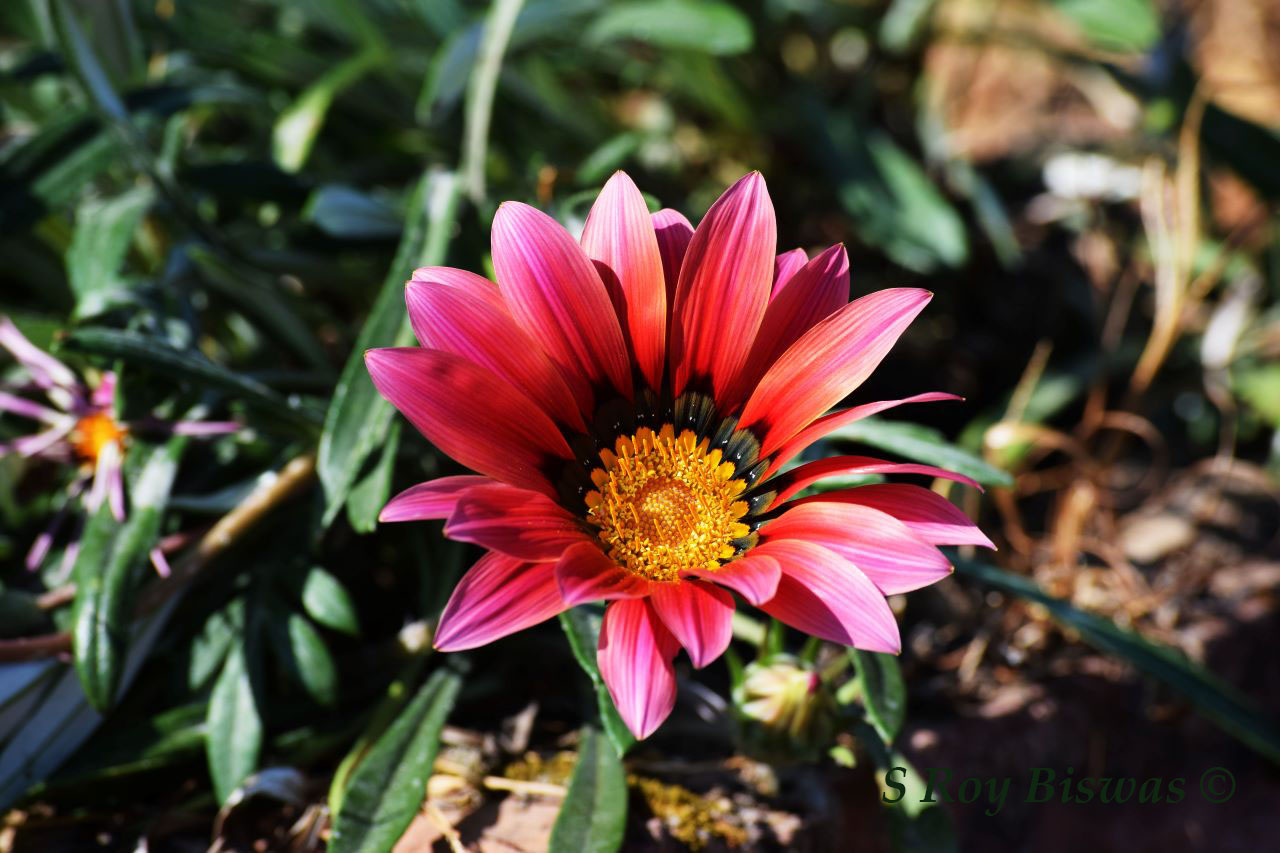
Close up of Gazania flower growing in my garden in  village Badankhet

Some acorns growing on an Oak tree  in village Badankhet

As my caretaker had got the verandah and garage cleaned up, we just opened up the flat and within a few minutes had got the rooms swept, as there is hardly any dust etc. and quickly settled in.  We had the parathas heated and served with piping hot tea and thus, had a late lunch cum tea.  It was quite cold as the evening started setting in, so as already instructed, the caretaker had arranged for some fire wood to light up a fire and accordingly, he lit up two wood stoves and after the smoke stopped emanating, the wood coal alongwith the stove was moved inside and this heated up the rooms and it became quite comfortable inside the flat.  We had an early dinner that day, as the driver also was tired, having driven more than 350 Kms., almost at a stretch and we all retired for the night.  We woke up late the next morning, all refreshed and rejuvenated, away from the hustle & bustle of city life and its pollution, but had a vacation that was coupled with chirping birds, fresh air and refreshing view of the Himalyan peaks, although this year they were not as clearly visible due to dust, since there had been no rains for past quite some times.

View of Jakholi village as seen from village Badankhet

View of Mori village as seen from village Badankhet

View of another typical Kumaoni village as seen from  village Badankhet
As we drive back towards Delhi - some view of the hills
As we drive back towards Delhi - typical Kumaoni style collection of grass for use in winters by woman folk of the villages
As we drive back towards Delhi - we are about to enter Corbett region - just ahead of Kumheria 

The famous north Indian festival celebrated by the ladies i.e. Karva Chauth was also scheduled during this break taken by us and the fiery reddish moon rise on that day was a sight to behold, I have attempted to capture the essence, but the camera does not do the justice, as against what the eyes perceive and see.  The usual birds and flora was all around including some flowers blooming in my plot and I have incorporated the photographs to introduce the readers to the vivid scenes and scenery that defines my village home in Badankhet, Gram Panchayat Timila in Tarikhet Block in Ranikhet Tehsil and I leave you with visuals of the lifeline of the village i.e. the perennial mountain spring and the flora and fauna around.  I had kept this blog pending, so that I could start with my first blog in January, 2021 and hope to continue blogging thereafter, as time & happenings around take place.  Wish you all a fruitful and refreshing year ahead. 

The moon with reddish hue over Ranikhet hills on 'Karva Chauth' day 

Here is the link to videos of the journey and my village mountain spring


Video of short drive through Corbett forest


Video of mountain spring in village Badankhet

© S Roy Biswas


Sunday, July 1, 2018

Kartik Swami temple – a platform for viewing Himalayan vistas


Kartik Swami temple – a platform for viewing Himalayan vistas

The majestic view of the Himalayan ranges as seen from Kartik Swami temple
             I had read about this destination with awe and had seen the photographs of the spectacular vistas of Himalayan ranges on the internet.  Accordingly, visiting Kartik Swami temple was the last, but not the least in order of priorities for me.  I had kept this trek for the last leg, so that even if we got tired, it would be the last trek of the trip.  Having visited Deoriatal the previous day and that being a tiresome journey, sans any food etc. we all got up late in the morning, including the driver.  The ladies of the group i.e. my wife and daughter had started mumbling and grumbling about the trek to Kartik Swami temple, when they heard that it was a 3 km. trek one way.  Therefore, I had no other option than to drop them at Syalsaur and my Son also volunteered to stay back with them.  Thus, I visited the famed Kartik Swami temple on my own.
View of Kedarnath peaks from Syalsaur as we start for Kartik Swami temple

As the road construction activity is underway the vehicles stop on either side
Going past Mohan Khal en-route Kartik Swami temple road
             Katik Swami temple is a small temple dedicated to Lord Kartik, son of Lord Shiva & Parvati, placed on a ledge that offers 270º view of the Himalayan ranges.  It can be reached by trekking for 3 Kms. from a nondescript little village called Kanakchauri.  This village can be accessed both from Rudraprayag as well as a small village called Banswara on Kedarnath Highway, about a kilometer from Syalsaur.  Kanakchauri village is about 40 kms from Rudraprayag on the Rudraprayag - Pokhari route, whereas from the road at Banswara, it is about 37.9 Kms. from Syalsaur.  This road is a narrow and due to ongoing road construction work for another road, connecting some of the villages in the hills, which was taking place, due to displacement of rocks in the process, we had to wait mid-way for about 45 minutes or so.  But this road being used mainly by the local villagers falling in this route, namely – Gair, Kanyas, Akauri etc., till one reaches Mohankhal, which is the nodal point wherefrom the road from Pokhri meets, it is a smooth ride with very few vehicles traversing along this road patch.  Kanachauri village can also be approached from Karanprayag, which is about 40 Kms. from Pokhri and it is another 15 Kms. from Pokhri to Kanakchauri. 
Terraced fields and small villages perched on mountainsides en-route Kartik Swami temple

First view of the Kanakchauri village and ridge astride which is the famed Kartik Swami temple
The first view of Chaukhamba massif on trek route to Kartik Swami temple 
             Kanakchauri village is a very small village and total length would not exceed 150-200 meters along the main road, wherein numerous shops catering to local requirements as well as eateries dedicated to tourists run shop.  In case of heavy rush of tourists, there is not ample space available and the road, being quite narrow, parking is definitely a problem here.  The Mayadeep group has a reasonable rest house constructed mainly with bamboo here and they quote a price of Rs.2000/- per night for each such bamboo hut.  However, I have come across blogs wherein it has been claimed that bargaining can give you a good deal of around Rs.800/- per room per night also during lean seasons.  The trek route for the famed Kartik Swami temple is easily identifiable by a gate constructed on the road side leading towards the trek route.  Although, there are no sight to any Himalayan peaks visible from the village road itself, but a few hundred meters upward trek would make them visible.  The trek route is about 3 Kms. and takes about two hours’ time at a medium pace and the trek runs through a pleasant and virgin Oak and Rhododendron forest and the stillness is broken only with a twig or two breaking under your shoe or that of a bird chirping somewhere in the canopy and the gradient is moderate.
A Nuthatch bird on trek route to Kartik Swami temple
The description hoarding on trek route to Kartik Swami temple
The hut of the temple priest of Kartik Swami temple
A display poster erected by Uttarakhand Tourism near Kartik Swami temple

             Nestled in the Garhwal Himalayas at an altitude of 3048 meters (about 10,000 ft) in the Rudraprayag district of the State of Uttarakhand is the temple of Kartik Swami. Kartik Swami temple is perched on a spur of a ledge, in a serene and beautiful location, that provides a spectacular panoramic view of some of the highest mountains peaks of the Himalayan ranges in India.  The snow laden peaks of Bandar punch are visible to the west. In addition, the peaks of Kedar Dome, Meru, Kedarnath, Neelkanth, Trishul, Nanda Ghunti and Nanda Devi group of peaks are also visible from Kartik Swami. The main attraction of Kartik Swami is the mighty Chaukhamba peak which appears, as if as, it is framed as the temple’s background.  En-route, just before you take onto the huge stone steps for the final assault on the ridge to reach the temple top, is the home of the priest of the temple, who stays in a basic concrete house (an ashram), which is less than 1 km before the temple and he will accompany travelers/devotees to the temple, if required.  There is something mystical about Kartik Swami temple trek, as on the way you find broken bangles and vermillion (sindoor) all along the path made as offerings, while the temple complex has a lot of bells hanging around it.  The ever interrogative mind of mine was getting vexed to know about the mythology of the place and hence I made some research on the internet, searching for answers to my query.

The pen nib like peak_Janhukoot peak as seen from Kartik Swami temple
Panoramic view of the famed Kartik Swami temple
The main temple doorway of Kartik Swami temple
The idol of Lord Kartikey in Kartik Swami temple
The mighty Chaukhambha peak as seen from Kartik Swami temple
         Mythological anecdotes relate this place to Lord Kartik Swami, who is the elder brother of Lord Ganesha and according to Hindu mythology, he is considered as “God for War and Victory.”  He is also known as Murugan Swami in Tamil Nadu, Subramanya in Andhra Pradesh and Karnataka and Kartikeya in Bengal. The temple encompasses an idol of Lord Kartik Swami carved on a marble rock.  According to Hindu mythology, Lord Shiva (the destroyer) told his sons Ganesha and Kartikeya that one of them, who will be the first to take seven rounds of the universe will have the privilege of being worshiped first.  Ganesha took seven rounds around Shiva and Parvati, stating that he saw the Universe in them, while Kartikeya faithfully circled the universe. Impressed by Ganesha, Lord Shiva gave him the honor of being worshipped before anyone else. While Lord Kartikeya was taking his final round, he encountered Narada Muni (albeit intentionally), who informed him that he had been made to look like a fool by circling the Universe and that Lord Ganesh had already been granted the boon.  Angered by this kind treachery, Kartikeya sacrificed his body and gave his flesh back to his mother Parvati and his bones to Lord Shiva as an ultimate sacrifice.
As the evening sets in we head back to Syalsaur from Kartik Swami temple
            Having visited the temple and spent some quality time there, we traversed back through the serene trek through the Oak and Rhododendron tree forest and reached back Kanakchauri in about an hour’s time.  As we were totally famished by this time, myself and my driver, who had accompanied me to the temple top, ate some noodles with eggs and tea, which was so sweetened that I could only have one gulp, before discarding it.  Thereafter, as we were about to make our way back, a forest worker requested for ride upto Mohankhal as he had missed the last bus.  We dropped him at his desired destination and made our way back to Syalsaur and thus, ended my winter sojourn for the year, albeit visiting a few more destinations on our way back.


Here is a link to the video of the destination -


Saturday, March 11, 2017

Sitlakhet – a destination of snow & solitude

Sitlakhet – a destination of snow & solitude
Snowfall at Sitlakhet
The name ‘Sitla’ in Hindi means ‘Cool’ and ‘khet’ is ‘farm land’, so the trans-literation of name would be ‘Cool farm land’ or more appropriate would be ‘farms in cool climes’ and during my recent visit I found that it does fits its literal translation.  Sitlakhet is an unspoiled nature’s treasure trove nestled on the lap of a hill, the top of which is occupied by the famed Shyahi Devi temple, overlooking the valleys below it and bestowing it with a nature’s gift unparalleled in the annals.  Perched at an altitude of 1785 meters i.e. the exact elevation of the Tourist Rest House or TRH for short at Sitlakhet, managed by KMVN, which translates to around 6000 feet above MSL (Mean Sea Level).  However, the famed Syahi Devi temple would easily be touching 7000 feet above MSL.  If you search the net for the destination, it would throw up results in name of ‘Anant Rasa’, a resort being run by the famed photographer from Nainital, Sh. Anup Shah.  The place also houses a camping site run by the ‘Discovery Channel’.  The entire verdant valley is cocooned in dense forest of Oaks, Silver birch, pines et al and is nature’s treasure trove in all its splendour. 
Taking a selfie en-route at Mukteshwar
The small market of Sitlakhet
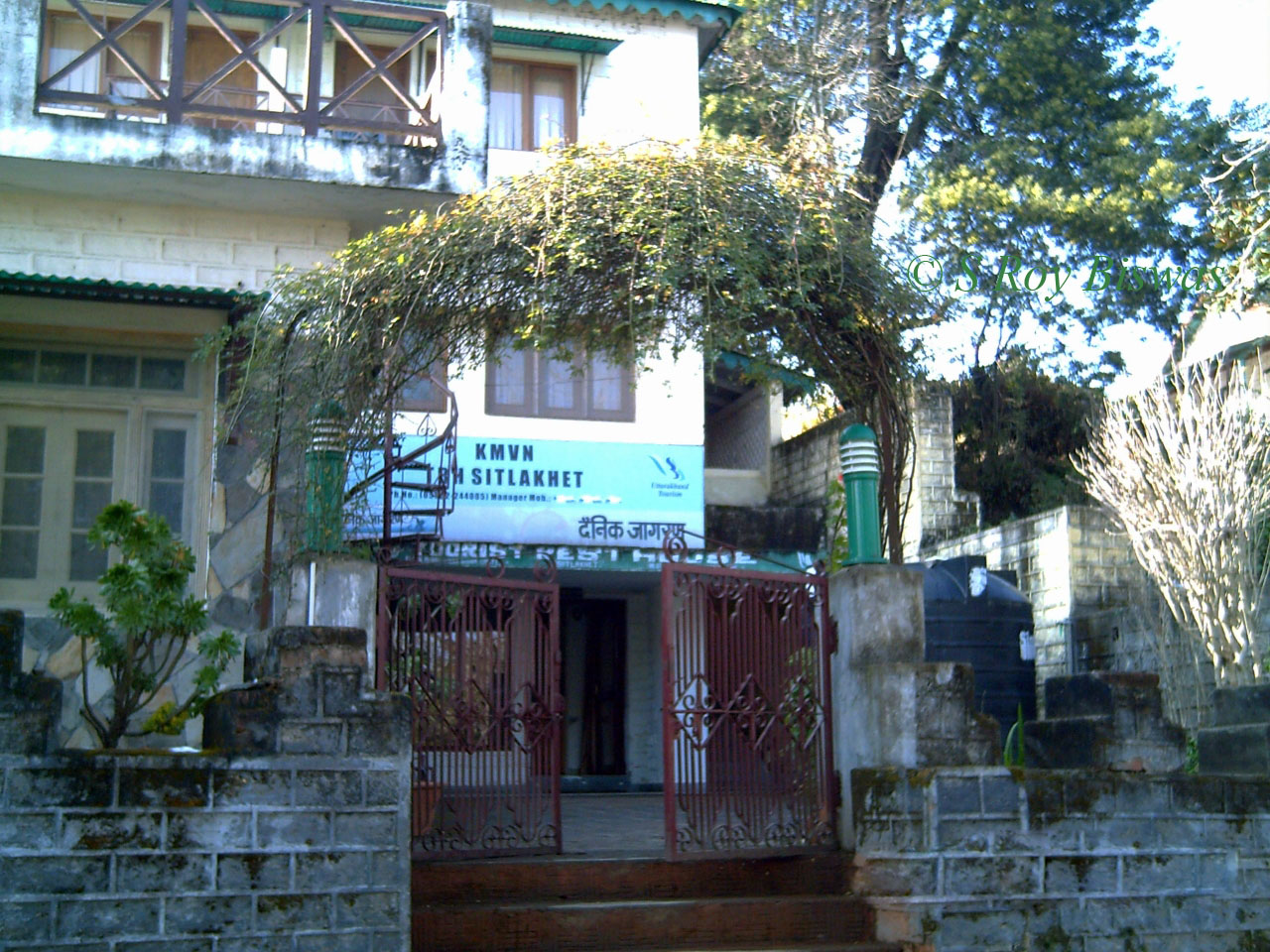
Tourist Rest House run by KMVN at Sitlakhet
            We had started from Padampuri late in the afternoon, as the train was delayed and we had taken a break to have some snacks etc. as detailed in my previous blog.  We headed on the road towards Dhanachuli, but just before reaching Dhari, the driver took a detour through a village road and he took the diversion at Boranshi, being a short cut that runs through small hamlet named Chaukhuta and reaches Kasiyalekh and therefrom through Gangachor to the junction called Bhatelia.  From Bhatelia the road leads towards Mukteshwar and this distance is about 20 odd Kms.  The weather had turned inclement as we commenced with our journey from Padampuri and by the time we approached Mukteshwar, it had started snowing and the children got excited and alighted from the Car at the forest checkpoint to click a few photographs.  The road distance from Mukteshwar to Almora is about 32 Kms. via Sheetla – Khawarbpul.  Having gone past Almora, we headed downstream towards Kosi, a further distance of 10 Kms. and therefrom having crossed the bridge, we headed towards the road leading past the ITBP Camp and the barrage built on Kosi River for supplying drinking water to residents of Almora.  After having gone past a small hamlet named Deoli we reached another nondescript little village named Kharkuna wherefrom the road bifurcates and the straight one towards the right hand side leads on towards Dhali and onwards to Sitlakhet, the total distance being about 27 Kms. from Kosi bridge.  Thus, it was a long haul of almost 80 Kms. that took about three & half hours’ drive because of the weather & road conditions.  As it was getting late, I decided to explore availability of boarding in the TRH and got one as it was in the middle of the week and it usually gets its guests on weekends.
Snow on a tuft of grass
As it snowed intermittently from the evening in Sitlakhet 
The morning after the snow fall in Sitlaket
The author out for a shoot 
            After having checked into the four bedded room, we ordered for some bread pakoras and coffee and as the evening started setting in, the cook Ganesh asked for the dinner order, as the TRH is at an isolated location and Sitlakhet itself is a very small hamlet and thus, in order to procure non-vegetarian or any specific vegetarian food, one has to book well in advance, so that the procurement may be done from either Kathpuriya, Majhkhali or Ranikhet.  Accordingly, we placed our orders and just as we had started enjoying Pakoras & Coffee it started snowing at Sitlakhet.  As the evening slowly merged into the night, the intensity of the snowfall increased with every passing minute, but the children were enjoying the experience immensely.  News came in late in the evening that the person entrusted with the job of procuring our order from the nearby road head was struck in the snow and thus, the order may have to be revised.  The staff of three that runs the TRH had lighted a small bonfire to keep themselves warm and as the electricity got disconnected due to the snowfall, we made a beeline for the space behind the kitchen where the fire wood had been lit, to keep ourselves warm.  However, at around 8.00 P.M some good news poured in that the person assigned the task of procuring Chicken had finally made it to the TRH and we could therefore, relish our next order of hot Chicken soup, that was prepared quickly and served piping hot and for dinner we got served ‘Garlic Chicken’ preparation with rotis/hand baked breads.  The cook Ganesh has some exceptional culinary skills and enjoys his work, which in turn results in some lip-smacking snacks and/or main course meals.
The Shahi Devi temple complex at Sitlakhet
Close up of the Himalayan ranges as seen from Sitlakhet
Panoramic view of the Himalayan ranges as seen from Sitlakhet
Panoramic view of Almora from Sitlakeht
        Bereft of electricity and with a solitary candle light flickering in one corner of the room, we all retired for the night in the cold climes of Sitlakhet and being tired over the day’s journey, all of us fell asleep quickly.  I was the first one to wake up in the morning and immediately peaked outside, although the sunlight was all around, yet the sunlight was only filtering through in patches, as the clouds were in motion in the deep blue sky above.  I got up quickly, completed the morning ablutions and moved out to get some shots with my camera.   As the cloud cover became thinner with passage of the day, by 9.00 A.M. a lot of birds started chirping all around and I had a fabulous time shooting to my heart’s content.   Later in the morning I moved towards the market and headed towards the Shyahi Devi temple.  However, the road that leads to the temple top is neither paved with concrete nor is its surface tarred and hence the vehicles run only for the first half of the journey of three Kms. i.e. one & half kilometres and the remaining half has to be completed on foot by trekking.  Due to the snowfall the vehicles too were not plying or going up the trail and it was not possible to trek up to the temple in the slushy & snowy conditions and therefore, I had to give up any hope of making it to the temple top, however, for the benefit of the readers I am providing with a link to the photographs of the temple - http://wikimapia.org/18958637/Siyahi-Devi-Man.
Himalayan Yellow finch enjoying the Sun after nights snowfall
Return of the Himalayan Griffon - flying high in Sitlakhet
            Not being able to accomplish my target of visiting the temple, I returned back to the TRH and after having partaken the B’fast that is part of the tariff charged for the room, we headed for my pad and en-route went past many a small hamlets till we reached Kathpuriya, which is another small hamlet on the State Highway from Almora to Ranikhet and at a distance of 10 Kms. from Sitlakhet.  On the way I struck up a conversation with the driver of the taxi hired by me Mr. Chandan Singh, who is a local resident and resides near the temple at the hill top and he informed me that Sitlakhet had abundant water being blessed by Shyahi Mata and a natural spring takes care of all local requirement of water and also supplies water to Almora township.  He also informed me that the temple was surrounded by about seven Deodar trees, which appear in shape of two tigers when seen from Almora or other nearby hilltops.  Another small snippet that he provided was the fact that a small village, about 2 Kms. from Sitlakhet called ‘Khoont’, is the ancestral home of the legendary freedom fighter & politician Late Sh. Gobind Ballabh Pant.  As we reached Kathpuriya, one enters the state highway running from Almora to Ranikhet, one has to turn left and head towards Majhkhali and thereafter reach Ranikhet, which is about 18 Kms. from Kathpuriya.  From Ranikhet we rambled down to Ganiadoli, where we made some purchases for daily needs/use for our home and then headed further via Tarikhet to our final destination to our home in Timila.  Thus, ended the winter vacation break journey for the year.
Here is the link to the video for the destination -


© S Roy Biswas

Saturday, December 28, 2013

Revisiting - Almora & Ranikhet (a photo-blog)

Revisiting -  Almora & Ranikhet  (a photo-blog)

Sunrise over the Himalayan ranges - view from Ranikhet
   My blog about Almora is already available and the link is as follows - http://ghummakar-biswas.blogspot.in/2011/12/almora-visiting-jageshwar-katarmal.html but as happens, you cannot visit every small temple or tourist spot at one go.  Therefore, as we were traversing back from Jalna, we found out that in order to reach Ranikhet, we had to return back to Almora and thereafter head towards Ranikhet.  We proceeded towards Saharphatak, this road further leads to Lohaghat from Jalna, till we came across another small village about 4-5 Kms. from Jalna called Lamgara.  Here from a small road bifurcates through some small villages and connect with the Almora-Pithoragarh road.  Instead of back tracking through the same route that we had used while travelling from Almora for Jalna, we chose this route instead to avoid monotony.
Huge cobwebs - absorbing the moisture from the clouds/fog enveloping the valley
Impatiens spp. - Balsam flowers
Terraced fields - on way from Jalna to Almora
        Lamgara is also perched at an altitude which is almost similar to Jalna and also offers some good panoramic view of the Himalayan ranges & the vales below.  The road that runs towards Almora from here can be best described as a little better than a dirt track, but it runs through some pristine forest area and regions untouched by the modern world gizmos.  The life these village still trudges at a slow speed that can be kept pace with and the lack of hustle & bustle leads to a sense of serenity in these region.  There were a lot of birds to see and photographer, but our friend’s father, who is almost an octogenarian, was getting impatient due to constant halts and hence we had to rush through.  He was more intent to reach Jageshwar temple complex, as it was the auspicious Hindu month of ‘Sawan’ and performing puja (performing Hindu rituals) at the various ‘Shivlingas’ (Shiva’s phalanx is worshipped in Hindu temples) is considered very auspicious by Hindus.  Most Hindus believe that Jageshwar is the place of Nagesh, 8th among the Dwadasa Jyotirlingas i.e. Ten plus two Jyotirlings  (the twelve resplendent Lingas of Lord Shiva established by Lord Vishnu), which is stated to exist in the forest of Daruka/Deodar (Cedrus deodaraor daruka van/forest.  Jageshwar holds a special position as being the first in the list of such Jyotirlingas
Brown fronted woodpecker
Asian Koel 
Yellow breasted Greenfinch or Himalayan Greenfinch
         We reached Jageshwar temple complex at around 11.00 A.M and found that the complex was almost empty.  While purchasing the ritualistic articles required for performance of the puja inside the temple complex, I struck up a conversation with the shopkeeper and he informed that during this year, because of the calamity that had struck Kedarnath region, the tourist influx had been badly affected in entire of Uttarakhand and the business was very poor, almost a slump of 80% from normal.  We too could sense this, as despite being a very auspicious month for performing Puja, the crowd of Hindu devotes were quite conspicuous by their absence.  But this offered us a window of opportunity and we could perform the Puja in an elaborate manner inside the temple complex, which otherwise would have been a luxury in case of heavy rush of pilgrims.  There is no definite dating of the construction of Jageshwar group of temples but according to the Archaeological Survey of India (ASI), they belong to the post-Gupta and pre-medieval eras and are estimated to be about 450 yrs old. These temples range in the period from the 8th century (early Katyuri Dynasty) to the 18th century (Chand Dynasty). The temples were renovated during the reign of Katyuri King Shalivahandev. There is an inscription of Malla Kings on the main temple premises indicating their devotion to Jageshwar. The Katyuri Kings also donated villages to the temple priests for its maintenance. The Chand Kings of Kumaon were also patrons of the Jageshwar temple.  Numerous Jageshwar temples were constructed or restored during the Gurjara Pratihara era.  It is believed that while establishing the various maaths in Uttarakhand, like the Kedarnath and Badrinath dhams, Adi Shankaracharya too had visited Jageshwar and renovated and re-established many temples before leaving for Kedarnath. The Samsan ghat of Jageshwar is also the cremation ground of the erstwhile Chand Kings. The temples architecture belongs to the Nagara style, characterized by a tall curved spire surmounted by an amalaka (capstone) and a kalasha crown. Most of the temples enshrine a stone Lingam, surrounded by stone sculptures of various deities. The pilgrimage to Jageshwar is considered as sacred as the famous Chardham yatra.

Temple spire of Jageshwar temple - near Almora
Panoramic view of Jageshwar temple - near Almora
Inside the Jageshwar temple precincts
Idol of Kal Bhairav in Jageshwar temple complex
The ceremonial fire or 'Yagna kund' in Jageshwar temple
       The folklore in the regions around Jageshwar tells us a gripping story about building the Main temple Near Kot Linga Temple Complex. Lord Shiva selected this place to be his abode. During the Tapasya by Lord Shiva, demons obstructed his penance. Then God "Sam" came into being as Trinetra (the third eye of Lord Shiva), who sent his ‘Ganas’/Demons to kill these demons. It is believed that Lord Sam will come to Kot Linga temple premises to save humanity and Jageshwar in Kalyuga. Adi Shankacharya tried to build the maim temple at Kotlinga but to no avail as Lord Sam wanted Kotlinga to be specifically reserved for the Meditation of his beloved Lord Shiva. Old Ruins of a temple structure can be found near Kotlinga. Local People still believe that Lord Sam will come and built the real Jageshwar temple near Kotlinga and thus, save the mankind from adversities of Kalyuga.  It is also believed that anyone who prays here is saved from ‘akaal mrityu’/untimely or sudden violent death.  The temple city comprises a cluster of 124 large and small stone temples, dating 9th to 13th century AD, with many preserved by the  (ASI), which include Dandeshwar Temple, Chandi-ka-Temple, Jageshwar Temple, Kuber Temple, Mritunjaya Temple, Nanda Devi or Nau Durga, Nava-grah temple, a Pyramidal shrine, and Surya Temple.  The most famous of them is the Mahamrityunjay temple is the largest and oldest temple in the Jageshwar temple complex. This temple of Shiva is eastern facing and the Linga is worshipped as the saviour from death. The unique linga has an eye shaped opening. Pilgrims believe that reciting the Mahamritunjaya Mantra is a fruitful, auspicious and powerful method of self-realisation, removal of evil effects, and freedom from all kinds of fears, illness and negativity. The Mahamritunjaya Mantra is attested in the Sukla Yajurveda Samhita III/60.  Thus, having performed the Puja at the main temple, we proceeded further to visit another the famous temples that was missed by me during my previous visit i.e. Golu Devta temple in Chitai, Almora.
Outside view of Golu Devta temple in Chitai, Almora
Temple gate of Golu Devta temple in Chitai, Almora
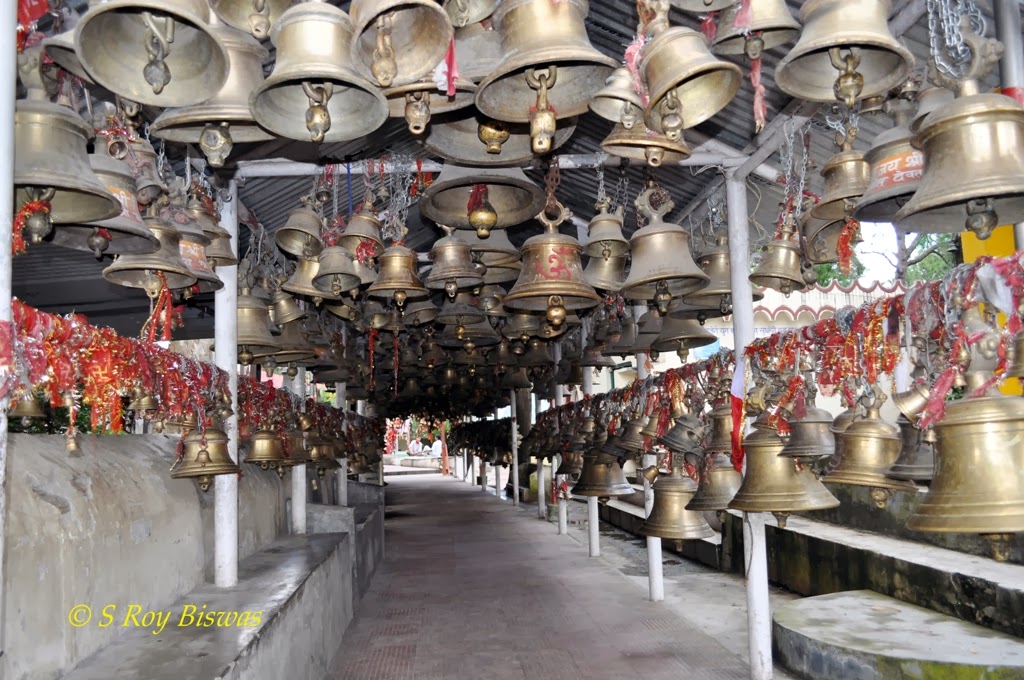
Bells placed by devotees inside Golu Devta temple in Chitai, Almora
Inside view of Golu Devta temple in Chitai, Almora
Golu Devata is thought to be as an incarnation of Gaur Bhairav (Lord Shiva), and is worshipped all over the region and regarded as the dispenser of justice by the devotees with extreme faith.  Historically, he is considered as the brave son and General of Katyuri King, Jhal Rai and his mother was Kalindra, and his grandfather was Hal Rai and great-grandfather was Hal Rai. Historically the origin of Golu Devata is accepted at Champawat in Uttarakhand. His mother Kalindra is believed to be the sister of two other local deities Harishchand Devjyun (the divine spirit of Raja Harish of the Chands) and Sem Devjyun and both these deities are regarded by the locals as uncles of Lord Golu.  Another legend suggests that he was a General in the army of the Chand King , Baz Bahadur (1638–78), and died displaying exemplary valour at war, the temple at Chitai was erected in his honour, 8 km from Almora city.  On the other hand another legend says that Golu Devta was killed by the king of Binsar  due to some false doubt, and he was beheaded by the king and his body fell at Gairad at Dana Golu and his head fell at Kaparkhan, near modern day Binsar, a few km from Almora. At Dana Golu, there is the original and most ancient temple of Golu Devta.  The most popular story, however, about Gwalla talks of a local king who, while hunting, sent his servants to look for water. The servants disturbed a woman who was praying. The woman, in a fit of anger, taunted the king that he could not separate two fighting bulls and proceeded to do so herself. The king was very impressed by this deed and he married the lady. When this queen got a son, the other queens, who were jealous of her, placed a stone in its place and the child in a cage and put the cage into the river. The child was brought up by a fisherman. When the boy grew up he took a wooden horse to the river and on being questioned by the queens, he replied that if women can give birth to stone, then wooden horses can drink water. When the king heard about this, he punished the guilty queens and crowned the boy, who went on to be known as Gwalla devata.  Golu Devta is seen in form of Lord Shiva, his brother Kalva Devta is in form on Bhairava and Garh Devi is form of Shakti. Golu Devta is also prayed as key deity (Ista/Kula Devta) in many villages of Chamoli. Normally  a three days puja or a 9 days puja  ritual is performed to worship Lord Golu Devta also known as Goreel Devta in Chamoli District. Golu Devta is offered Ghee, Milk, Curd, Halwa, Poori, Pakauri (in order – Clarified butter, sweetmeat made out of wheat coarse flour, fried bread made out of bread flour, fried snacks made with chick pea flour batter & vegetables) and head of the sacrificed goat. Usually, two male goats are sacrificed (Bali is performed), preferably of black colored ones. One is sacrificed inside the temple complex of Golu devta and the other outside temple in a remote location. The sacrificed goat is received as ‘prasada’ of Puja. Golu devta is known as God of justice and prayed with great pride and enthusiasm. Golu Devta is offered with White Cloths, white pagari and white shaal.  Having visited the temple and performed the Puja/ceremony, we were famished by then and immediately proceeded to have our lunch at the nearby dhaba/local eatery joint.
Monsoon magic - all green valleys
Panoramic view of Almora township - view from road to Ranikhet
Sunrise over the distant Himalayan ranges - view from Ranikhet
Sunrise view from Ranikhet
As the clouds gather in the valleys below - view from Ranikhet
          Having have had our lunch, we immediately proceeded towards Ranikhet as we wished to reach there at the earliest before nightfall.  Although it was about 2-3 hours journey, but because of bad road conditions at certain sections, we were delayed and the intense fog & clouds added to our misery and it had already started raining by the time we reached Ranikhet.  As we were quite tired, after partaking dinner early we retired early to bed.  The next morning we got up to a bright new day, the cloud cover had all but disappeared and a glorious view of the sunrise over the Himalayan ranges enlivened our spirits.  There was a nip in the air due to overnight rains and we walked out to the adjacent market and had piping hot ginger tea (local tea with pieces of ginger boiled with water).  Since it was a pilgrimage tour, after having bathed we all headed for Binsar Mahadev temple that is situated at a distance of about 19 Kms. from Ranikhet.  I am not narrating the details of the place as I have already posted a detailed blog about this place and whose link is as follows - http://ghummakar-biswas.blogspot.in/2013/03/ranikhet-meadow-of-queen-revisited.html.

Begonia bloom in Bhowali
Another variety of Begonia bloom in Bhowali
White Begonia bloom in Bhowali
Close-up of Begonia bloom in Bhowali
An ornamental plant after rains in Sattal
Morning glory
         After paying our obeisance at the famed Binsar Mahadev temple, we ambled back to Saattal on my request, with the intent of photographing some birds in the area.  But as the luck would have it, as soon as we reached Saatal around noon, the weather took a turn for the worse and it started pouring cats & dogs literally.  We could no do anything but to wait it out and the weather remained down under the next day too and as I was using a prime mirror lens with an minimum aperture of f/6.3, the low light conditions took away any chances of my photographing any of the exotic birds, but I did try to shoot some and the results are there to see, although not upto the mark.  After this short but rejuvenating break, we headed back to Delhi and the rains kept us company all the way back upto Delhi.

Black Drongo on its perch - Sattal
Asian barred Owlet - Sattal
Orange Minivet - shot against the light - Sattal
Orange Minivet - on the canopy camouflaged - Sattal 
White chinned laughing thrush - Sattal
Grey headed Canary  flycatcher - Sattal