Andaman & Nicobar
- The Enchanting Coral Islands of India
(Excursion along the Andaman Trunk Road)
Part-III
– Baratang again (MudVolcano & ParrotIsland)
Sunrise over Baratang
Day 3 (Day 6 since
we arrived in Andaman)
The
next day, we again started early as we had to reach Baratang by afternoon, since we were scheduled to visit the Parrot
islands during the evening. As per our
pre-decided plan, we again went to Danapur near Mayabunder and had a sumptuous
Breakfast of Aloo Paranthas (stuffed potato fried Indian bread), made with
actual desi ghee (clarified butter), which he charged @ Rs.25/- per parantha,
maybe he got smarter overnight. The
driver disappeared for quite some time and I could make out that he had some
prior appointment at the place and thus, had been insisting upon visiting
Mayabunder during the return leg. Having
stuffed ourselves well we headed for the long journey ahead, we embarked upon
the 200 Kms. plus journey back to Baratang.
We broke the journey at first at Rangat, where we had some cold drinks
and thereafter, a forced one at Kadamtala, waiting for the ferry and again had
some delectable Pineapples there. After
crossing over to Batuktala we made a run upto Baratang and before going towards
the jetty side, we headed for the Mud Volcano.
The hoarding at Mud Volcano in Baratang
The scene of the actual site of Mud Volcano in Baratang
The
road leading upto the Mud Volcano is in very bad shape and only bigger vehicles
and jeeps can navigate, with difficulty across the terrain. One has to further trudge another 500 odd
meters, 200 of which is upwards to reach the Mud Volcano through some muddy
& slipper slush. The Mud
volcano at Baratang came
into being on 18th February, 2003 when an explosion at night with
fire & mud spews being ejected from the earth, accompanied by minor tremors
shook the region. At present, the Mud
Volcano covers an area of about 1000 sq. meters, with a central semi circular
dome of about 30 sq. meter diameter and is about 2 meters high. The main crater now appears to be submerged
under a mass of grey colored clay, that is intermittently being ejected
alongwith some odorless gasses, at a very slow pace. However, for a person who is not well
conversant with geological presentations, this place does not offer any
spectacular views. Having trudged back
to the vehicle, we headed towards Baratang as we were booked at the forest Rest
House for the night. This Rest House was
the best one I had seen or lived in during my stay in Andaman’s and the staff
too was very courteous and prompt.
On the way back - spotted a Black Serpent Eagle
The Elephant and Mahout - in the jungle
We
had reached the Forest Rest House at around 3.00 P.M and as we were
considerably late, we could not have lunch, but the aloo paranthas that we have
had in the morning saved the day for us.We ordered some Coffee and pakoras (fried snacks) and after partaking
these, took a short power nap to rejuvenate ourselves for our evening
jaunt.At around 4.00 P.M. we headed for the Nilambur
jetty and boarded the boat that was to take us to the famed ParrotIsland.Parrot Island is another of the famous
tourist destinations in Baratang, it takes about 30-40 minutes to reach these
Islands by outboard engine fitted boats and cost @ Rs.400/- per round trip per
person or Rs.2500/- for full boat.The
boats take off after 4.00 P.M and pass through very deep sea with mangrove
forest bearing islands all around.The ParrotIsland
is quite distinct from others and the resident Parrots having trimmed off the
mangrove forest tops with precision, the entire island appears to have been
trimmed by human hands.The boats drop
anchor about 200 odd meters from the shore line and the boats drifts continuously
in the sea water, thus, taking long shots (through telephoto) becomes quite a difficult
task, because of the instability.The
boatmen carry their fishing lines with them and utilize the free time at their
disposal catching some fish for themselves, while the tourists gorge in at the
spectacle that unfolds at the ParrotIsland.The Parrots, numbering in thousands, start homing
in just after the sun set, first in small groups and then their numbers
gradually swell and they roost for the night in these islands.Due to low light conditions, coupled with
continuous swaying movement, it is very difficult to photograph them.According to my estimation, the number of
Parrots is way upward of 7000 and apparently come in from all directions, so it
can be conceived that they come in from all the surrounding Islands of
Andaman’s, within a diameter of 25 odd Kms. or so.After the birds had roosted for the night,
the overboard engines were started and by this time everything had gone pitch
black, only the boatmen knew as to how they navigated their boats during the
night & in pitch dark conditions.It
is a spectacle that one watches but rarely in his life and having gorged in
copious amounts of natural beauty, we bid adieu to BaratangIslands
the next morning.
Parrot Island - on the right hand side - tree tops trimmed like professionals
Andaman & Nicobar
- The Enchanting Coral Islands of India
(Excursion along the Andaman Trunk Road)
Part-I
– Baratang (LimeStoneCave)
& Rangat
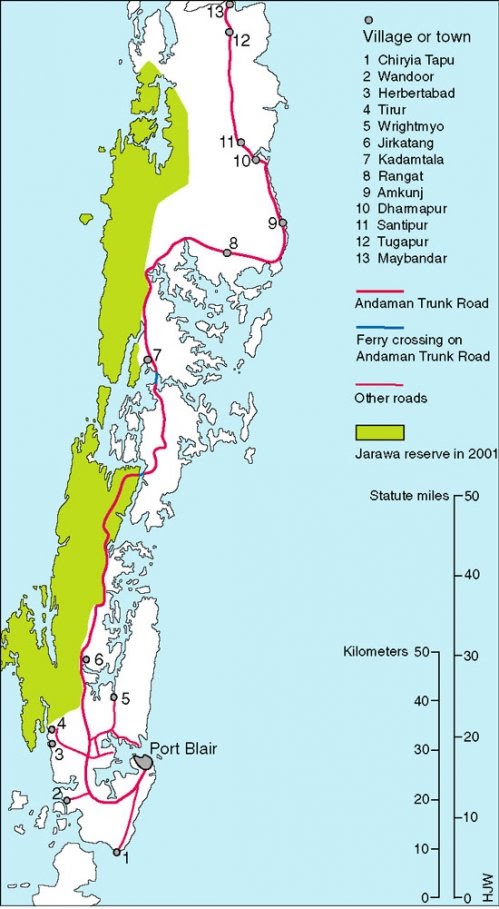
Map of the Andaman Trunk road (from internet)
The
Andaman Trunk Road runs from Port Blair to Diglipur, a stretch of road that
runs from Chidya Tapu in the extreme south end of the Andaman Island to its’
extreme north i.e. Diglipur, which covers a distance of about 328 Kms. (one
way). The road runs along the eastern
coast line of the Andaman Islands, but
criss-crosses across the heart & soul of these islands, running through its
virgin forests, aboriginal inhabited settlements and across several
straits. Having completed our sojourn in
& around Port Blair, we headed for Diglipur, which was to be a four day
journey.
Jirka Tang - the starting point of the Convoy
The local market up and going early in the morning catering to the hundreds of vehicles & their occupants
The Jarwas - who are protected in these reserve areas
Day 1 (Day 4 since
we arrived in Andaman)
As
advised by our driver & guide for the tour Mr. John, we started early in
the morning at 3.30 A.M. sharp (delaying our start by half an hour after much
haggling with him), in the Mahindra Xylo Jeep, provided by the tour operator
Mr. Deepak, who also owns the ‘Da Bay Inn’ Hotel, in Port Blair, a person whom
I found to be bequeathed with a very amenable & pleasant personality. The main motto of the driver was to be ahead
of all other vehicles in the first convoy that leaves Jirka Tang check
post at 6.00 A.M. After driving through
the pitch dark roads, with hordes of Cows occupying the main road near many a
small villages during the night, being pitch dark with no street lights and
sudden appearance of dark cows or rain pits, it was a nightmare of a journey
from Port Blair to Jirka Tang. However,
when we reached Jirka Tang it was merely 4.45 A.M. in the morning and the sun
was just making an appearance in the east.
Despite having started so early in the morning, we were still second in
the queue and it being a long wait till 6.00 A.M (Indianstretchable Time),
as the convoy invariably starts at around 6.20-6.30 A.M. only, the children
were advised to have a quick nap. But
this was going to be impossible because of the clamor caused by the vendors and
hawkers. Initially, I was reluctant to
buy any street side food, but my experience in the Spiti region last year,
coupled with the advice of the guide, I purchased five (05) plates of Vada (a
south Indian fried snack), as a Doctor friend of mine had suggested that the
hot oil kills most of the harmful Bacteria.
This turned to be our savior, as in the ensuing journey and even in
Baratang we could not get any proper food.
The Middle Strait view
Baratang
The
journey from Jirka Tang commenced with a lot of expectations of encountering
some Jarwa
aboriginal tribesmen, whose pre-historic ways of life have changed little, in
these isolated Islands, during the thousands
of years that they have been inhabiting these islands. These tribes live in reserved forest areas
and occasionally come out on roads, while traveling to different locations for
their day to day needs. In order to
insulate them from the modern culture, interaction with the tourists is totally
prohibited and filming them in any manner is punishable under the law. The road passes through some really
picturesque & virgin forest areas, with a plethora of birds singing, but
few can be spotted from the moving vehicles.
The distance of about 45 odd Kms. is to be crossed from Jirka Tang to Middle
Strait, but takes about two hours time for the entire entourage of
vehicles to cross, as the speed limit is just 40 Kms. per hour on this stretch
of road and that too is seldom achieved because of the State Transport Busses
that move ahead in the convoy, just behind the Police escort vehicle. The Police escort vehicles move at the head
of the convoy and one at the tail end of it, with bike riding Policemen
patrolling in between. The decision to
start early and heed to the advise of our guide/driver paid dividends, as we
were the first to reach the middle strait and board the ferry, with the vehicle
and people et al. Having crossed the MiddleStrait
through a ferry, we reached Baratang (Nilambur jetty),
having traveled about 105 Kms. (in about 4 hours), where we scourged for some
decent food, but nothing was available, so we had a short Breakfast of biscuits
& cold drink. This part of the Islands is in the Middle Andaman or Middle District, as
it is administratively divided at present.
It was almost 8.00 A.M in the morning and it was getting quite humid
when we got into the speed boats to visit the lime-stone caves in Baratang.
Baratang Map (from internet)
View from Baratang or Nilambur Jetty
The
Lime-stone
caves are situated at a distance of about 25 Kms. from the Nilambur
jetty, wherefrom the speed boats can be hired personally (@Rs.2000/- for a
small speed boat for a round trip) or shared with tickets available @Rs.300/-
per head for a round trip. The journey
to the Limestone caves, is an adventure in itself with the speed boats cutting
across the sea water and small islands passing by with Mangroove forests
reaching out into the sea. But as
picturesque as it appears, at times it can be equally dangerous, as the Sea
Crocodiles lurk in the water near the Mangrooves and it is advisable to avoid
putting ones hands or legs out in the sea.
We were bewitched by the natural splendor of green speckled all around
us and at the time we least expected, we were ushered into the Mangroove inlet
and the boat passed deftly, avoiding the overhead branches and roots, through a
narrow natural causeway, which led to a bamboo jetty. We all disembarked and here from started the
1.5 Kms. trek through the tropical rain
forest of Andamans,
for reaching the Limestone caves. As the
rain clouds were gathering, the humidity levels had shot up many folds and the
guide was urging every one to move fast because of the impending rainfall. The weather conditions coupled with the
uneven & slippery walking conditions, were adding to the woes and most of
us were drenched in sweat and parched.
We finally made it to the lime stone caves, which have been formed by
gradual erosion of the rocks rich in Calcium Carbonate (maybe of sea organism
origin) by water over thousands of years, which has crafted these rocks into
various hues & shapes, the only source of ventilation to these caves are
the sky-holes above. Inside the cave, massive limestone formations dangled from the ceiling
like chandeliers, glowed from the sides and sprouted from the ground like short
pilasters. One hung like a thick pillar from the ceiling of the cave and waters
drips into the cave constantly. The serrated edges of the limestone blocks
shine in the dark. Overall, the experience was worth the money and
effort.
The description of Lime Stone Caves
Through the mangrove forest - towards the Limestone caves
Inside the Limestone caves
Having
returned from the limestone caves, we reached Baratang Nilambur jetty at around
11.45 A.M. and our driver suggested that we head for Rangat and should
visit MudVolcano & ParrotIsland
during the return leg. We agreed and
boarded the vehicle, which made its way from Baratang to Rangat, a journey
covering a further 70 Kms. Having passed
Baratang and after having traversed through some more virgin forest, suddenly I
spotted a bird perched high up on a tree and immediately stopped the vehicle to
have a look and take a shot, if possible, it was an endemic Andaman Sea Eagle
and I got a prized catch with my Camera. Having traversed though the jungle area, we
reached Batuktala jetty
wherefrom we again boarded the jetty alongwith the vehicle and alighted at Kadamtala jetty, the cost of
ferry ride across all such straits in Andaman are fixed i.e. @ Rs.4/- per
person & @ Rs.50/- for passenger car/vehicle (one way). We were a wee bit famished by now and decided
to have some fresh fruits being sold by vendors, we found the local Bananas
delectable and the Pineapples sweet and juicy.
Thereafter, we embarked upon our journey from Kadamtala and this was
again through the JarwaReserveForest
area, but no convoy or Police protection is required in this region and one has
to make an entry while exiting the area at Farlobjig
Post. Thereafter, we went past Rangat
township, as we had our booking at the Hawkbill
Nest Tourist Guest House run by the Andaman tourism department and is at a
distance of about 20 odd Kms. beyond main Rangat township/bazar on banks of CutbertBay, the nesting grounds for
the Hawkbill turtles. Enroute we visited
the Amkunj beach, which was
nothing spectacular but for the total eco-concept of the beach, with all the
constructions made of locally available materials like bamboo, wood etc. We
also had a look at the Panchavati
Waterfalls, which is actually a misnomer, as it is small 10-12 feet
high rock from where the rain water drains out to sea and the water flow can
only be witnessed during & just after rains. By the time we had reached the Rest House it
was almost 2.00 P.M. and only after much persuasion and coercion, did the staff
agree to provide Dal & Bhaji for lunch.
This trait I noticed in most of the Tourism run lodges, as the staff is
recruited entirely on ‘daily wages’ basis and are continuing as such for years
together, thus their impetus to work is much dwindled. However, by the time we had refreshed
ourselves, it had started pouring outside and we enjoyed our hot Dal &
Bhaji and rice immensely. Having taken
our lunch, we retired to our rooms as it was not possible to go out &
explore due to intense rain, but I took a shot of a few Kingfishers resting on
the electricity line to ride out the torrent.
Thereafter, I too retired into my room for a nap, as we were up since
3.30 A.M. in the early morning.
The endemic Sea Eagle - perched on tree top almost 100 feet high
Selling Pineapples at the Kadamtala Jetty
Elephants at work
Farlobjig check point
Aerial view of Rangat
Aamkunj beach - Rangat
Enjoying the rain - shot taken from the balcony of Hawksbill Guest House in Rangat
Fisher women loading their catch in local bus at Rangat
More ominous rain clouds gathering at Rangat
After
a good nap, we got up and had a cup of tea, but by this time evening was
setting in, as it sets in pretty early in this region of India i.e. by 5.00 P.M and we quickly dashed out
to visit the nearby CutbertBay. It had already become quite dark by the time
we reached the bay. It was also not very
spectacular and because of the fishing village nearby, it was quite filthy also
and we beat a hasty retreat back to the confines of the Guest House. As the Guest House Manager had seen my
identity as per entry made in the Guest House register, we got a very good
dinner at night comprising of Chicken curry et al, prepared with care &
caution. Having partaken our first &
last true meal for the day, we retired to our beds early in preparation for the
second day of our journey.