Having enjoyed
the river cruise the previous evening, we had planned to visit the famed
Dudhsagar falls the next day.We had
booked a package for visiting Dudhsagar falls alongwith spice garden visit as
an add on and the tour operator had charged us @ Rs.1800/- per person inclusive
of all charges, except for breakfast/cold drinks/water and camera charges etc.
payable at the National Park entry.The
Tempo Traveler arrived right at 6.30 A.M in the morning and we were the first
passengers to board.However, a small
fiasco occurred before we could board, as according to the rules of the service
apartment, the gates were to be opened for entry at 7.00 A.M and the Gurkha
guard stationed at the gate refused to even let us out and we had to call the
Manager to sort out the issue, that delayed our departure by a good 10 odd
minutes.Since we were staying in North
Goa and in Arpora locality, the total distance till Dudhsagar falls was about
81 Kms., as it is about 65 Kms. from Panjim.The journey was smooth and uneventful, as the air conditioner was
working well in the early morning hours, we did not feel the stinginess in the
air because of the high humidity, till we got down at Kulem to start the jeep
ride inside the Mollem National Park.A
small eating joint turned out to be one of the many such options available at
Kullem to have B’fast and to use the loo.We had some idlis (steam baked rice pudding), as it seemed to be the
safest bet in the circumstances and some cold drinks to drown the same.Thereafter, we were segregated in batches to
eight persons and allocated jeeps by the tour manager and thus, started our
journey towards Dudhsagar falls through the National Park.
The journey inside Mollem National park area begins
Entry gate of Mollem National Park
The trek inside the Mollem National Park
After a
kilometre and a half of well metalled road, the road deteriorated into a dirt
track and sitting on the back side of the Jeep was an experience in itself, as
it stretched all my muscles in my body, in order maintain my equilibrium in the
Jeep.The distance from Kulem to
Dudhsagar is about 11 Kms., of which the Jeep ride comprises of about 9 Kms.
and trek of about 2 Kms. to reach the base of the Dudhsagar falls.The 9 Kms. Jeep ride takes a good 45 minutes
to an hour and is one hell of an experience, especially if you are seated in
the boot of the Jeep.Yet I was so much
engrossed in my intent to visit this famed destination that this horrendous
jeep ride could not deter my determination a wee bit.I was fascinated by the various photographs
of this famed water fall available in the internet and despite the fact that I
was not visiting it during monsoons, yet I was yearning to see it with my own
eyes, the splendour of this famed waterfall.
A short video of ride inside the Mollem National Park
The famed Dudhsagar waterfalls, is amongst the 100 highest
waterfalls in the world. The waterfall has a height of about 310 metres and an
average width of about 30 metres during monsoons. The falls assume spectacular
proportions during the said rainy season, when it is fed abundantly by the clouds
and the water cascades down in a silver avalanche, from the Mondovi River basin
and is a awe inspiring beauty of the Western Ghats.This cascade of water is at a junction close
to Goa-Karnataka border and visitors can access the falls from both side.However, one is not allowed to visit the base
of the falls, where we were headed for, during the monsoon season due to the
reason that there is flooding in the region and the dirt road inside the
National Park also becomes inaccessible.
Close up of the top portion of the Dudhsagar falls
A close up shot of the middle part of the Dudhsagar falls
A close up shot of the base of the Dudhsagar falls
Like all naturally beautiful destinations in India, there are some
legends or the other fascinating folklores associated with such
destinations.Likewise the famed
Dudhsagar falls is also associated with a folklore that goes as that there
lived a princess on the edge of the woods whose beauty was famed far and
wide. It is said that she was so
beautiful that even the birds sang her praise and the sun blushed and hid
behind the clouds on her approach. The Princess followed a daily morning ritual
of taking a bath in a serene and lovely pool in the woods, and after her bath,
she would partake a jug full of sweetened milk from a golden jug. One day, it so transpired that she spotted a
handsome prince watching her from behind some trees. Embarrassed at the
invasion of her privacy and feeling vulnerable in her nudity, the Princess
immediately flung the milk from the golden jug, in front of her, creating a
sheet of flowing milk that acted as a curtain, protecting her from the gaze of
the Prince. Legend has it that the sheet of milk, which cascades down the
slopes of the mountain to this day in the form of the gushing, milk like waters
of the Dudhsagar falls. Dudhsagar in Hindi literally means “Ocean of milk”.
A short video of the Dudhsagar falls
After the torturous 50 minutes of Jeep ride inside the Mollem
National Park, as the road meandered through the forest and across steams
overflowing across the roads, we finally reached the point from where the trek
to the famed waterfall commences.By
this time it was about 10.00 A.M in the morning, but the humidity and heat was
exhausting, so we commenced on our journey with water bottles, cameras and the
life jacket towed onto us, as the last article is not of choice but compulsion
to carry as per the rules of visit to the falls.At this start point there is a viewing
gallery infested with monkeys and provides for a glimpse of the waterfalls, for
those who cannot trudge the 2 Kms. trek.The journey was through jungle and hence it was a bit more pleasant, as
direct sunlight was not making its full impact on the forest floor.There were rivulets flowing by, with small
wooden and metal bridges strewn across them for east passage, birds were
chirping high up on the canopy and overall it was experiencing nature first hand.We trudged for a good thirty odd minutes,
stopping here for a gulp of water or there on a rock to catch our breath and
suddenly the top of the waterfall became visible.This vision suddenly rejuvenated our flagging
spirits and the sprint was back in our legs.There were quite a few monkeys around on the trek route and so were of
same kind from our species as well, who despite instructions, were feeding them
and thus, creating a nuisance for other visitors.Even some foreigners, who are otherwise more appropriate
in their approach, were indulging in the same act.However, these little distractions were too
trivial to take away the pleasure of imbuing the immensity and grandeur of the
waterfall.
A photo of the famed Dudhsagar falls during monsoons - added from the internet
A bird inside the Mollem National Park
A train passing by high above on the bridge was an added spectacle
for us and for a few seconds I went into a trance and visualized the view of
the waterfall during rainy season when the waterfalls in cascades as the train
passes by, albeit in reality it was a small trickle now. I have culled an image of the fall from the
internet as it appears during monsoons for benefit of my viewers to appreciate
its immense beauty. However, during
monsoons no one is allowed to approach this base region due to heavy inflow of
water and the other spectacle during these lean months is the water reservoir
that forms at its base, where the tourists frolic during this period. Having, spent a good hour or so at the base
of the waterfalls, we retraced our steps back to the Jeep and fortunately being
first to reach this time around, occupied the front seat and thus, was saved
the torturous ride during the return journey.
A panoramic view of the Spice Garden
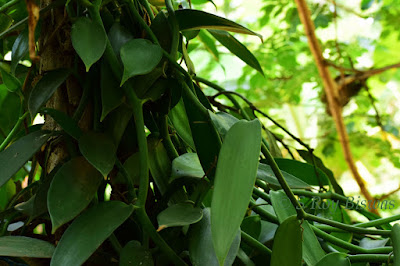
Close up of plant that provides Vanilla essence
Close up shot of Cashew fruit and flowers
A Nutmeg tree in the Spite garden
A Cardamom plant in the Spice Garden
Having returned back Kulem, we again gulped in some packed fruit
juice, cold drinks etc. to replenish our depleted energies and water intake to
offset the loss due to heavy sweating.Thereafter, we boarded the Tempo traveller again and headed back towards
Panjim.On the return leg of the
journey, near the Ponda Township we headed to a Spice Garden (name I do not
recollect or do not want to mention as I am not inclined to provide any
recommendations etc.).The trip to the
spice garden was also a soothing experience, after traditional welcome, we were
offered ginger lemon laced green tea, which was quite refreshing and for the kids
there was a separate paid counter for purchasing cold drinks etc.After a brief introduction thereafter, all
guests were taken around the spice garden on a guided tour and this was
followed by lunch that comprised of typical Goanese cuisine and we enjoyed
every bit of it.Thus, concluded our
journey for the day and we headed back to your apartment in Arpora.
Visiting Dona
Paula and enjoying the River cruise in Goa
A panoramic view of the Dona Paula - confluence of Zuari River with Arabian Sea
I
continue from where I had left off in my previous blog. Having had our lunch we headed back to our
service apartment, so as to avoid the harsh afternoon heat and for a brief
siesta as well. Thereafter, we started
for Dona Paula at around 4.30 P.M in the evening and reached there in about 45
minutes. Dona Paula is a secluded
bay about 7 kms. from Panaji, with its magnificent view of the Mormugao harbour,
it is one of the must visit destinations of Goa. This idyllic rocky tourist
attraction lies at the junction where the Mandovi and the Zuari rivers meets
the Arabian Sea. The Dona Paula monument
is located on a small islet, linked to the mainland by a small bridge and a
quay. However, during my visit the
entire stretch was under renovation and hence the entire area was barricaded
and tourists were not allowed to venture beyond the barricade. But as I had also visited the destination in
2011, I have used my old pictures to convey the real essence of the
destination.
A long shot of the cliff head of famed Dona Paula - present day view
A close up of the Dona Paula - as seen at present from a distance due to repair work
This destination is also steeped in various local
stories about a local lady named Dona Paula, who was in relationship with
Portuguese nobility and hence was killed by being thrown off from the
cliff.A small collections of such
anecdotes read as follows –
Dona Paula as it looked from nearer the site in 2011
The famed 'Image of India' one looking East and other West depicting confluence to two regions
The busy market selling wares of local flavour
One legend has it that she was the lady-in-waiting
of the Governor-General's wife, and in course of time the Governor fell victim
to her beauty and charms. They were found out and the governor's enraged wife
had her stripped and bound and rolled over the cliff, into the sea, wearing
only her string of pearls, a gift of love from the Governor.
A SHORT VIDEO OF THE WATER SPORTS ETC. IN DONA PAULA, GOA
The local fishermen of the area and other natives
of the place narrate quite a few ghost stories about Dona Paula. Even the setting of moon phase has several
connotations in their stories, some say that on moonlit nights, while others
swear that on pitch dark nights and few others say that on the stroke of
midnight, she rises from the sea and roams the area, wearing only a string of
pearls and nothing else.
One of the many jetty s where from one board's the river Cruise boats
As the River cruise in Mondovi River commences
A local fishing boat passes by
Another story that does round amongst the natives
is that on Gasper Dias, a nobleman, on whose estates a fort was built because
of its strategic importance, is also said to have been one of Dona Paula's
lovers. Her ghost, local villagers say, appears looking desperately for the
nobleman.
One of the many floating casinos - The Deltin Casino
Another of the many floating casinos - Casino Pride-II
Another one of the many floating casinos of Mondovi River - Big Daddy casino
However, now a days the most popular legend is that
Dona Paula is believed to have been the daughter of one of the Portuguese
Viceroys and her lover is believed to have been a native fisherman, a
relationship which aroused strong racist feelings amongst the Portuguese, who
got her killed by throwing her off from the cliff.Now her ghost roams at night in search of her
native lover.
A Sea Gull flying around for some food thrown by Cruise passengers
A locally ferry transporting passengers across the Mondovi River from Panaji
A typical Portuguese architecture - a home and a chapel
There is a statute at the rocky cliff head and many
just pass it off as the statute of Dona Paula and her lover.However, the said whitewashed statue sculpted
in 1969 by Baroness Von Leistner and named as the "Image of India"
and is said to be depicting the figures of Mother India and Young India, one
looking to the East and the other to the West. The Wheel of Ashoka, is in the
middle half buried in stone to represent the ancient culture that nurtured this
fusion of ideas and emotions.Apart from
this windswept spot, there are a lot of local water sport activities that are
available here like boating, para-sailing, water scooters, yachting, swimming,
wind surfing and fishing.As for the
ladies there are a lot of small shops selling local and other trinkets, which
one might like to buy as souvenirs of their visit.
Artists performing Dhangar dance during cruise
Artists performing Kunbi dance on the cruise
The artists performing Musal dance during the river curise
The artists performing the Corredinho dance during the cruise
An integral part of Goa landscape - a Chapel by the river side
A panoramic view of the Miramar beach
As the sun sets and sets the water on fire - as seen from the River cruise
Another view of the setting sun from the River Cruise on Mondovi River in Goa
A fast moving river patrol boat of Goa Police
View of the lighted Chapel against the setting sun in Goa
As the sun light fades - the Casinos light up
A close up of the Casino Pride II all lighted up as night falls on Mondovi River
Another cruise boat - all decked up at night with florescent colors glides by
View of the Treebo run serviced apartment in Arpora
A photograph of Salt Restaurant in Arpora, Goa (sourced from web)
Having spent some quality time at Dona Paula, we
retraced our route back to the vicinity of the Panjim Township and visited the
Miramar beach. Thereafter, we headed for
the jetty nearby and purchased the tickets for famed Mondovi River Cruise. The cost the tickets vary from Rs.250/- to
750/- per person based upon the size and amenities being provided in the
boats. We settled for a middle priced
Rs.450/- per head cruise boat. The boat
started its journey at around 6.15 P.M and there was an open deck on which the
tourists were seated, with a small raised platform at one end where from local
disc jockey’s played loud music, inviting the children and ladies in groups to
dance on the stage. After some time a
local troupe performed live local dances and the host described the details of
dances being performed. A short detail
of the dances performed were – (1) Dhangar
Dance - Dhangars, a shepherd community believed to have
migrated from Kathiawar region of South Gujarat and settled in the hilly north western
fringes of Goa; (2) Kunbi Dance - Kunbis,
the earliest settlers of Goa, are a sturdy tribal community, who though
converted to Christianity, still retains the most ancient folk tradition of the
land. Their songs and dance belonging to the pre-Portuguese era are uniquely
social and not religious. The fast and elegant dance by a group of Kunbi women
dancers, wearing traditional yet very simple dresses, lends a colourful touch
to this ethnic art form.; (3) Mussal
Dance - The Kshatriyas, the warrior class of 'Chandor', perform this
dance-cum-song to celebrate the victory of Harihar, the Hindu King of
Vijaynagar over the Cholas in the early 14th century; and (4) Corredinho
Dance - A Portuguese folk dance and a beautiful example of Portuguese cultural
influence, this elegant dance is highly popular among Goan elite youth.
Corredinho Marcha de Fontainhas, a song-cum-dance, is famous for its rhythmic
and exquisite footwork where normally six couples take part. The colourful
costumes are a feast to the eye.
There are vendors who do the rounds on the decks selling their ware,
mostly food items, but very few people were interested in buying, instead most
of us had our eyes riveted on to the nature’s splendour that was unfolding
before our eyes or else enjoying the dance show put forth by the troupe. We returned back to the jetty at around 7.10
P.M and by that time the nightfall had been ushered in and we headed back to
our hotel. That night we dined at a
upcoming shack restaurant known as ‘The Salt’ in Arpora, as it was walking
destination from our place of stay. We
had authentic Goanese food, with the all-time favourite ‘Fish n’chips’ thrown
in, along with main course and we enjoyed the ambience, food & service to
the hilt. Thus, ended our second day of our Goa tour.
As we happened
to reach Goa on Monday evening, we had not planned for much for that day,
taking into consideration the fact that flights at times get delayed. The furnished apartment that I had booked for
our stay in Goa was in North Goa and in Arpora locality. As the Baga
beach was the nearest and in a walking distance, we decided to visit this
destination in the evening. Baga is located at the north end of the contiguous beach
stretch that starts from Sinquerim, Candolim and stretches right up to Calangute. We spent the evening enjoying the various
activities taking place in the beach and also enjoyed the sun set from the
Beach. The beach has a long row of
colourful umbrellas with sitting decks placed below them in a neat row all
along the coastline. Since we had placed
ourselves in a serviced apartment, we through it fit to have our dinner at the
beach side shack and then head back to the apartments. Accordingly, we decided to dine at the
famed shack, called as St. Anthony’s running since the 1960’s and we enjoyed our
evening to the hilt, as the ambience as well as the food was worth every penny
spent.
Here is a short video of the Baga beach
Early next
morning, as scheduled by us, especially it being a Tuesday, we had decided to
visit the temples in South Goa and the Churches in Old Goa. Accordingly, we
started in the hired vehicle early in the morning, so as to avoid the stinging
late morning/afternoon sun.The first
destination visited by us in South Goa was the famed Balaji temple, which is
situated in Kunkulied village. The
temple whose full name is Tirupati
Balaji Padmavati temple and it is placed amidst a lush green complex, with a
carpet of grass that is interspersed with flowering plants, provides for a
soothing experience.The temple complex
consists of the main temple, housing a tall statue of Lord Balaji and similar
in appearance to the deity in Tirupati.Next to this main temple is a smaller temple dedicated to Lord Ganesha
and Goddess Padmavati and this temple complex too like all the other temples in
south India has a tall ‘dhwaja stambha’.Despite having started early, walking on the
paved path was next to impossible due to the heat and we had to trudge
alongside on the green grass.Having
paid our obeisance in the temple, we proceeded further to visit the next temple
in South Goa.
The entrance to the famed Balaji temple
The lush green temple complex of Balaji temple
The most famous temple destination in South
Goa is the Mangeshi temple, which is
about 450 years old and dedicated to Lord Shiva and is situated in Ponda.The main features of this temple is the seven
story lamp tower called ‘deep stambha’
and a magnificent water tank that is considered to be the oldest part of this
temple complex.Apart from this there is
also a prominent Nandi Bull in the temple precincts.Earlier the temple was well exposed for
viewing, however, at present the corridor in front has been covered thereby
obscuring the temple façade to some extent.It is one of the most beautiful temples in Goa and is a must visit
destination.
The magnificent 'Deep Stambh' in Mangeshi temple
The corridor in front of the main temple in Mangeshi
The water tank in Mangeshi temple
We retraced our
way back to Old Goa to visit the old churches there, as it was the part of Goa that
housed the Portugese invaders and they had developed many churches in the
region over the centuries.These
churches are really an architectural wonder in their own rights.The first of such church that we visited was the
Basilica of Bom Jesus, which is
famous for housing the mortal remains of St.Francis Xavier and is also an
UNESCO heritage site.No amount of
narration would truly portray the architectural beauty of this church and I
would rather let the photographs do the talking.
The outer facade of Basilica of Bom Jesus
The inside view of the altar of Bom Jesus church in Old Goa
An ornate altar inside the Bom Jesus church
Another close up view of the altar inside Bom Jesus Church
A painting inside the church of Bom Jesus depicting remains of St.Francis Xavier
The next church
that we visited was the Se Cathedral
that is located right across the road, opposite to the Basilica of Bom
Jesus.The
main entrance of the cathedral has Latin inscriptions of Corinthian columns.
Out of the eight chapels in the Church, two have ornamented perforated wooden
screens and remaining six panels have scenes of Saint Catherine’s life carved
on them. This filigree carving gives a royal look to the place. The Chapel of
Blessed Sacrament is famous for decorated wall and ceiling painting. The arches
of the altars are decorated with old paintings. One can also find many small statues,
wooden figures and other artefacts.The
Se Cathedral also holds a huge brass bell called as Golden Bell that is the
largest in Goa. The main altar of the church stands as a dedication of
Catherine of Alexandria.Only a
pictorial representation can do justice to the beauty of this church as well
and you may enjoy the photographs.
A panoramic view of Se Cathedral
View of the altar of Se Cathedral
Close up of the altar in Se Cathedral
One of the statutes inside Se Cathedral
Chapel of Blessed Sacrament inside Se Cathedral
St. Catherine of Alexendria inside Se Cathedral
By
the time we were finished with visiting the Churches, we were totally famished
and being a Tuesday, we had to have a vegetarian food only and hence as advised
by our driver, we headed for Krishna Restaurant to have our lunch, which is in the vicinity in Old Goa. The driver dropped us there and went for
lunch, but thereafter, despite calling on his mobile number umpteen number of
times, it was found to be unreachable and with all the camera equipment in the
car, there was a sense of panic that set in and just as I was about to approach
the local police, the driver came in claiming that his mobile has malfunctioned
and thereafter, we headed back to our service apartment.I am putting this incident on record so that
all those who follow my blog do not leave their costly equipment in their hired
vehicles to avoid unnecessary stress and anxiety.
Family having lunch at Krishna Vegetarian Restaurant