The view of the entry gate to the Nature awareness center & camping site
A counter set up at the entry gate - colorfully decorated with animated figures
Panoramic view of the camping site in the center
I
have posted several blogs in the past about the various tourist destinations in
Ranikhet, although they too did not contain details of all the
destinations.However, of late Ranikhet
is being developed as an eco-tourism destination and in this series the second
such center to be developed by the Almora Forest Division is the ‘Ranikhet Nature Awareness Center & Camping
site’.This center has been
developed near the famed temple of Binsar Mahadev and this region is a notified
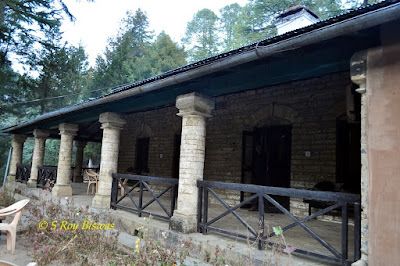
forest area, with a British era ‘forest rest house’ situated in the vicinity
and me alongwith some of my office friends had stayed there way back in
December, 2013 (am sharing a few of those photos to give a visual feel of the
area about ten years back).This center as
has been set up now, was inaugurated by the local MLA Shri Karan Mahra on 12th
August, 2021.
The British era forest guest house in the vicinity of the Nature awareness camp
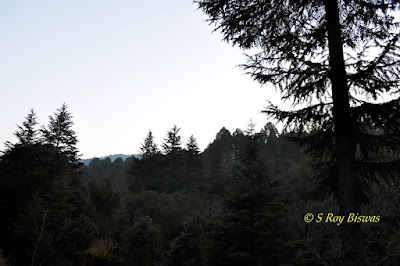
A silhouette of the Binsar forest in early morning
A Verditer flycatcher in the Binsar forest
This
center is situated near village Sauni, which is about 12 Kms. away from
Ranikhet on the Ranikhet-Ramnagar State Highway. On this Highway itself, as one traverses
towards Bhatraujkhan, the road bifurcates from a point called Soni daat (about
1 Kms. from Sauni village) leading towards the famed Binsar Mahadev temple and
other villages beyond like Devlikhet, Chamarkhan etc. and after traversing a
distance of about 600 odd meters, one comes upon the entry gate of the said ‘Ranikhet Nature Awareness Center & Camping
site’. The site has been developed
along a small rivulet flowing through the forest and there are about 09 (Nine)
riverside camps that have been set up with several common toilets placed
alongside for facilitating the visitors during their stay. In order to provide proper security, within
the environs of the forest, this area is properly fenced all around, to protect
it from encroachment by the wild animals.
The place has a big dining space cum restaurant, where the resident
visitors as well as the other daytime visitors can order some food and
drinks. The cost of stay per tent for
two persons is Rs.1500/- per night. The
region boasts of a plethora of birds and for adventure tourism lovers there is
mountain bike trail with cycles being provided (at a nominal cost) to the
visitors alongwith treks within the forest also being organized through trained
guides. A 3D small movie theater with a
seating capacity of about 15 (Fifteen) persons is also operational for the
visitors at a nominal fee. The entire
complex has been tastefully decorated with paintings of birds and animals
painted on the buildings within the complex.
It is a must visit destination for nature lovers (I have placed a copy
of the pamphlet of the complex for contact purpose.) and here is a link to the
inaugural function of the camp - https://ne-np.facebook.com/theproductionpronews/videos/199782995512894/
Nature awareness
center and camping site, Soni village,Ranikhet is on Facebook also (may check out the photos) - https://www.facebook.com/sonitourism/
ॐ Ranikhet – a few new Eco-destinations (Forest Healing Center)
The entry gate of the Forest Healing Center
I
have posted several blogs in the past about the various tourist destinations in
Ranikhet, although they too did not contain details in respect of all the
destinations, but only the major attractions.Since these blogs were posted a long time ago, in case some of the
readers missed out on them, I am providing a link to my blogs –
However, of late Ranikhet is being developed
as an eco-tourism destination and in this series the first such center to be
developed by the Almora Forest Division is the ‘Forest healing center’ in Kalika, Ranikhet.Inaugurated on the 7th of March,
2021 by the Research wing of the Uttarakhand Forest Department, this center is
spread over an area of 13 Acres of pre-dominantly Pine and mixed forest
areas.The Chief Conservator of Forest
(Research) of Uttarakhand, Sh. Sanjiv Chaturvedi while addressing the Press
during inauguration ceremony stated - ''It
draws inspiration from Japanese technique of forest bathing (shinrin-yoku) and
ancient Indian traditions and that basic theme is, be silent, go slow, think
less and feel more." – here is the link to the news item regarding the
inauguration of the said site - India's
first forest healing center inaugurated in Uttarakand's Ranikhet -https://www.hindustantimes.com/environment/indias-first-forest-healing-centre-inaugurated-in-uttrakand-s-ranikhet-101615184202227.html
The direction board at main road junction of Kalika temple
A Instruction panel inside the Forest Healing Center
An information panel inside the Forest Healing Center
Now
let us try and understand the Japanese concept of ‘Shirin yoku’, it literally means as – ‘Shirin’ is Forest and ‘yoku’
is bathing.Forest bathing concept—basically
means just being in the presence of tree and it became part of a national
public health program in Japan in 1982.Nature
appreciation—picnicking en-masse under the cherry blossoms, for example—is a
national pastime in Japan.From 2004 to
2012, Japanese officials spent about $4 million dollars studying the
physiological and psychological effects of forest bathing, designating 48
therapy trails based on the results. Qing Li, a professor at Nippon Medical
School in Tokyo, measured the activity of human natural killer (NK) cells in
the immune system before and after exposure to the woods. These cells provide
rapid responses to viral-infected cells and respond to tumor formation, and are
associated with immune system health and cancer prevention. In a 2009 study,
Li’s subjects showed significant increases in NK cell activity in the week
after a forest visit, and positive effects lasted a month following each weekend
in the woods. This is due to various essential oils, generally called phytoncide,
found in wood, plants, and some fruit and vegetables, which trees emit to
protect themselves from germs and insects. Forest air doesn’t just feel fresher
and better—inhaling phytoncide seems to actually improve immune system function and
positive effects lasted a month following each weekend in the woods.This is due to various essential oils,
generally called phytoncide, found in wood, plants, and some fruit and
vegetables, which trees emit to protect themselves from germs and insects.
Forest air doesn’t just feel fresher and better—inhaling phytoncide seems to
actually improve immune system function.
Types
of phytoncides
α-pinene
d-limonene
β-pinene
sabinene
myrcene
camphene
A representative image of the impact of the various phytoncides on our body (sourced from the internet)
Therefore, conceptually
forest bathing is a slow process, for example to discover the answer, masters
do nothing but meditate in forests to gain illumination. Forest bathing works
in a similar manner, just be with the trees and let the phytoncides interact at the molecular levels in the human cells. No hiking, no counting steps on a Fitbit but
imbuing the essence slow and steady. You
can sit or meander, but the focus point is to relax rather than accomplish
anything.Activities associated with the
Forest Healing Center thus, involves many activities like forest walking,
tree-hugging, forest meditation and sky gazing.The trail in the Forest Healing Center, Kalika, Ranikhet has also been
designed as such, so that people visiting this destination can sit in leisure
and have a slow walk inside, with wooden platforms and canopies built for
resting and rejuvenating and this helps in healing of both the mind and the
body.A must visit destination for the
nature lovers and a brilliant initiative of the Forest Department, Almora for
this futuristic endeavor in the country.
An observation cum resting 'Machan' erected inside the Forest Healing Center
Another informative board inside the Forest Healing Center
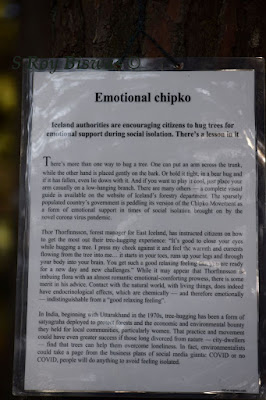
A informative bulleting about 'Chipko movement' inside the Forest Healing Centre
Here is a link to a
short video of the destination -
I used to visit Ranikhet region to
take care of my property every few months, whenever my engagements with work
permitted.However, during the previous
year, due to the Corona pandemic, I could visit village Badankhet/Timila only in
November, 2020 during the entire year.So in order to keep my track record of the blog continuing in 2021, I
had posted about this trip in January, 2021 and that was the only blog that I
could post last year.As I myself got
afflicted with Corona in March end/early April, 2021 and the continued
lockdowns and stringent measure in force, I could only visit my village again
in end of October in 2021.With the
advent of newer Corona strain spreading its wings, I am posting this blog in
January, 2022 to atleast keep the yearly tab filled albeit the fact that this
time around I did go around a bit and will be posting a few more blogs in this
series.
Distribution of rainfall during the disaster in October, 2021 (sourced from web)
Devastation caused by the rains during October, 2021 in Naintal (sourced from the internet)
After the curbs imposed by
Uttarakhand Government were eased to some extent, coupled with the fact that
our family had got itself double vaccinated, I decided to visit my home in
village Badankhet/Timila in end of October, 2021 as most of the official
engagements had been rounded up for the time being.We were getting ready for the journey, after being
struck in our home for about a year in Delhi, we were very excited about the
intended trip, sans our kids who had decided to stay put in Delhi because one
of them was busy with his online job and the other with online classes,
internet accessibility being a problem in the village home.However, news started trickling in from the
late evening of 18th October, 2021 about incessant rains hitting the
Kumaon region hard and by the next day, it had attained alarming proportions
akin to 2013 calamity in Garhwal region i.e. when Kedarnath tragedy took
place.By the time the rains slowly
relented by late evening of 20th October, 2021 and a clearer picture
emerged the next day i.e. 21st October, 2021 it could be seen that
Nainital district of Kumaon region was the worst affected (I have placed a
graphical representation sourced from the internet) and most of the roads etc.
in the Kumaon region were very badly affected.All the tourists and trade routes had been devastated and it would take
months to rebuild.Only the State
Highway route running from Ranikhet to Ramnagar/Corbett, across my village,
remained the only source of road communication that linked the hills to the
plains below.We had become apprehensive
about our trip that was to commence on the 25th of October, 2021
because of the road conditions.After
talking to few locals over telephone we were informed that instead of the usual
route running from Delhi-Ghaziabad-Moradabad-Ramnagar-Mohan-Totam-Bhatraujkhan-Ranikhet,
we were required to divert our route a little by diverting towards Marchula
just before Mohan and take to the roads towards Chimtakhal (before reaching
Marchula) and travel through some small nondescript villages before reaching
Bhatraujkhan via Machor.(here is the link to the news about the devastating floods
- News report about the floods in Uttarakhand in October, 2021)
Passing through some pristine nature
Mobile signal towers now perched even in remote villages
Not being familiar with this new
route, although the road upto Ramnagar and a little way beyond it would be the
same, but thereafter we were totally unaware of the road conditions etc., hence
we started very early in the morning from Delhi.Part of the journey has been covered by me in
the video that is embedded below in the blog.The road conditions were excellent, as travelling after a year, we found
that most of the flyovers etc. that had been under construction during the
journey during the previous year had been completed and we went past Ghaziabad
in a jiffy.Earlier, the Ghaziabad part
was a real headache, as traffic, especially two-wheelers would travel on the
opposite direction on the roads, thereby making the passage narrower and
consequently leading to huge traffic jams.But it had become a thing of the past, but a new issue awaited us on the
Highway, it was compulsory use of ‘Fast tag’ to be affixed on the Car, for
smooth passage across various toll plazas maintained by the NHAI on these
roads.After waiting for about half an
hour, we were able to get the ‘Fast tag’ affixed and thereafter, the journey
was smooth.We reached Gajraula well in
time for B’fast at Bikanerwala and proceeded ahead with our journey.The road till Moradabad crossing of the
National Highway is in prime shape, but thereafter it is a mess till one
reaches Thakudwara and this portion consumed a lot to time.Thereafter, we again got struck in a jam at
Kashipur due to construction of a flyover in the township and apparently very
little progress has been made, since my last visit a year ago.However, after having gone past this
irritant, we crossed Ramnagar smoothly and just before Mohan we turned left
towards Marchula and this road leads towards Pauri Gharwal via Manila.The road though narrower, passes through some
really nice landscape, with very few vehicles, but is bereft of facilities like
food joints etc.The road takes a U-turn
from Chimtakhal and passes through nondescript villages like
Godiyon-Kankot-Toliyun-Khabli-Burjangarhi till it joins the earlier taken road
just before Machor village.This road is
about 14-16 Kms. longer than the normal route through Mohan and Totam and hence
it took us about an hour longer to reach our home than usual.It was late in the evening that we reached
home and after having an early dinner, we retired for the night.
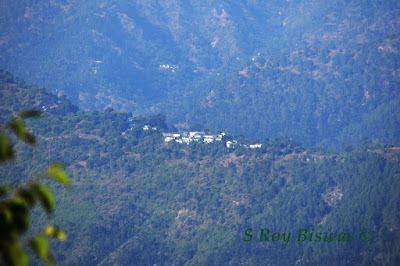
A small village perched on a ridge
A typical village with a temple as seen on the road
Birds eye view of Ramganga River flowing by Bikhiyasen as seen from Harara village
We returned back to Delhi on 31st
October, 2021 and by that time the road from Mohan side had been opened for
traffic and hence we descended towards Ramnagar from this side.The place where the road had been blocked
near Totam has been covered in the video.But due to the blockade of the Highway by the infamous Kiasan rally activists
at Ghaziabad border, we had to take a torturous detour and were delayed at the
last leg of our journey by more than two hours and thus concluded our one and
only journey for the year 2021.