Buoyed
by my visit to the Sultanpur Bird Sanctuary during the last week of February
(as detailed in my previous blog), my legs were itching to visit the other main
winter birding site near Delhi
i.e. Okhla Bird Sanctuary. As I was still
tied up with my office work, I got the opportunity to visit this pristine
destination in the second week of March and I was quite apprehensive about
seeing any of the migratory birds, as the weather had turned a wee bit warmer. However, armed with my camera I decided to
visit the destination with my driver and a friend.
Grooming session in progress
The
Okhla Bird Sanctuary is situated in Gautam Budh Nagar in the middle of the
Okhla Vihar and Barrage upon the river Yamuna in New Delhi. In order to conserve the numerous
resident and migratory birds that are found here and also keeping in view the
tourist inflow, this area was declared as Okhla Bird Sanctuary in 1990. Towards
the south of this sanctuary we find Kalandi Kunj which is another picnic spot. We made our way from Dwarka towards NOIDA by
the DND flyover and before entering NOIDA, we took the turn heading towards
Mayur Vihar Phase-III. As soon as you
get down from the flyover, where the road meets the main road coming from NOIDA
towards Mayur Vihar/Akshardham temple, one has to take a left turn heading
upwards and again turn further left till you reach the main gate of the
Sanctuary, which is about 1.5 Kms. from the main road. We took the wrong turn towards the right and
ended up at a road end, where I found a pair of monkeys grooming each other and
then asked the guard about the directions and headed towards the Sanctuary.
A Black Kite
A Purple sunbird
Red Vented Bulbul
Black Kite in flight
The sanctuary came about into existence
with the construction of the Okhla Barrage way back in the late 1950s and 1960s
and is right on the Yamuna River between Delhi and Uttar Pradesh at the
south-eastern end of Delhi on one side and the western boundary of NOIDA. With YamunaRiver
being on the route of Migratory Birds and providing large space with suitable
habitat on its both banks and suitable food in plenty, the birds had been using
this area as a staging post for their migration both ways during the
winter. Over Three hundred species of
birds (out of about 450 species recorded for Delhi
and around Delhi)
can be spotted here. The spot is good for birding throughout the year, though
best season is during September-March for Winter Migratory Birds. Amongst these, around more than 50% are
migratory birds coming from Tibet,
Europe and Siberia that come here for their
winter migration. With the onset of the winter season in November, the arrival
of migratory birds starts and with the onset of the summers around March, those
visitors start flying back to their own land.
The migratory birds visiting the sanctuary during the winters are - the
Northern Shoveller (Anas Clypeata)
and Gadwall (Anas strepera). The
Northern Pintail (Anas acuta) and
Ruddy Shelduck (Tadors ferruginea),
the rare migratory birds like the Garganey (Anas
querquedula), Common Shelduck (Tadora
tadorna), Comb Duck (Sarkiodiornis
melantos) are also seen occasionally. Other common species include the
Common Teal (Anas crecca), Tufted
Duck (Aythya fuligula), Common
Pochard (Aythya ferina), Greylag
Goose (Anser anser) and the
Bar-headed Goose (Anser indicus). The
resident Spot billed Duck (Anas
poecilorhyncha) is abundant. There are several other bird species like
Mynas, Drongos, Babblers, Francolins, Peafowl, Bee eaters etc. are also seen
commonly along the bund.
Spot billed duck
Common Moorhen
Cormorant
Cormorant sunbathing
A Lapwing nest
Northern Pintails
Northern Pintails
Brown headed Gull
The
entry to this place opens at 7 am and one can drive their own car right till
the last point on the mud trail near the watch towers. Apart from some morning
walkers, only serious bird-watchers frequent this place.
Entry &
camera charges:
For Car/Jeep - Rs.100/-
For still camera - Rs.30/-
I am enclosing a sample of the scanned copy of the booklet issued at the entry
gate, listing the details of the birds and fee etc.
I had last visited Sultanpur Bird Sanctuary near Gurgaon
way back in 2007 and that too without having any knowledge about the place and
hence could not get very many pictures of the destination. Having visited Rankhet region in January and
due to pre-occupation in the office, I could not find time to visit any of the
winter birding sites near Delhi during the winters. Therefore, when the weekend offered some
respite from the office work, I immediately made announcement of the
forthcoming trip to Sultanpur on the last Saturday of 2013 and made
preparations likewise. However, on the
ensuing night of travel, I was suddenly jolted out of my slumber by a thunderous
thunder clap, caused by a thunder that had struck nearby, rattling the window
panes et al. It started pouring cats n’
dogs, but the optimist in me reassured that in Delhi such thunder showers are
only passing phase and it would settle down in a hour or so. Slowly, as my ears got used to the repeated
thunder claps, I gradually receded back to sleep. However, as my alarm clock buzzed, I found
that it was still raining outside. By
this time my wife also had got up and started getting the food stuff etc.
organized for the picnic, we were to embark upon. Even the driver rang up on the dot, seeking
advice regarding his reporting time, which I promptly postponed by an hour and
informed him that I would be calling him up, as and when we were ready to leave
or inform him if the trip was off. But I
could not find any signs of the sky relenting and slowly the pessimist in me
took over and I went back to my bed. My
wife, however, refused to take the matter lying down and she started surfing
the internet and searched the weather sites, looking for the exact weather
conditions prevailing in Sultanpur.
Suddenly, she called me out aloud and informed me that the weather would
remain overcast, but the chances of rainfall in Sultanpur were very scarce till
2.30 P.M. in the afternoon. Her argument
was that in any case I would have covered the park by that hour even if we
reached there by 11.00 A.M, I reluctantly got out of the bed, only partly
convinced and thus, the credit for this entire trip goes to her optimism.
Overcast Dwarka
Entering Gurgaon
Sheetala Mata temlple in Gurgaon
We
started almost two hours late than the originally scheduled time of 7.00 A.M.
and started a little after 9.00 A.M. from Dwarka and found that the roads were
empty and conditions heavily overcast as the drizzling continued. We got past Dwarka and headed towards
Gurgaon. On the Old Gurgaon road, after
going past the Bijwasan crossing & then past Kapashera, we finally crossed
over to Gurgaon. Being a Saturday, it
was working day for many a factory workers and the road till the Maruti Company
was awash both with a sea of people alongwith that of the actual kind i.e.
Water logging. The progress was slow,
but as we headed away from Delhi the drizzling stopped and by the time we had
got past Gurgaon, there were patches of blue sky visible. We reached Sultanpur at around 10.30 A.M. and
immediately headed for the ticket counter and luckily we were one of the first
to reach there. The ticket price is
reasonable with an entry fee of Rs.5/- per person, parking fee @ Rs.10/- ,
Still Camera @ Rs.25/- and any Video Camera (professional or otherwise) @
Rs.500/-, since we were carrying all the articles listed, I purchased tickets
worth Rs.560/- for entry to the Sanctuary.
Thereafter, we head our B’fast in the car itself, properly arranged by
my better half and then headed into the Sanctuary. But as we were about to enter, it started
drizzling and I immediately covered my gear with weather cover provided in the
Lowepro Camera Bag and took out my Umbrella, a wee bit skeptical as to whether
we would have smooth or a rough time inside.
My negative thoughts were blown away along with the drizzle by a strong
gust of wind and despite being overcast, we had a fairly comfortable visit to
the Sanctuary.
Countryside on way to Sultanpur
Had rained earlier but blue patches of sky appear in distance
Sultanpur National Park is located 16 kms from Gurgaon, on the Gurgaon-Farrukhnagar stretch, off the Delhi - Jaipur Highway (NH-8). Sultanpur
National Park falls in the Gurgaon
district of Haryana,
surrounded by Kaliwas village in the North, Sadhrana village to the South,
Sultanpur village to the West and Chandu village to its East. Typical of the
area, the geography is semi-arid (it borders Rajasthan), and has been notified as an Eco Sensitive Zone by the
Govt. of India (Ministry of Environment & Forests). The Sultanpur Lake was a seasonal lake and originally
used to fill up in the monsoons only, but is now fed with water from the Yamuna
River. It is surrounded by marshes around it, and lush greenery, especially in
the monsoons. The area surrounding the lake is filled with reeds and grasses,
but no large trees. Although the name of
Sultanpur Bird Sanctuary has been associated with the great Indian
ornithologist Dr. Salim Ali, but the credit of actually identifying the place
goes to Mr.Peter Jackson, a keen bird watcher and the then Honorary Secretary
of the Delhi Bird Watching
Society. Mr.Peter Jackson, along with
his friends, used to frequent the Najafgarh Lake to watch birds in the early
1950s. This lake was created as a result of excessive monsoons and a blocked
drain into the Yamuna. However, by the mid 1960s, the govt. of Delhi had cleared
this blockage in the drain and the Najafgarh lake had disappeared, and so had
the birds. Jackson traveled further north to see where the birds could have
moved on to and discovered another lake created by the monsoons. This was the
Sultanpur Lake. The lake was full of fish and insects and had lush
surroundings, all of which attracted birds from all over the region.
On the way - Indian Roller
On the way - Grey hornbill
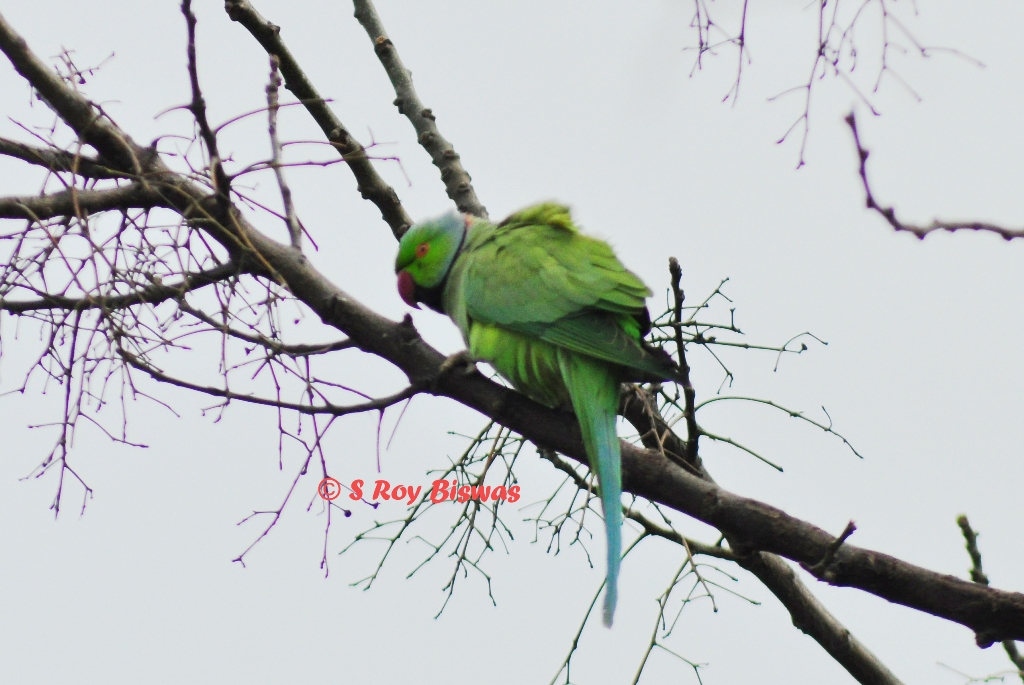
On the way - Alexdrine Parakeet
On the way in Dwarka - Black Eastern Redstart
On the way - A Kingfisher
Over the next few
years, Jackson took many bird lovers, including Dr. Salim Ali to this lake.
Finally, in 1970 Mr.Jackson approached the then Prime Minister of India, Mrs.
Indira Gandhi, with a request to convert the lake and its surrounding areas
into a bird sanctuary. Ms.Indira Gandhi, who was also the founder of the Delhi
Bird Watching Society, took keen interest in this proposal and instructed the
Govt. of Haryana to
undertake the project. Thus, in 1972, the Sultanpur
Bird Sanctuary was created from
the 359 acres of land surrounding the lake.Twenty years
later, on the 13th of July 1989, Sultanpur was upgraded to the status of a
National Park. The Govt. of
Haryana took many steps to ensure the long term sustainability of the
sanctuary. While the lake was originally a monsoon-fed lake, the Govt. made
arrangements from the Yamuna River to ensure that the lake now functioned
through the year. Additional trees such as Neem and Acacia were planted along
the lake, as these trees are known to attract birds. Few artificial islands
were also created in the lake, to facilitate the roosting of the birds.
In Sultanpur Bird Sanctuary - a bill board
Right at the entrance - White wagtail
A huge bee hive
Water birds galore
Black & white - A cormorant & an Egret
Common Moorhen
Cheetals resting
Close up of a Cormorant
Eurasian Spoonbill landing & a Kingfisher on the branch watching
Spoonbill in flight
Neelgai or Swamp Deer
Norther Pintails
Norther Pintails in flight
A Northern Shoveller in flight
Purple Moorhen
Birds roosting
Today Sultanpur
National Park offers visitors a glimpse to over 250 different bird species,
bulk of which (150+) are the resident avian population and the remaining (100)
are migratory birds, which come in from as far as Siberia, Turkey, Afghanistan
and East European countries. Amongst
the resident Bird Species, a few are - Purple Sunbird, Eurasian Thick Knee,
Common Hoopoe, Black Headed Ibis, Little Egret, Great Egret, Cattle Egret,
Common Hoopoe, Painted Stork, Paddyfield Pipit, White Ibis, Black Headed Ibis,
Crested Lark, Eurasian Collared Dove, Laughing Dove, Red Collared Dove, Little
Coromorant, Indian Cormorant, Common Spoonbill, Gray Francolin, Rock Pigeon,
Magpie Robin, Weaver Bird, White throated Kingfisher, Red Wattled Lapwing,
Plover, Indian Roller, Red Vented Bulbul, Rose Ringed Parakeet, Common Mynah,
Bank Mynah, Green Bee Eater, Greater Coucal. Although, the Bird Sanctuary once boasted of
hosting the Siberian Crane, it was last recorded in 2009 and amongst the other Migratory
Bird Species that visit the lake every year are - The Demoiselle Crane, Greater
Flamingo, Common Teal, Yellow Wagtail, White Wagtail, Northern Shoveler, Black
Winged Stilt, Ruff, Common Greenshank, Spot billed Pelican, Rosy Pelican,
Spotted Greenshank, Starling, Bluethroat, Spotted Sandpiper, Eurasian Pigeon. Striped
Snipe and Brahminy Duck are also visible in winters, though not very often. Apart from them, there are other wild life of
four legged variety that can be seen in the National Park, namely - Striped
Hyena, Leopard, Blue Bull, Nilgai, Black Buck, Four Horned Antelope, Wild Dog,
Mongoose, Hedgehog, Caracal, Indian Porcupine, Wild Cat and Rattle Badger. Not
all of these are originally from this habitat; some of them were introduced by
the Govt. to create a better overall balanced ecosystem habitat in the area. However, as far as flora of the region goes,
the area is a dry deciduous forest with primary vegetation is grasses like
Savannah, and trees like Jamun, Khair (Acacia), Ber, Tendu, Banyan and Dhok. However, the forest surroundings are covered
with small grasses and bougainvilleas that have been entirely created by humans
and leave an evident touch of human hands intervening in the pristine natural
vistas. We enjoyed every bit of our
sojourn to this place, till we were brought back to the city environs by a
large group of ladies of all sizes & shapes strutting around the perimeter
talking & conversing loudly. I
thought that I would have the place to myself after they go past, but in came a
cacophony of primary school students, led by their teachers and I realized that
my trip for the day was all but over and as I moved out of the nature zone, it
had started to drizzle, as aptly forewarned by the weathermen for the day.
I had visited the destination in 2007, but had just put in a cryptic little blog for Sulekha, as they were the starting days for me of posting blogs. However, I have not shifted the blog to this site and accordingly, have penned a fresh travel blog. The occasion was the annual convocation being organized by the office was working for at that particular point of time and we had to visit the destination to tie up the ends and finally had to open a camp office in Chennai for a week at the time of the Convocation in February, 2007. After conclusion of the Convocation and having wound up the work, I availed a days leave to explore Mahabalipuram also.
Ripe Palm fruits
Chennai is an unusually hot place and even in month of February, we were able to get ripe Palm fruits being sold by the road side when we went visiting Mahabalipuram. Madras was one of the first outposts of British East India Company founded in 1639, when the British East India Company (represented by Francis Day and Andrew Cogan and aided by a local translator Beri Thimappa) was granted land to build a trading settlement by the local Telugu ruler (Nayak) of the suburb of Vandavasi, Damerla Venkatapathy Naidu on his father's name Damerla Chennappa Naidu. The document of the land grant is dated 22 August 1639, and hence Madras celebrates its birthday on 22 August each year as Madras day. Madras is derived from Madraspatnam, a name given to the area when the British negotiated settling there with Damerla Venkatapathy Nayakudu. The British built Fort St. George (today the legislative and administrative seat of the state). Fort St George was completed on St George's day in 1640 (23 April) and hence was named after the patron saint. George Town then developed becoming the modern city of Madras, absorbing several nearby boroughs. Thomas, one of the twelve apostles of Jesus Christ, is associated with Chennai. In 1996, the Tamilnadu government renamed Madras to Chennai providing the reason that 'Chennai' was the city's traditional name while Madras was one derived during colonial rule.
Marina Beach in Chennai
Covelong Beach - on way to Mahabalipuram
Being situated on the coastline of India on the Indian Ocean side, there are quite a few beaches around Chennai, the most famous amongst these beaches are – i)Marina Beach, which is a 12 km long and offers excellent opportunities for walks and has a very wide sandy foreshore. Its width is up to 300 m (985 ft). The Marina of Madras is the second longest urban beach in the world. The South Beach Road runs past the Madras University, the Senate House, the Chepauk Palace; ii) Edward Elliot's beach, is spread along the coast down south from Marina. This beach is comparatively quieter and it is located near Besant Nagar. At the end of this beach are the Velankanni church and the Ashtalakshmi temple; iii) Breezy Beach is located in the quiet neighborhood of Valmiki Nagar (Thiruvanmiyur) in Chennai. It is smaller and less popular than the Elliot's beach; and iv) Covelong as it was known earlier is a small fishing village located 40 km (25 mi) from Chennai on the way to Mahabalipuram. Now it is a luxury beach resort. There was a fort built by the Nawab of Carnatic, Saadat Ali. It was here that the French General Labourdonnais landed his troops in 1746. Later it was taken by Robert Clive in 1752 and destroyed. The Beach is separated from the mainland by the canal running from Chennai to Mahabalipuram. I had the opportunity to visit the first named and last named beaches due to paucity of time.
The panoramic view of Ratha temples in Mahabalipuram
Mahabalipuram is situated 60 Kms. south of Chennai and easily accessible by road throughout the year. Chennai in turn is accessible both by Air & Rail/Road from across India. The best advised visit window is between December to February, as one has to trek a vast stretchs on foot to explore the entire Temple complex. Mahabalipuram is a 7th century port city named after Pallava king Mamalla. It was built between the 7th & 9th Centrury AD and comprise of various temple complexes built in Dravidian style of architecture and reflect distictive influence of Buddhist elements of rock cut sculptures & design - It has been declared as a UNESCO Heritage site. The temples comprise of three main categories - Cave Temple, Rathas (sculpted out of monolithic natural stone formations) and sculpted relief’s on rock faces.
The Mandapams in Mahabalipuram
The ancient Mamallapuram, as Mahabalipuram was formerly known, was flourishing port town of the Pallava rulers of south India who chiseled in stone a fabulous "open-air museum" of sculpture under the vault of a burning sky. Most of the temples and rock carvings of this place were built during the reigns of Narsinha Varman I (AD 630-668) and Narsinha Varman II (AD 700-728). Though the initial kings of Pallava dynasty were followers of Jainism, the conversion of Mahendra Varman (AD 600-630) to Shaivism led most of the monuments to be related with Shiva or Vishnu.
Places of Interest -
The Five Rathas - The five Rathas were fashioned like the wooden chariots drawn during those times and include the Dharmaraja, the Bhima, the Arjuna, the Draupadi and the Sahadeva. The Five Rathas, about 200 m south of the main hill, were fashioned out of a smaller hill sloping down from the south. From the largest part was made the biggest of the five rathas, the Dharmaraja. Then followed onwards north, in the descending order of height, the Bhima, the Arjuna and the Draupadi. A little to the west of Draupadi there was a comparatively large rock and out of it the Sahadeva Ratha was made. Immediately in front of the Draupadi again two smaller rocks were sculptured into an elephant and a lion. Behind the Draupadi and the Arjuna, which stand on a common base, there is a Nandi.
The pinnacle of Dharmaraja Rath in Mahabalipuram
The Draupadi Rath in Mahabalipuram
Closeup of the elephant behind Draupadi Rath
Nandi Rath behind Arjuna Rath in Mahabalipuram
The Bhima Rath in Mahabalipuram
Mandapas - The main hill at Mamallapuram is dotted with pillared halls carved into the rock face. These mandapas, with their graceful columns and intricate figure sculptures bear witness to the artistry of the Pallavan rock cutter. The ten pavilions at Mamallapuram, of which two are unfinished, were designed as shrine, with a sanctum and on outer hall. The shallow porticoes are adorned with exquisite sculptures of gods, goddesses and mythological figures. The Ganesh mandapa is an active shrine even today, with the idol of the elephant-god being revered by the faithful, fourteen centuries after it was first consecrated. Beyond the circular rock called Krishna's Butterball is the Varaha mandapa dedicated to the two avatars of Vishnu as Varaha the boar and Vamana the dwarf. The pillars of this pavilion are perhaps the earliest to display a motif that became the signature of southern architecture-the lion pilaster, where a heraldic lion support ornamental pillar. The Mahishasura mardini mandapa has the goddess Durga in bas relief, slaying a buffalo-headed demon, and the Vishnu Sayana Mandapa shows Lord Vishnu lying under the protective hood of the seven-headed serpent Adishesha. Of the other mandapas, the Panch Pandava mandapa, that is unfinished, has a more elaborate facade. Its pillars are adorned with rearing lions springing from the capital, and the shrine is the only one surrounded by a passage which allows passage around it's circumference.
Mahisasur Mardini relief in Mahabalipuram
The reclining Vishnu relief in Mahabalipuram
Arjuna's Penance - This skillfully carved rock is the largest bas - relief sculpture in the world. It gets its name from the figure of an ascetic who is believed to be Arjuna, the hero of Mahabharata, doing penance to obtain a boon from Lord Siva. However, there are others who think that the figure is actually Bhagiratha who entreated Siva to let the river Ganges flow over the earth.
The Arjuna's penance in Mahabalipuram
Arjuna's penance - flow of Ganga relief in Mahabalipuram
Shore Temple - Facing the sea and designed to catch the first rays of the rising golden sun, the Shore temple is perched on top of a rocky outcrop. This shrine is dedicated to both Lord Shiva and Lord Vishnu. The temple has interconnected cisterns through which the sea can be let in to transform the temple into a water shrine. But, in recent times, a stone wall as been added to protect the shrine from the rising seas and further erosion.
Panoramic view of the Shore temple in Mahabalipuram