A panoramic view of main road & market of Tarikhet
Tarikhet is a big
hamlet, which is the Block headquarters that goes by the same name and
comprises of 134 village Panchayats. The STD code of the destination is –
05966 and PIN code is – 263663.It is at
a lower elevation of about 1500 odd meters above mean sea level and apart from
the Block Development Office, it houses banks, ATMs, a Primary Health
Centre, Govt. Inter College et al. With Indian
independence struggle movement in its credit, Tarikhet is a charming, verdant
and beautiful cute village nearby Ranikhet on the way to I have been away from
writing blogs for a long time and as I am struck down because of the pandemic,
while searching for smaller destinations in the region of the internet, I could
find only some scanty and scattered information.Accordingly, I decided to gather information
and put them on the internet in form of blogs for the readers and hence
starting this series as ‘Nondescript destinations of Kumaon’.In this series, I am starting with Tarikhet
being the nearest township from my village.
A panoramic view of Tarikhet from Gandhi Kutir
Tarikhet is a
charming, verdant and beautiful cute hamlet nearby Ranikhet on the way to
Ramnagar. It is a rather big hamlet, which is the Block headquarters that goes
by the same name and comprises of 134 village Panchayats. It is perched at a lower elevation of about
1500 odd meters above mean sea level, but has salubrious climate the year
round.Being the block headquarters, apart
from housing the Block Development Office, it also has two banks and their
ATMs, a Primary Health Centre, many private run as well as Government run
schools, Govt. Inter College et al. The STD code of the
destination is – 05966 and PIN code is – 263663.
Outside view of the Gandhi Kutir
Close up of the pillar commemorating visit by Gandhi ji
A plaque indicating the Gandhi kutir
Tarikhet is well
known for its association with the Indian independence struggle movement in its
credit.The recognition of Tarikhet and
its association with freedom struggle is attributable to the famous ‘Gandhi Kutiya', a small hut where Mahatma
Gandhi stayed for three days in June, 1929. Tarikhet was the nerve
center for all the activities related to the freedom struggle. This is a must
place to be visited to get the feeling of the history of India and
its independence. This prime attraction is now in a rather neglected
state here, which is the small hut known as Gandhi Kuti, where Mahatma Gandhi,
the great symbol of peace and tranquility and Father of our Nation, stayed once
during the freedom movement. This place is thus,
a symbol of India’s freedom struggle against the British Raj.
However, as you approach this venerated place, the government apathy is palpable
& noticeable straight away. The condition of the approach road is
atrocious, with no maintenance whatsoever. Even more so is the actual
Kutir, which is ceremonially spruced and decked up during the Gandhi Jayanti
etc., as informed by the local residents, or else in case when some local
leaders troop in and make tall claims, only to disappear later. The
staircase is in bad shape, the place where Gandhiji stayed was converted into a
school but the same is now in a state of total disrepair and the locals have
even removed the doors & windows from the building, that sans any kind of
security or periphery wall whatsoever. The statute of Ghandhiji that was
placed inside the Kutir and was on verge of being vandalized, has been kept in
safe custody by the Principal of the local school of Prem Vidyalaya,
Tarikhet.
The statue of Gandhi ji kept in Prem Vidyalaya in Tarkhet
The
place bristles with activities all round the year, with people moving to and
fro in the market or visiting Government offices for their works.The market is spread across both sides of the
State Highway that connects Ranikhet with Ramnagar and is the main market for
local villagers for sourcing their requirements, be it clothes or other day to
day sundry requirements.It houses some
quaint little sweetmeat shops and a few restaurants that cater mainly to local
cuisine.There is a small hotel or
rather a home stay that goes by the name of ‘Pine grove Hotel’ and is situated
in the outer vicinity of the township.The
place also offers an opportunity to visit a temple housing the famed Golu Devta,
the reverend deity of the region and also is home to a small temple dedicated
to Lord Hanuman inside the temple complex.
Thus, this destination
known as Tarikhet, although may not be a destination of great tourist
attraction, but is definitely a quaint and tranquil little destination, where
the nature lover traveler can spend a few days in solitude.
Here is a link to a short video of the destination
An enjoyable
visit to Assan Barrage – a bird watcher’s delight
(A photo essay)
A panoramic view of the Assan Barrage or Dhalipur lake
Having
visited Rajaji National Park, we headed towards Dehradun, as we also intended
to visit the famed Assan Barrage Bird Sanctuary, which is situated about 40 odd
Kms. from Dehradun.We started from
Chilla at around 9.30 A.M and headed along the Chilla Dam road, as it was the
shortest route to the destination i.e. about 97 Kms. via
Rishikeh-Raiwala-Doiwala on the Dehradun Ambala National Highway and as we
encountered some blocked roads and heavy traffic in Dehradun, thus it took us
around six hours to reach the destination, albeit with quite a few stoppages in
between.While loitering around the
barrage looking for a few birds to photograph during the previous day evening,
an elderly gentleman had approached me and he introduced himself to be a
photographer as well as a guide.During
the course of discussion he had pointed two birding spots to me, the first one
was beyond the cut on the road towards the lane leading to village Ganga
Bhogpur on the Chilla dam road itself, which was part of Rajaji Wild trail and
could be accessed by a small dirt road that digressed from the main road,
whereas the other was near ‘Bhumi Devta’ temple and at quite some
distance.So we decided to explore the
region of Rajaji Wild trail on our way to Dehradun, since this destination sat
right on our path.
Sighted a Mountain Hawk Eagle - on the way
A Rufous Treepie in Rajaji Wildlife trail
A Small Minivet in Rajaji Wildlife trail
It
was easy for us to trace the location we intended to visit and having parked
the vehicle under the shade of a tree, the driver preferring to have a cup of
piping hot tea at the road side tea stall while enjoying the morning Sun, I
proceeded towards the place, which was actually a dirt trail leading upto banks
of holy River Ganga and on its banks it bifurcated towards the opposite
directions, running parallel to the River banks.It was a wooded place with shrubs covering
most of the forest floor.However, even
before we could reach the site we had to make a stop on the road, having
spotted a handsome bird of the Eagle family, whose photograph and identity I
have placed in the blog.This
destination too appears to have a great potential for bird watchers, as apart
from water birds, I could hear a cacophony of birds chirping in the undergrowth
and I could even spot a Red billed Leothrix also commonly called the ‘Liksptick
bird’ because of its red coloured bill, but could not capture it in the camera,
as I was a bit casual in approach.Even
this short visit showed immense potential and it is advisable for the bird
watchers to have a look at this place, next time you visit Chilla.
Entry gate of Tourist Rest House at Assan Barrage run by GMVN ltd.
A group of Bramhiny ducks in the Assan Barrage waters
An Eagle flying in the sky above
We
proceeded further and were relying on the Google Map for directions, albeit
that I was also continuously back checking from locals also, as there have had
been instances where this web based application leads persons to such places
wherefrom it becomes very difficult to proceed further.I had faced this malady earlier too and this
time around also having gone past the Rishikesh Railway station, the application
led us to a dirt road that seemed to end next to a huge bridge under
construction.We were flummoxed and
after approaching some locals, we were told that if we continued along the dirt
track that was totally on undulating terrain, we would be able to reach the
road and join the traffic just after where the bridge construction ends.We followed advice, as we did not have many
more options and after many a tortuous moments, we were finally able to land of
the Ambala-Dehradun Highway.The Highway
was well kept and we made it to Dehradun in good time, but once inside the city
we were just pommelled to almost a standstill due to huge traffic snarls,
especially in the market region and we lost much time during this part of the
journey.Having gone past the market
area, we drove past the Dehradun Airport and thereafter, the traffic was smooth
again.But we were late and I was a bit
famished by now, so when I saw some people selling fresh Orange juice along the
highway, we stopped and had some quality fresh juice that immediately
rejuvenated our flagging spirits.
Bramhiny ducks in flight
Another group of Bramhiny ducks in flight
A Watercock (female) in the lake
A group of Common Coot in the lake waters
It
was almost late afternoon when we reached the Assan Barrage site and as we had
pre-booked the Tourist Rest House accommodation managed by the Garhwal Mandal
Vikas Nigam, we headed directly for the destination.But being holidays, the entire place was
choked and teeming with people.I
somehow made it to the Managers office and found that every staff had been
deployed to serve food and beverages to the customers.I showed him my booking and he directed some
staff member to lead us to our rooms, but due to very heavy rush we had to do
the honours of transferring our luggage to our rooms.Further, due to shortage of staff and coupled
with heavy rush on that day, despite placing order for some snacks etc., as we
were already a famished lot, I had to remind them for food for quite a few
number of times, before the same was delivered.
A pond heron in the lake
A large conglomeration of water birds away from prying eyes of humans - on distant side of the lake
A pair of Red crested Pochard along with other water birds in the lake
A Ferruginious Pochard in flight over the lake
As the evening sets in - the Bramhiny ducks seek a resting place
A group of Pochard's also doze off as the evening sets in
Having
had the snacks and a cup of tea/coffee as per individual choice, we decided to
drive towards the other side of the Assan Barrage or Dhalipur Lake.This place comprises of a man-made lake that
resulted from construction of a barrage across the Asan River and a discharge
channel from Yamuna River that draws water to the Dhalipur Power station in the
year 1967.The lake with semi-marshy
conditions prevailing in some parts, spread over an area of over four square
kilometres.The altitude is merely 389.4
meters over mean sea level and is a perennial lake i.e. it has water all the
year round.As per the records, the lake
has about 53 species of water birds, of which 19
are winter migrants from Europe and Asia. During this period a record of 90% of
the water birds population comprises the following 11 (Eleven) migratory
species, namely Brahminy Duck, Pintail, Red Crested Pochard, Gadwall, Common
Pochard, Mallard, Coot, Wigeon, Common Teal, Tufted Duck, and Shoveller. We drove across the barrage and headed left
towards the village side to watch the birds and were glad that we did so, as
many of the birds preferred the isolated region, away from the hustle and
bustle of the barrage area, which has a constant flow of traffic. We spent some quality time watching and
photographing the birds and as the evening set in, we headed back to the
Tourist Rest House (TRH).
A group of Red crested Pochards at Assang Barrage TRH
A Grey Hornbill at the Assan Barrage TRH
Some Greater Scaup(s) resting in Hathni Kund Barrage
Another view around Hathni Kund Barrage
By the time we arrived back at the TRH, the visiting hours
were well over and the humongous crowd that had gathered during the day the
quietly dispersed.We had the complex
all to ourselves and ordered a fresh round of snacks & beverages that not
only arrived promptly, but was prepared in much better manner.We had our dinner at the lakeside enclosure,
enjoying the food as well as the starlit night sky and calling of the water
birds, comforting each other.Thereafter, we retired for the night and the next morning was glorious
with full view of the lake and birds, I photographed a few birds in the complex
itself and also made a video that I have shared below.Then having B’fast at around 9.00 A.M we
headed back towards Delhi via Yamuna Nagar and Karnal. On the way we stopped over for a few minutes at the Hathni Kund Barrage to check out for migratory birds. However, as we approached these heavily industrialized
zones, the fog that envelopes the plains during winters made an appearance and
we were literally crawling at places due to very dense fog and at times
traffic.We reached Delhi late in the
evening and thus ended our winter sojourn for the year.
A short visit
to Rajaji National Park – Chilla range
A Golden backed woodpecker inside the TRH Chilla
We were struck up and could not
undertake any short trips due to certain difficulties in my home front. However, we got a short window of about a few
days and I had to plan for a destination that could be reached overnight or
across a day and after visiting the destination for a day, return back the next
day. After much research, I zeroed in on
Chilla range of Rajaji National Park. It
is situated in Haridwar District of Uttarakhand and is about 220 odd kilometres from Delhi and
further lies about 8 Kms. from the Hardwar Railway Station. The distance was doable within about five
hours and in case of any exigency I could rush back at home quickly. Being a reserve forest, it was an ideal
location for us, to be away from the hustle and bustle of city life for some
time. For the trip to fructify, the
foremost requirement was to identify a suitable place to stay at the location
and also to find out if any accommodation was still available. There are only two good boarding &
lodging arrangement within the precincts as well as periphery of the Park
vicinity i.e. the Forest Rest House and the other one is the Tourist Rest House
run by Garhwal Mandal Vikas Nigam Ltd. (GMVN for short). By luck I could source a family room in the
GMVN run facility, as the Forest Rest house was fully booked.
A map showing location of Rajaji National Park, Chilla (sourced from net)
The outer gate of TRH, Chilla
Inside wide-angle view of TRH, Chilla
View of water canal formed by the barrage behind TRH, Chilla
A Cormorant looking for fish in the canal behind TRH, Chilla
We
started in the morning at around 7.30 A.M, which was quite late by our
standards, considering the fact that whenever I visit my summer pad in
Ranikhet, we usually start at around 6.00 A.M sharp.But as the distance was about more than a 100
Kms. less and coupled with the fact that the present drive did not require any
hill driving, we were quite comfortably placed.The road from Delhi to Meerut was excellent, being newly constructed, by
using the bye-pass we were able to make quick progress upto Meerut.Thereafter, the road was again congested and
the journey, time consuming.Around
10.00 A.M we reached Muzzafar Nagar and had our first break for B’fast at
Bikanerwala, which is very conveniently placed, right on the highway, with
ample parking space.The restaurant
offers great food and there is a wide variety to choose from and the public
utilities are well maintained and is a most suitable spot to drop in for a
short break.Having, had our fill we
proceeded further and reached Haridwar after negotiating another bottleneck at
Roorkee.Having reached Haridwar, we
overshot the cut which led to the destination and instead manoeuvred our car
towards the barrage entry and were rightly guided back to take the cut from
road that leads towards Chandi Devi temple and we finally reached Chilla at
around 3.00 P.M.Thereafter, having made
ourselves comfortable in our rooms, we ordered some snacks and really enjoyed
them, the food per se was quite delicious in the GMVN run Tourist Rest
House.Having had our tea and snacks, it
was time to call up Viru Negi to check out about the next day’s safari booking
for visiting Rajaji National Park.Late
in the evening he turned up in his Jeep and after dropping his guests for the
day, we had tete a’ tete and I sought the afternoon safari for the next
day.During the period that I waited for
Viru Negi ji to make an appearance, I strolled along the canal formed due to
barrage across the Ganga River and could spot quite a few birds around the TRH
complex itself and shot photographs using my camera and am sharing with you all
in my blog.
A Buzzard flying by at the birding spot near Chilla
Some Cormorants flying across in the sky avboe
Bahminy Shelduck in Ganga in the birding spot near Chilla
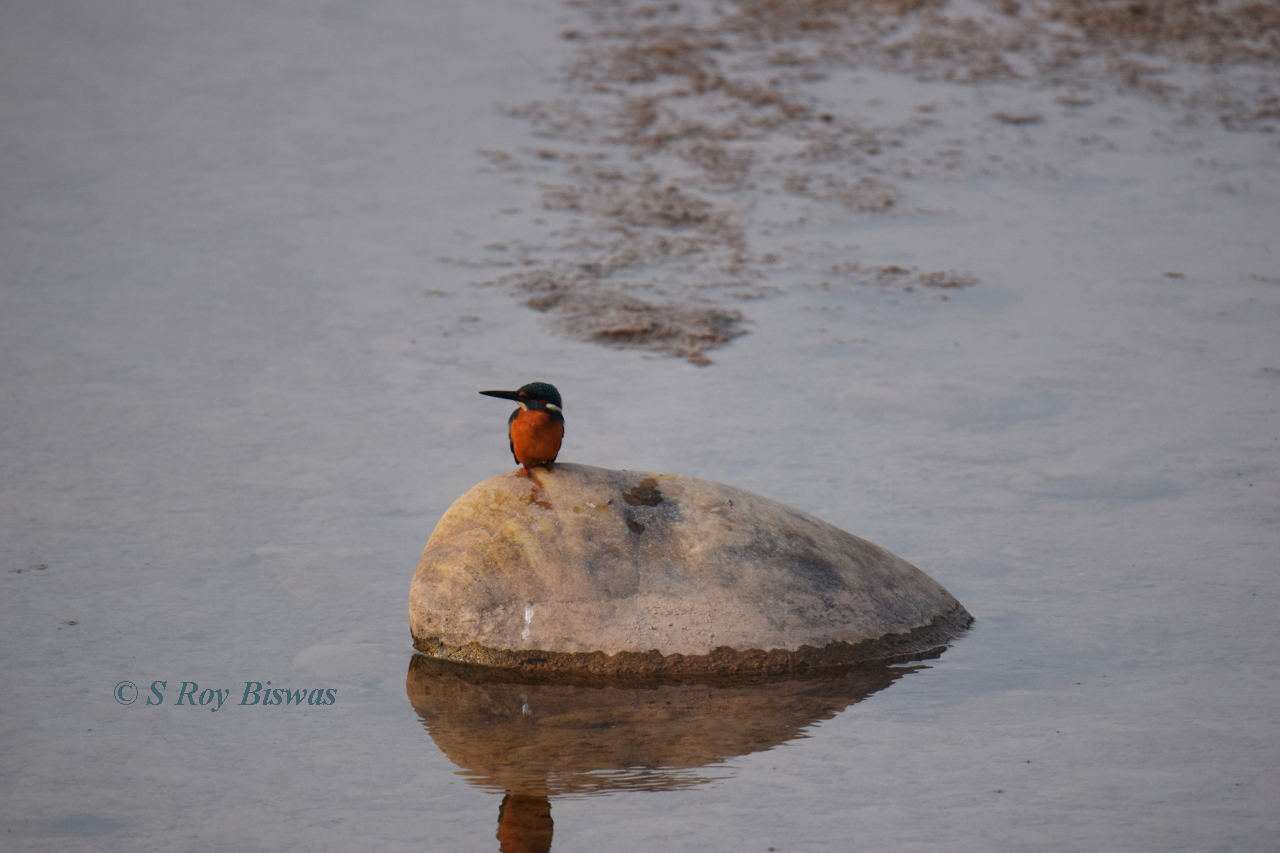
A Common Kingfisher in the birding spot near Chilla
New day morning
while I was strolling with my camera along the side of TRH, another local bird
enthusiast approached me and gave me some information about another birding
spot in the locality and we drove up to the destination and shot a few birds
with my camera, accompanied by my Son and daughter. Thereafter, we returned back to have lunch
around 1.30 P.M and were thereafter, picked up by Viru Negi ji for our
afternoon safari at around 2.30 P.M, since the safari began at 3.00 P.M. The Rajaji National Park is situated along the hills
and foothills of Shiwalik ranges in the Himalayan foothills within the Shivalik
biosphere. Historically speaking, there used to be
three separate wildlife sanctuaries namely – Rajaji Wildlife Sanctuary
established in 1948; Moticur Wildlife Sanctuary established in 1964; and Chilla
Wildlife Sanctuary established in 1977.
In the year 1983 all these three reserves were all combined to create
one body named as the Rajaji National Park and in the year 2015 it received the
status of a Tiger Reserve. It is named
after Sri C Rajagopalachari – the first Governor General of free India. Spread across more than 800 Sq. Km., with
altitude spanning from 330 to 1350 meters, it is a fairly large park that is
adjacent to the holy cities of Hardwar, Rishikesh and Dehradun in Uttarakhand. Chilla Reserve is situated next to the
hydropower plant. So one can see a
branch of Ganga flowing here, with many seasonal rivers merging into it. In fact, the GMVN guest house is located on a
narrow strip of land where one such seasonal stream meets the Ganga.
A Golden backed woodpecker inside Chilla range
Terai like grasslands inside the Chilla range
Huge Sal trees and other trees inside the forest in Chilla range
A Back shouldered Kite inside the Chilla range
A Siberian stonechat inside Chilla range
A male Chital or Spotted deer inside Chilla range
A small portion of the holy River Ganga flows for about 24 km
within the park precincts. Other small seasonal rivers or rivulets join it at
various places within the reserve forest. However, we could only see some dry River beds
across the reserve, through which our jeeps drove through during the
safari. The
area is covered with diverse forest types ranging from semi-evergreen to
deciduous and from mixed broad-leaved to terai like grassland and has been
classified as Indus-Ganges Monsoon Forest type. Lofty strands of Sal dominate
in many parts of this forest range giving it a surreal feeling, as the evenings
set in.
Pug mark of both Elephant and a leopard inside Chilla range
A watch tower inside the Chilla range
A Mountain Hawk Eagle inside the Chilla range
A juvenile Sambar male inside the Chilla range
A Sambar female inside Chilla range
Rajaji
is home to a plethora of avian species, which are found in forested foothills
and in open grassland. The location of
this reserve forest being in a transition zone between temperate western
Himalaya and central Himalaya enhances the species diversity and consequently
the viewing prospects of a large number of birds that inhabit this broad
spectrum. As per the official website, the Rajaji's checklist has about 400
bird species and includes good birds like Greater Scaup, White-naped
Woodpecker, Great Hornbill, Black-bellied Tern, Pallas's Fish Eagle, Northern
Goshawk, Black-necked Stork, Yellow-billed Blue Magpie, Scaly Thrush,
Snowy-browed Flycatcher, Rusty-flanked Tree-creepers, Pale-footed Bush Warbler,
Tytler's Leaf Warbler, Green Avadavat and Reed Bunting. Apart from this, the National park is
best known for is its elephants. I had always heard about herds of elephants
roaming freely in the region that one can come across while driving through the
forest, but it was not to be in our case. In fact, this is the identified North
Western end of Elephant corridor in India. If you travel further North or West
from here, you would not find any wild elephants.
A male Peacock inside Chilla range
A female Red Jungle fowl inside Chilla range
A White breasted Kingfisher inside Chilla range
A Woolly necked Stork inside Chilla range
Sambhar deer - both male & female inside Chilla range
The safari charges are quite
reasonable with a Jeep Safari of two and half hours duration costing around
Rs.3,500/- with guide, but may vary from season to season.As the winters had yet to pass and the
weather was not very clear and being quite cold early in the morning, I
preferred an afternoon safari.The
afternoon safari starts at about 3.00 P.M and ends at about 5.30 P.M and one
can book it in advance or get one at the entry gate itself, if the rush is
less.I, on the other hand, was able to
establish contact with one of the well-known guides operating in the Rajaji
National Park and is quite well acquainted with all the portions of the
park.I had contacted him over phone and
he was courteous enough to arrange for the entire safari for us and his name is
Viru Negi (Mobile No.+91-9917606031).He is a very nice person and anyone interested can contact him directly
on this mobile.The safari itself is
better than that of Corbett in respect of time and distance covered, albeit
there are fewer Tiger sightings in the region.We got to see a lots of deer, birds including Jungle fowls and by the
time as the evening set in, we could hear alarm calls of Langurs and Sambars,
but could not sight any Tiger nor any Elephants to speak of.By the time we were returning back, it had
become literally cold and we were also famished, as the Park authorities do not
allow any packed food items inside the park and rightly so.The photographs shall speak for themselves
about the trip and a short video of the safari inside the park for my viewers –